
In the world of data-driven decision-making, one of the biggest challenges lies in extracting meaningful insights from unstructured text — documents, reports, emails or articles that lack consistent structure. Manually organizing this information is both time-consuming and prone to errors. Enter LangExtract, an advanced Python library by Google that leverages Large Language Models (LLMs) like Gemini and OpenAI to automatically extract structured information from raw text with unmatched accuracy and reliability.
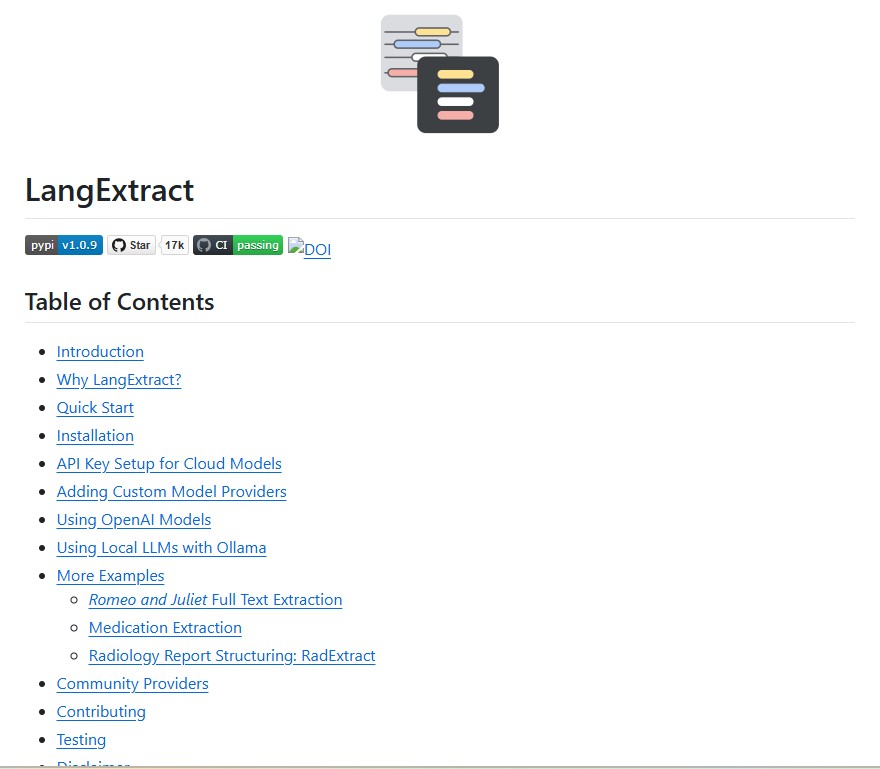
Designed for developers, researchers, and data scientists, LangExtract enables users to transform complex, unorganized text into structured, machine-readable data without the need for extensive coding or model fine-tuning. Whether you’re working on medical reports, literary analysis or enterprise document processing, LangExtract offers an intelligent, scalable and flexible framework for information extraction.
What is LangExtract?
It is a modern Python library built to extract structured data from unstructured text using the power of LLMs (Large Language Models). It processes any type of textual input from clinical notes to research papers and converts it into structured outputs like JSON making it easy to analyze, visualize and integrate into other systems.
At its core, LangExtract allows users to define custom extraction instructions through simple prompts and example data. The system then uses models like Google Gemini, OpenAI GPT-4o or local models via Ollama to identify, label and organize relevant information.
Its unique feature is precise source grounding which maps every extracted entity back to its exact location in the original text. This ensures full transparency and traceability – a major advantage for tasks that demand high accuracy and explainability.
Key Features of LangExtract
LangExtract stands out among AI-powered extraction tools for its reliability, flexibility and advanced technical design. Here are the key features that make it a favorite among AI developers:
1. Precise Source Grounding
LangExtract maps every extracted element directly to its position in the source text allowing users to trace each piece of data to its origin. This transparency is essential for compliance, verification and human-in-the-loop workflows.
2. Reliable Structured Outputs
It enforces a consistent output schema ensuring that data adheres to predefined structures. With few-shot learning examples, users can guide models to produce schema-constrained and contextually accurate results.
3. Optimized for Long Documents
LangExtract solves the “needle-in-a-haystack” problem using text chunking, parallel processing and multi-pass extraction. This means it can handle entire books, lengthy medical records or long-form reports while maintaining high recall and precision.
4. Interactive Visualization
A unique advantage of LangExtract is its built-in visualization tool. It generates interactive HTML reports that let users explore extracted entities within their original context making data review more intuitive and insightful.
5. Multi-Model Flexibility
LangExtract supports multiple model providers:
- Google Gemini Family – Optimized for structured extraction with schema adherence.
- OpenAI Models – Seamless integration with GPT-4o and other APIs.
- Local LLMs via Ollama – Run models locally without cloud access or API keys.
This multi-model architecture ensures adaptability to various use cases, budgets and deployment environments.
6. Domain Agnostic & Extensible
LangExtract is designed to work across any domain – legal, healthcare, finance, literature, or enterprise without additional training. Developers can also extend functionality by adding custom LLM providers via plugins.
How LangExtract Works: From Setup to Extraction ?
Step 1: Installation
LangExtract can be installed from PyPI in seconds:
pip install langextract
Developers can also install it from source for development or testing:
git clone https://github.com/google/langextract.git
cd langextract
pip install -e .
Step 2: Define the Extraction Task
Users define what they want to extract using clear natural-language prompts and examples. For instance:
import langextract as lx

prompt = """
Extract characters, emotions, and relationships from the text.
Use exact text for extractions without paraphrasing.
"""

examples = [
    lx.data.ExampleData(
        text="ROMEO. But soft! What light through yonder window breaks? It is the east, and Juliet is the sun.",
        extractions=[
            lx.data.Extraction(extraction_class="character", extraction_text="ROMEO"),
            lx.data.Extraction(extraction_class="emotion", extraction_text="But soft!"),
        ]
    )
]
Step 3: Run the Extraction
With just one function, users can process text through their chosen model:
result = lx.extract(
    text_or_documents="Lady Juliet gazed longingly at the stars, her heart aching for Romeo.",
    prompt_description=prompt,
    examples=examples,
    model_id="gemini-2.5-flash"
)
Step 4: Visualize Results
The extracted data can be exported to .jsonl format and visualized interactively:
lx.io.save_annotated_documents([result], output_name="results.jsonl")
html = lx.visualize("results.jsonl")
This creates a clean, interactive HTML visualization where each extracted entity can be examined within its original text context.
Real-World Use Cases of LangExtract
LangExtract’s versatility makes it suitable for a wide variety of use cases across industries:
- Healthcare Data Extraction: Automatically extract medication names, dosages, and medical relationships from clinical text — showcased in LangExtract’s Medication Extraction demo.
- Radiology Report Structuring (RadExtract): Structuring radiology reports into standardized formats using LLMs for better healthcare data interoperability.
- Literary Analysis: Extracting relationships and emotions from novels like Romeo and Juliet for text analytics and academic research.
- Business Intelligence: Mining customer feedback or support tickets for sentiment and intent classification.
- Legal and Financial Documents: Parsing contracts, compliance reports, and financial statements into structured summaries.
Integration with Cloud and Local Models
LangExtract seamlessly integrates with both cloud-hosted and on-device LLMs:
- Cloud Models (Gemini, OpenAI): Set API keys using environment variables or
.envfiles for secure authentication. - Local Models (Ollama): Run models like gemma2:2b locally without internet dependency — ideal for privacy-focused applications.
This dual support ensures flexibility for developers balancing cost, performance, and data security.
Community and Extensibility
LangExtract’s open-source ecosystem encourages community innovation. Developers can:
- Create custom provider plugins for new LLMs.
- Contribute through pull requests following Google’s contribution guidelines.
- Explore the Community Providers registry to discover and share new integrations.
With over 16,500 GitHub stars and active contributions from leading AI engineers, LangExtract is evolving rapidly as the go-to framework for LLM-based information extraction.
Conclusion
LangExtract by Google represents a breakthrough in automated information extraction — combining precision, transparency, and scalability. By unifying the power of Large Language Models with structured data pipelines, it bridges the gap between raw text and actionable insight.
Whether you are an AI researcher building domain-specific extraction workflows, a healthcare data scientist analyzing medical records, or a developer seeking to automate document understanding, LangExtract provides the tools to do it efficiently and intelligently.
With its robust architecture, multi-model compatibility, and transparent source mapping, LangExtract is more than a library — it’s the future of structured knowledge extraction in the LLM era.
Follow us for cutting-edge updates in AI & explore the world of LLMs, deep learning, NLP and AI agents with us.
Related Reads
- Qwen3-VL-8B-Instruct — The Next Generation of Vision-Language Intelligence by Qwen
- LangChain: The Ultimate Framework for Building Reliable AI Agents and LLM Applications
- Master Machine Learning: Explore the Ultimate “Machine-Learning-Tutorials” Repository
- LangGraph by LangChain-AI: The Framework Powering Stateful, Long-Running AI Agents
- OpenSearch for AI Agents: Empowering Intelligent Search and Automation
1 thought on “LangExtract by Google: Transforming Unstructured Text into Structured Data with LLM Precision”