
In today’s rapidly evolving artificial intelligence landscape, Generative AI agents have emerged as one of the most transformative developments. These agents do not just generate text; they reason, plan, collaborate, call tools, analyze data, and operate autonomously to complete complex tasks. Whether used in research, business automation, creative industries, or software development, modern AI agents are reshaping the future of intelligent systems.
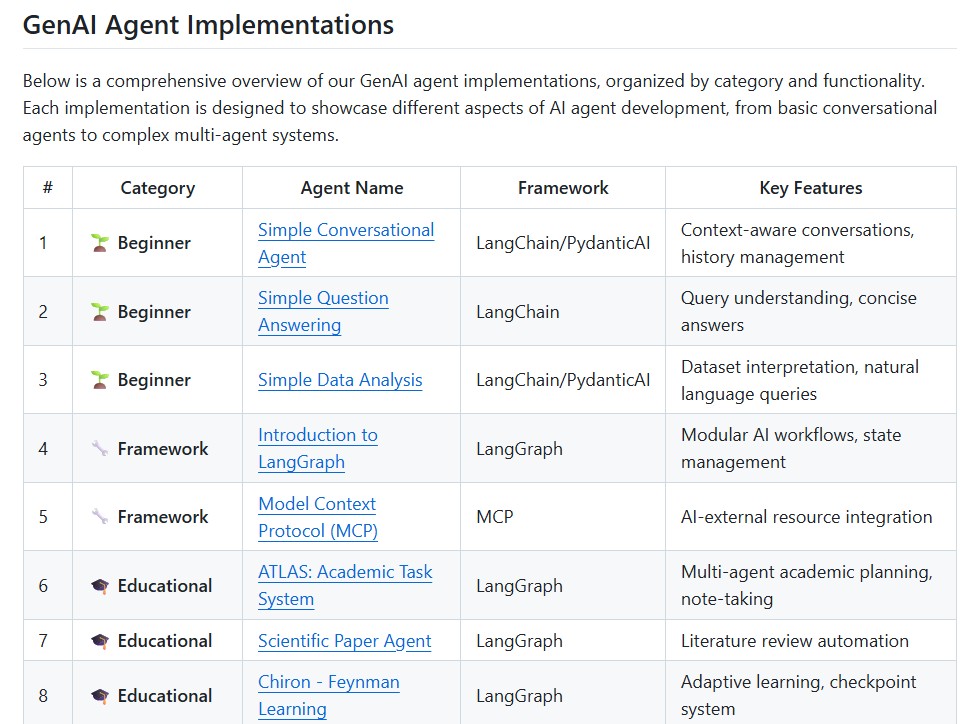
Among the many resources available to learn agent development, the GenAI Agents repository by Nir Diamant stands out as one of the most comprehensive, accessible, and practical guides for developers at all levels. With more than seventeen thousand stars on GitHub, this repository offers deep insights into agent architectures, step-by-step tutorials, and real-world examples across education, business, research, creativity, and advanced automation. From simple conversational bots to multi-agent collaborative systems, the GenAI Agents repo covers everything you need to build robust, scalable, and intelligent agents.
In this blog, we explore the key components, features, and practical value of the GenAI Agents repository, demonstrating why it has become a trusted resource for developers learning to build advanced AI systems.
What Is the GenAI Agents Repository?
The GenAI Agents repository is a collection of tutorials, sample implementations, and detailed workflows designed to teach developers how to create generative AI agents using modern frameworks such as LangChain, LangGraph, CrewAI, PydanticAI, AutoGen, and OpenAI Swarm. It includes:
- Beginner-friendly agent examples
- Framework-specific tutorials
- Multi-agent systems
- Real-world business and productivity agents
- Creative content generation agents
- Complex RAG and deterministic graph-based reasoning agents
- Educational and research-focused systems
- Continually updated implementations reflecting the latest AI advancements
It acts as both a learning hub and an inspiration library for anyone interested in agentic AI technologies.
Beginner-Friendly Agents: The Perfect Starting Point
The repository starts with simple projects that introduce the fundamentals of conversational agents, question-answering systems, and data analysis bots. Examples include:
- A simple conversational agent with memory
- A lightweight Q&A agent
- A simple data analysis agent that answers dataset-based questions
These examples help beginners understand prompt structure, model interaction, state management, and basic chain formation. By starting with simple implementations, learners quickly gain confidence before moving on to more complex workflows.
Framework Tutorials: Building Strong Foundations
A major strength of this repository is its in-depth tutorials focused on leading agent frameworks. Key tutorials include:
Introduction to LangGraph
Teaches how to create modular, graph-based workflows where each node represents a step in the reasoning or task execution pipeline. Developers learn:
- StateGraph creation
- Node design
- Workflow compilation
- Multi-step agent processing
Model Context Protocol (MCP)
Explains how to connect AI agents with external data sources and tools through an open standard protocol. This is essential for building powerful agents capable of interacting with real-world systems.
Each framework tutorial includes both conceptual explanations and hands-on implementation guides.
Educational and Research Agents
The repository showcases intelligent agents designed specifically for research and academic use cases. These include:
- ATLAS, an academic learning and planning system
- A scientific paper agent that performs literature reviews
- Chiron, an adaptive learning agent using the Feynman method
These agents demonstrate how multi-agent architectures and structured workflows can support complex academic and research processes.
Business and Professional Agents
A significant portion of the repository focuses on real-world business use cases. Example implementations include:
- Customer Support Agent
- Essay Grading Agent
- Career Assistant
- Project Manager Assistant
- Contract Analysis Agent
- End-to-End Testing Agent
These agents provide inspiration and practical reference for professionals who want to automate tasks such as ticket classification, contract review, project scheduling, or test automation.
Each implementation includes detailed workflow diagrams, APIs, state management structures, and integration points.
Creative and Content Generation Agents
One of the most impressive sections includes agents for creative AI applications. Examples include:
- GIF Animation Generator
- TTS Poem Generator
- Music Compositor
- Business Meme Generator
- Murder Mystery Game Engine
- Multi-platform content intelligence system
These agents demonstrate how multiple models and tools can be combined to create dynamic, creative outputs at scale.
Analysis and Quality Assurance Agents
The repository contains agents designed for analysis, testing, and system improvement. Examples include:
- Memory-enhanced conversational agents
- Multi-agent collaboration research teams
- Self-improving reflective agents
- Sales call analyzer
- Weather emergency response system
- Self-healing codebases
- DataScribe for database exploration
These implementations highlight how AI agents can support quality assurance, code debugging, data exploration, and emergency response.
Advanced RAG and Deterministic Graph Techniques
The repository also includes advanced techniques for building highly controllable and reliable agents through deterministic graph-based architectures. These agents include:
- A controllable RAG agent for complex question answering
- Multi-step anonymization and retrieval workflows
- Adaptive planning systems
- Continuous re-planning and verification loops
These techniques are ideal for enterprise-grade systems that require reliability, accuracy, and grounded reasoning.
Why Developers Prefer This Repository
The GenAI Agents repo is valued for its:
- Breadth of agent examples across domains
- Beginner-to-expert learning progression
- Detailed workflows and state diagrams
- Code-first teaching approach
- Frequent updates
- Practical real-world focus
- Strong community and contribution support
Whether you want to learn, build, or innovate, this repository provides everything required to grow as an AI agent developer.
Conclusion
The GenAI Agents repository by Nir Diamant is one of the most comprehensive and practical resources available for learning generative AI agent development. It covers the full spectrum of agentic design, from simple conversational bots to advanced multi-agent research teams and deterministic graph-based systems. For developers, students, and AI enthusiasts, this repository provides a solid foundation and a powerful toolkit for building real-world AI systems.
As generative AI continues to evolve, the ability to build intelligent agents will become an essential skill across industries. With detailed tutorials, step-by-step workflows, and community-driven innovation, the GenAI Agents repository stands as an exceptional place to begin your journey.
Follow us for cutting-edge updates in AI & explore the world of LLMs, deep learning, NLP and AI agents with us.
Related Reads
- Microsoft’s AI Agents for Beginners: A Complete Guide to Building Your First AI Agent
- The Ultimate Guide to Prompt Engineering: A Deep Dive into DAIR.AI’s Leading Resource
- Parlant: The AI Agent Framework Built for Real-World Reliability
- Motif-2-12.7B: A Breakthrough in Efficient Large Language Model Architecture
- Lumine: The Next Step Toward Human-Like AI Agents in 3D Worlds
3 thoughts on “A Complete Guide to the GenAI Agents Repository: Building Generative AI Agents from Beginner to Advanced”