
As globalization accelerates and digital communication crosses linguistic boundaries, high-quality machine translation has become a core requirement for businesses, developers, and content creators. From real-time customer support and cross-border e-commerce to multilingual documentation and media localization, translation systems must now deliver accuracy, speed, scalability, and contextual awareness—often on limited hardware.
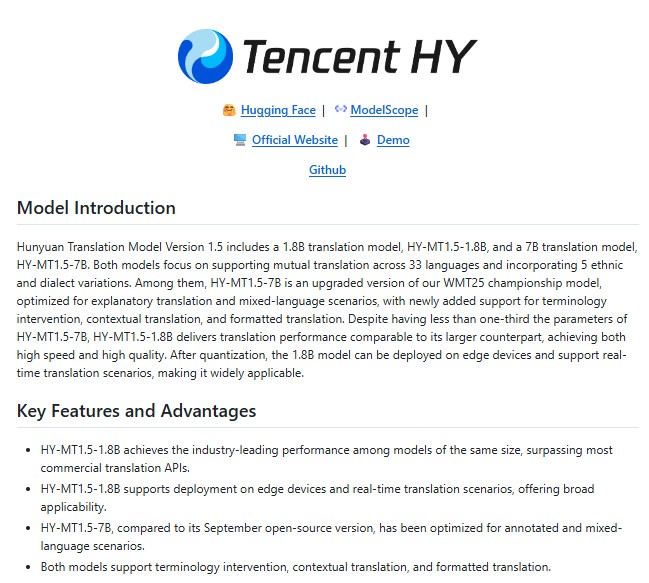
To address these demands, Tencent has open-sourced HY-MT1.5-1.8B, a compact yet powerful multilingual translation model under the Hunyuan Translation Model Version 1.5 series. Despite its relatively small size of 1.8 billion parameters, HY-MT1.5-1.8B delivers translation quality comparable to significantly larger models while enabling real-time and edge-device deployment.
What Is HY-MT1.5-1.8B?
HY-MT1.5-1.8B is a dense neural machine translation model developed by Tencent as part of the Hunyuan MT 1.5 release. It is specifically optimized for mutual translation across 33+ languages, including major global languages and several ethnic and dialect variations.
The model is designed to strike a balance between translation quality and computational efficiency. While Tencent also offers a larger 7B version, the 1.8B model achieves near-parity performance in many scenarios, making it ideal for production environments where speed, cost, and hardware constraints matter.
Core Design Goals
Tencent designed HY-MT1.5-1.8B with the following objectives:
- Deliver industry-leading translation quality among sub-2B models
- Support real-time translation and edge-device deployment
- Enable contextual, terminology-aware, and formatted translation
- Provide broad multilingual and mixed-language support
- Offer an open-source, enterprise-friendly solution
These goals make HY-MT1.5-1.8B suitable not only for cloud-based services but also for on-device and offline translation applications.
Key Features and Advantages
High Translation Quality at Small Scale
HY-MT1.5-1.8B achieves state-of-the-art performance within its parameter class, surpassing many commercial translation APIs. Its performance is especially notable given that it uses less than one-third of the parameters of the HY-MT1.5-7B model while maintaining comparable translation quality.
This efficiency is critical for companies seeking cost-effective multilingual solutions without sacrificing accuracy.
Real-Time and Edge Deployment Ready
One of the standout advantages of HY-MT1.5-1.8B is its deployability on edge devices. After quantization (FP8 or INT4), the model can run efficiently on constrained hardware, enabling:
- Real-time speech-to-text and text-to-text translation
- Mobile and embedded translation systems
- On-device privacy-preserving translation
- Low-latency multilingual chat applications
This makes HY-MT1.5-1.8B highly practical for consumer electronics, IoT, and offline-first applications.
Terminology Intervention
HY-MT1.5-1.8B supports terminology intervention, allowing users to explicitly define how specific words or phrases should be translated. This feature is especially valuable for:
- Legal and medical documents
- Technical manuals
- Brand-specific terminology
- Industry-standard vocabulary
By enforcing consistent translations, organizations can maintain accuracy and compliance across multilingual content.
Contextual Translation
The model supports context-aware translation, enabling it to consider surrounding information when translating a given segment. This improves coherence, resolves ambiguity, and ensures more natural translations in documents, conversations, and long-form text.
Contextual translation is particularly important for languages with implicit subjects, honorifics, or context-dependent grammar.
Formatted Translation Support
HY-MT1.5-1.8B can preserve structured and formatted text, such as tags, annotations, or placeholders. This is crucial for translating:
- XML or HTML content
- Subtitles and captions
- Technical documentation with inline formatting
- Software UI strings
The model ensures that formatting elements remain intact while accurately translating the textual content.
Supported Languages
HY-MT1.5-1.8B supports 36 languages, including:
Chinese (Simplified and Traditional), English, Hindi, Urdu, Bengali, Tamil, Telugu, Marathi, Gujarati, French, Spanish, Portuguese, German, Italian, Russian, Arabic, Japanese, Korean, Thai, Vietnamese, Indonesian, Malay, Filipino, Turkish, Persian, Polish, Czech, Dutch, Hebrew, Ukrainian, Kazakh, Mongolian, Tibetan, Uyghur, and Cantonese.
This extensive coverage makes the model especially relevant for Asian, European, and multilingual emerging markets.
Model Variants and Quantization Options
Tencent provides multiple versions of HY-MT1.5-1.8B to suit different deployment needs:
- BF16 for high-accuracy server inference
- FP8 for efficient GPU deployment
- GPTQ INT4 for low-memory and edge environments
These options allow developers to optimize for performance, memory usage, or power consumption depending on their use case.
Integration with Transformers
HY-MT1.5-1.8B integrates seamlessly with the Transformers library, making it easy to adopt for developers already working within the Hugging Face ecosystem. The model does not rely on a default system prompt, giving users full control over prompting strategies.
Tencent also provides recommended inference parameters to ensure optimal translation quality, balancing fluency and determinism.
Practical Use Cases
HY-MT1.5-1.8B is well-suited for a wide range of real-world applications, including:
- Real-time multilingual chat and messaging
- Website and app localization
- Cross-border e-commerce product translation
- Customer support automation
- Enterprise document translation
- Mobile and offline translation tools
- Multilingual content moderation and analysis
Its ability to run efficiently on edge devices makes it particularly attractive for privacy-sensitive and latency-critical scenarios.
Open-Source and Enterprise Friendly
Released under a Modified MIT license, HY-MT1.5-1.8B is open-source and enterprise-friendly. Organizations can freely use, modify, and deploy the model without vendor lock-in, making it a strong alternative to proprietary translation APIs.
Tencent’s continued commitment to open-sourcing high-quality models reinforces confidence in long-term support and ecosystem growth.
Conclusion
HY-MT1.5-1.8B demonstrates that high-quality multilingual translation does not require massive model sizes. By combining efficient architecture, advanced translation features, and extensive language coverage, Tencent has delivered a model that is both powerful and practical.
Its ability to support real-time translation, edge deployment, terminology control, and formatted text handling makes HY-MT1.5-1.8B an excellent choice for developers and enterprises seeking scalable, cost-effective, and open-source translation solutions. As multilingual communication continues to expand globally, HY-MT1.5-1.8B stands out as a reliable and future-ready translation model.
Follow us for cutting-edge updates in AI & explore the world of LLMs, deep learning, NLP and AI agents with us.
Related Reads
- Orion: The Next Evolution in Visual AI for Advanced Reasoning and Multi-Modal Intelligence
- Fara-7B: Microsoft’s Breakthrough Agentic Model for Real-World Computer Use
- MiniMax-M2.1: An Open-Source Leap Toward Enterprise-Grade Agentic AI
- Supabase: The Complete Guide to the Open-Source Postgres Development Platform
- K-EXAONE-236B-A23B: A Deep Dive into LG AI Research’s Frontier Multilingual Reasoning Model