
The field of generative AI has rapidly evolved from producing static images and text to creating immersive, multimodal experiences that combine video, audio, and language. As creators, developers, and enterprises demand more realistic and synchronized media generation, the need for unified audio-visual models has become critical. Addressing this demand, Lightricks has introduced LTX-2, a powerful open-source audio-video foundation model designed for efficient, high-quality, and locally executable generation.
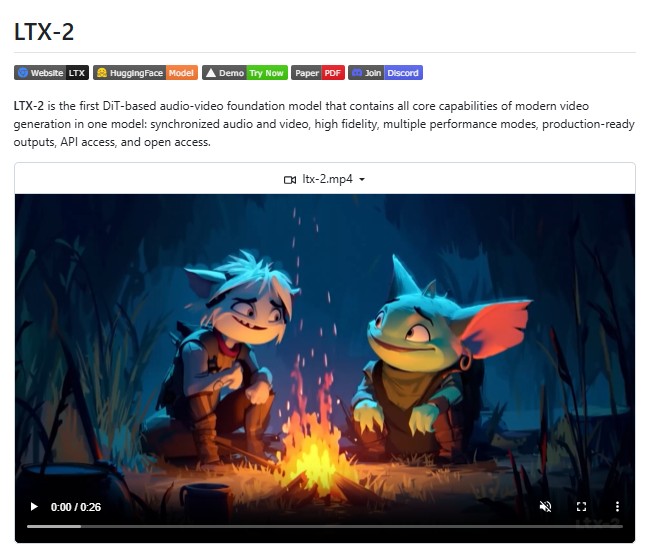
Released on Hugging Face as Lightricks/LTX-2, this model represents a major step forward in multimodal AI. Unlike traditional pipelines that stitch together separate video and audio models, LTX-2 generates synchronized video and sound within a single diffusion-based architecture, offering improved coherence, speed, and flexibility. In this blog, we will explore LTX-2 in detail—its architecture, features, use cases, deployment options, and why it matters in the future of generative media.
What Is LTX-2?
LTX-2 is a Diffusion Transformer (DiT)-based audio-video foundation model developed by Lightricks. It is designed to jointly generate video frames and corresponding audio, enabling realistic synchronization between visual events and sound. This unified approach reduces complexity and enhances alignment compared to multi-model pipelines.
LTX-2 supports a wide range of generation modes, including:
- Text-to-video
- Image-to-video
- Video-to-video
- Audio-to-video
- Text-to-audio
- Video-to-audio
- Audio-to-audio
- Combined text, image, audio, and video generation
This versatility makes LTX-2 one of the most comprehensive open-source multimedia generation models available today.
Core Architecture and Design
At its core, LTX-2 is built on a diffusion-based architecture optimized for audio-visual generation. Diffusion models are well known for their stability and quality in image and video synthesis, and LTX-2 extends this strength to synchronized sound generation.
Key architectural highlights include:
- Single-model joint generation of audio and video
- Latent-space processing, enabling efficient computation
- Modular design, supporting upscalers and LoRA fine-tuning
- Open weights, allowing full customization and research
The base model contains 19 billion parameters, striking a balance between performance and practicality for local execution on modern GPUs.
Model Variants and Checkpoints
LTX-2 is released with multiple checkpoints to suit different performance and hardware requirements:
- ltx-2-19b-dev: Full, trainable model in BF16
- ltx-2-19b-dev-fp8: FP8-quantized version for reduced memory usage
- ltx-2-19b-dev-fp4: NVFP4 quantized version for maximum efficiency
- ltx-2-19b-distilled: Faster distilled model with 8 inference steps
- LoRA and IC-LoRA variants: Lightweight fine-tuning modules
- Spatial upscaler x2: Higher resolution video output
- Temporal upscaler x2: Higher frame-rate video generation
This ecosystem allows users to scale quality, speed, and cost based on their specific needs.
Key Features of LTX-2
1. Joint Audio-Visual Generation
One of the most important innovations of LTX-2 is its ability to generate audio and video together. This ensures better temporal alignment, such as matching sound effects with visual motion, which is difficult to achieve when using separate models.
2. Multimodal Input and Output
LTX-2 supports text, image, video, and audio as both inputs and outputs. This enables complex workflows such as adding sound to silent videos, animating still images with audio, or generating complete clips from text prompts.
3. Local and Open-Source Execution
Unlike many proprietary video generation systems, LTX-2 provides open-source weights and is designed for local execution. This gives creators and enterprises full control over data privacy, customization, and deployment.
4. Training and Fine-Tuning Flexibility
The base LTX-2 model is fully trainable. Using the LTX-2 Trainer, users can create LoRAs for:
- Motion styles
- Visual aesthetics
- Character likeness
- Audio styles and sound identity
In many cases, fine-tuning can be completed in under an hour, making experimentation fast and accessible.
Integration and Deployment
Diffusers Library
LTX-2 is supported by the Diffusers library for image-to-video workflows. Users must ensure that video dimensions are divisible by 32 and frame counts follow the required constraints for optimal results.
ComfyUI
For no-code and visual workflows, LTX-2 integrates seamlessly with ComfyUI using built-in LTXVideo nodes. This makes it especially popular among creators and artists.
PyTorch Codebase
The official LTX-2 repository includes:
ltx-corefor model definitionsltx-pipelinesfor inferenceltx-trainerfor training and fine-tuning
It supports Python 3.12+, CUDA 12.7+, and PyTorch ~2.7.
Inference Providers
For users who prefer managed inference, LTX-2 is supported by fal, allowing image-to-video generation through a serverless API without local setup.
Practical Use Cases
LTX-2 unlocks a wide range of real-world applications:
- AI-generated short films and animations
- Social media video content with synchronized audio
- Game cinematics and background scenes
- Marketing and advertising videos
- Audio enhancement for silent or low-quality footage
- Creative prototyping for filmmakers and designers
Its ability to generate complete audio-visual clips from minimal input makes it especially valuable for rapid content creation.
Limitations and Ethical Considerations
Like all generative models, LTX-2 has limitations:
- It is not designed to provide factual information
- Prompt adherence may vary based on phrasing
- Audio quality may be lower when generating non-speech sounds
- The model may amplify societal biases present in training data
- Inappropriate or offensive content may occasionally be generated
Lightricks encourages responsible use and transparency when deploying LTX-2 in production environments.
Conclusion
LTX-2 represents a major milestone in open-source generative AI. By unifying video and audio generation into a single diffusion-based foundation model, it simplifies workflows while improving synchronization and creative control. With open weights, multiple optimized checkpoints, LoRA fine-tuning, and both local and cloud-based inference options, LTX-2 is positioned as a practical and powerful solution for creators, researchers, and enterprises alike.
As demand for immersive, multimodal content continues to grow, models like LTX-2 are shaping the future of AI-driven media creation making high-quality audio-visual generation more accessible, flexible, and efficient than ever before.
LTX-2 by Lightricks is an open-source diffusion-based audio-video foundation model enabling synchronized video and audio generation. Explore features, architecture, use cases, and deployment options in this detailed guide.
Follow us for cutting-edge updates in AI & explore the world of LLMs, deep learning, NLP and AI agents with us.
Related Reads
- Orion: The Next Evolution in Visual AI for Advanced Reasoning and Multi-Modal Intelligence
- Fara-7B: Microsoft’s Breakthrough Agentic Model for Real-World Computer Use
- MiniMax-M2.1: An Open-Source Leap Toward Enterprise-Grade Agentic AI
- Supabase: The Complete Guide to the Open-Source Postgres Development Platform
- K-EXAONE-236B-A23B: A Deep Dive into LG AI Research’s Frontier Multilingual Reasoning Model