Artificial intelligence is rapidly evolving beyond single-chat assistants into powerful systems where multiple AI agents collaborate to solve complex real-world problems. As businesses, researchers, and developers demand more scalable, autonomous, and intelligent solutions, multi-agent frameworks are becoming essential. One of the most advanced and fast-growing open-source projects in this space is OWL, short for Optimized Workforce Learning.
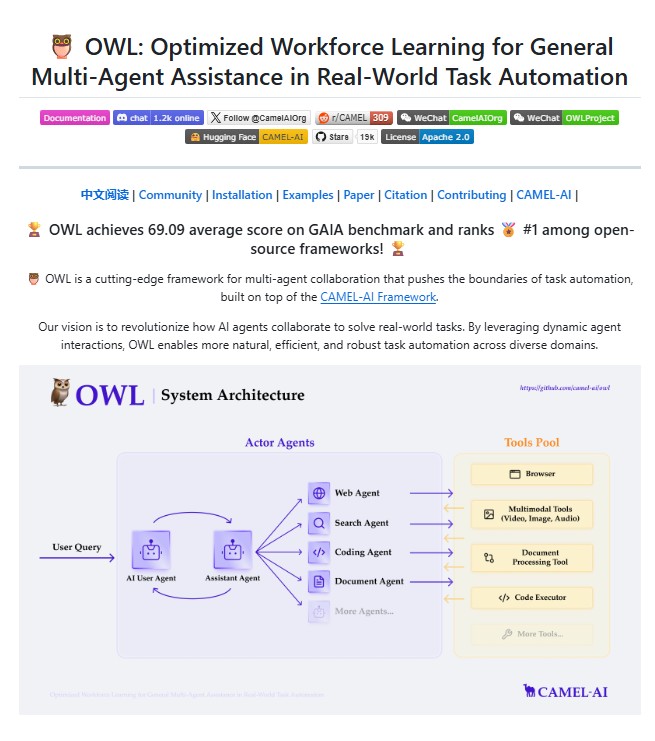
Developed by CAMEL-AI, OWL is a cutting-edge multi-agent framework designed for real-world task automation. It introduces a new way of organizing AI agents into coordinated workforces that can reason, use tools, interact with the web, and execute tasks in parallel. Built on top of the CAMEL framework, OWL has already achieved top rankings on the GAIA benchmark, proving its strength in realistic environments. Alongside OWL, the Eigent desktop application brings this technology directly to users through a privacy-first, local, multi-agent workforce platform.
This blog explains what OWL is, how it works, its key features, installation options, real-world use cases, and why it is shaping the future of agent-based AI automation.
What Is OWL
OWL is an open-source framework designed to enable multiple AI agents to collaborate intelligently on complex tasks. Instead of relying on a single large language model to handle everything, OWL structures agents into a workforce where each agent has a specific role, tools, and responsibilities.
It is built on CAMEL-AI, a research-driven framework known for agent role-playing and communication. OWL extends CAMEL’s capabilities by focusing on optimized workforce learning, which improves how agents coordinate, delegate subtasks, verify outputs, and adapt strategies in dynamic environments.
The framework is designed for real-world task automation, including web interaction, document analysis, code execution, research, and multimodal reasoning.
Why OWL Matters
Traditional AI systems struggle with long, multi-step tasks that require browsing, tool usage, reasoning, and decision-making. OWL solves this problem by allowing agents to work together, much like a human team. Each agent can specialize in a particular domain such as research, analysis, execution, or verification.
This collaborative design makes OWL more robust, efficient, and scalable than single-agent systems. It also reduces failure rates because agents can cross-check results and adapt when conditions change.
Eigent: The Multi-Agent Workforce Desktop Application
Eigent is the world’s first multi-agent workforce desktop application built on top of OWL. It allows users to create, manage, and deploy AI workforces directly on their local machines.
Eigent is fully open source, privacy-first, and does not require cloud infrastructure. All data remains on the user’s system, making it ideal for sensitive tasks and enterprise use cases. With Eigent, users can design complex workflows, assign roles to agents, and monitor task execution in real time.
Core Features
One of the most important features of OWL is parallel execution. Multiple agents can work simultaneously on different parts of a task, significantly improving speed and productivity.
OWL also supports online search through multiple engines, browser automation using Playwright, document parsing for formats such as PDF, Word, Excel, and PowerPoint, and Python code execution. These capabilities allow agents to interact with real-world systems rather than operating only in text-based environments.
Another key feature is multimodal processing. OWL agents can understand and analyze images, videos, and audio, making the framework suitable for tasks such as website analysis, video summarization, and visual reasoning.
Toolkits and Model Context Protocol
It includes a wide range of built-in toolkits for specialized tasks. These include search toolkits, browser toolkits, document processing, image and video analysis, code execution, mathematical reasoning, and many domain-specific integrations such as GitHub, Google Scholar, Maps, Weather, and Reddit.
The Model Context Protocol, or MCP, standardizes how AI models interact with tools and data sources. This ensures consistent and reliable tool usage across different models and environments. MCP also enables integration with Node.js-based services such as Playwright MCP for advanced browser automation.
Installation and Deployment Options
OWL supports multiple installation methods to accommodate different user preferences. It can be installed using uv, Python virtual environments with pip, Conda, or Docker. Docker-based deployment is especially useful for users who want a ready-to-run environment with minimal setup.
The framework supports Python versions 3.10, 3.11, and 3.12. Environment variables are used to configure API keys for different model providers. While OWL supports many large language models, OpenAI models are strongly recommended for optimal performance, particularly for tool calling and multimodal tasks.
Web Interface and User Experience
OWL provides a local web interface built with Gradio. The interface allows users to select models, manage environment variables, interact with agents through chat, and review task history. Because the interface runs locally, no data is sent to external servers beyond required model API calls.
The web UI supports multiple languages and makes OWL accessible to both technical and non-technical users.
Benchmark Performance and Research Impact
OWL has achieved top-ranking performance on the GAIA benchmark, which evaluates AI agents in realistic open-world environments involving browsing, reasoning, and tool usage. OWL’s high scores demonstrate the effectiveness of its multi-agent design and optimized workforce learning approach.
The project has been accepted at NeurIPS 2025, and its training datasets, model checkpoints, and technical reports have been open-sourced to support transparency and reproducibility.
Real-World Use Cases
OWL and Eigent can be used across many domains. Researchers can automate literature reviews and data collection. Developers can accelerate coding, debugging, and repository management. Businesses can automate repetitive workflows such as reporting, analysis, and market research. Content creators can generate, edit, and optimize content at scale. Data analysts can build end-to-end pipelines for data processing and visualization.
Future Roadmap
The OWL project continues to evolve rapidly. Planned improvements include expanding the toolkit ecosystem, improving long-horizon reasoning, enhancing agent communication protocols, and publishing detailed technical blogs on multi-agent collaboration. The team is also focused on improving robustness and performance in complex real-world environments.
Conclusion
It represents a major step forward in the evolution of artificial intelligence systems. By moving beyond single-agent models and embracing collaborative AI workforces, OWL enables more powerful, flexible, and realistic automation. With its strong benchmark performance, extensive tool support, privacy-first design, and active open-source community, OWL is positioned as one of the most important frameworks in the future of multi-agent AI. Combined with the Eigent desktop application, OWL makes advanced AI workforce automation accessible to developers, researchers, and businesses worldwide.
Follow us for cutting-edge updates in AI & explore the world of LLMs, deep learning, NLP and AI agents with us.
Related Reads
- Orion: The Next Evolution in Visual AI for Advanced Reasoning and Multi-Modal Intelligence
- Fara-7B: Microsoft’s Breakthrough Agentic Model for Real-World Computer Use
- MiniMax-M2.1: An Open-Source Leap Toward Enterprise-Grade Agentic AI
- Supabase: The Complete Guide to the Open-Source Postgres Development Platform
- K-EXAONE-236B-A23B: A Deep Dive into LG AI Research’s Frontier Multilingual Reasoning Model