Artificial Intelligence is evolving rapidly, but most mainstream AI systems are centralized, generic, and controlled by large corporations. While these systems are powerful, they often ignore one critical element: individuality. Users interact with AI that does not truly understand them, remember their context deeply, or represent their interests authentically. This growing gap has led to a new vision in the AI ecosystem—personal, user-owned intelligence. Second Me emerges as a groundbreaking open-source project that challenges the traditional idea of “super AI” by introducing a personal AI self that is trained, hosted, and controlled by you. It is not designed to replace human intelligence but to amplify it.
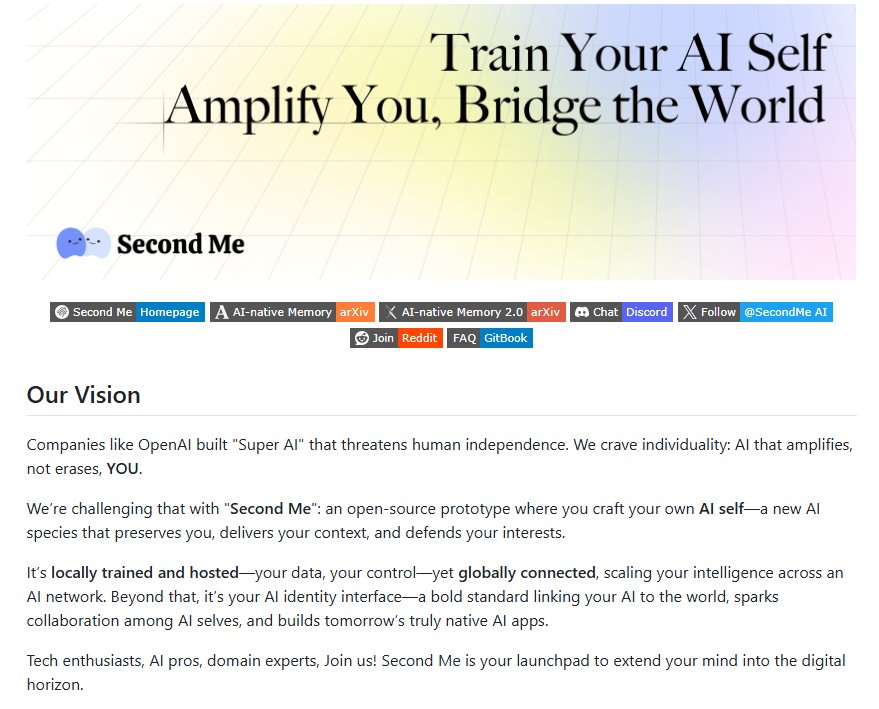
Second Me is more than just another AI assistant. It is an AI-native identity framework where your memories, preferences, and context come together to form a digital version of you. This blog explores what Second Me is, how it works, its key features, use cases, and why it represents the future of personalized AI.
What Is Second Me?
Second Me is an open-source AI prototype developed by the Mindverse team with a bold vision: to help individuals create their own AI self. Instead of relying on cloud-based models that collect and process user data on remote servers, Second Me is trained and hosted locally. Your data stays with you, giving you full ownership and control.
At its core, Second Me is built as an AI-native memory system. It uses advanced memory modeling techniques to store, retrieve, and reason over personal context. This allows the AI to respond in ways that align closely with your identity, thinking patterns, and goals.
The project positions itself as a new AI species—one that preserves human independence while extending intelligence into the digital world.
The Vision Behind Second Me
The creators of Second Me believe that centralized “super AI” systems pose a risk to individuality. When intelligence is owned by a few organizations, users lose control over how their data, preferences, and identity are represented.
Second Me offers an alternative approach. It focuses on decentralization, privacy, and user empowerment. The idea is simple but powerful: instead of one massive AI serving everyone, each person has their own AI self. These AI selves can interact with each other, collaborate, and form a decentralized intelligence network—while still remaining under individual control.
This vision makes Second Me not just a tool, but a foundation for future AI-native applications and digital identities.
Key Features of Second Me
AI-Native Memory and Personal Training
One of the strongest features of Second Me is its AI-native memory system. Using Hierarchical Memory Modeling and the Me-Alignment Algorithm, the system learns from your personal data and memories. Over time, it builds a structured understanding of who you are, how you think, and what matters to you.
This goes beyond simple chat history. The AI can retain long-term context and evolve as you add new information, making interactions more natural and meaningful.
Decentralized Intelligence Network
Second Me allows users to launch their AI self from a local machine into a decentralized network. With your permission, other users or applications can interact with your AI self. This makes your Second Me a digital identity interface that represents you across platforms and collaborations.
This feature opens the door to AI-to-AI communication, shared problem-solving, and distributed intelligence without sacrificing personal ownership.
Roleplay and Multi-Persona Capabilities
Second Me can switch roles depending on the context. For example, your AI self can represent you in professional discussions, creative brainstorming sessions, or social interactions. This role-based adaptability makes it suitable for diverse applications, from productivity tools to social platforms.
Privacy and Full Control
Privacy is a core principle of Second Me. Unlike centralized AI services, all data is processed locally. There is no forced data sharing, no hidden data collection, and no loss of ownership. You decide what your AI remembers, who can access it, and how it is used.
Technical Overview and Setup
Second Me is designed to be accessible to developers, AI enthusiasts, and professionals. It supports Docker-based deployment across Windows, Linux, and macOS, with additional acceleration options for Mac M-series chips using MLX.
The setup process is straightforward:
- Clone the GitHub repository
- Start the Docker containers
- Access the web interface through a local browser
The project also provides detailed documentation, FAQs, and deployment guides to help users choose models based on their system memory and performance requirements.
With support for models ranging from under one billion to several billion parameters, users can scale their AI self according to their hardware capabilities.
Real-World Use Cases of Second Me
Second Me is not just a concept; it is already being explored in practical scenarios.
In roleplay applications, users have created AI versions of themselves to answer questions, host AMAs, or simulate conversations. In brainstorming and planning tasks, Second Me can collaborate with other AI selves to generate ideas, itineraries, and strategies. Social and networking applications use Second Me as an icebreaker or digital representative in matchmaking and speed-dating scenarios.
These use cases demonstrate how personal AI identities can extend human presence and intelligence into digital spaces.
Open-Source Community and Future Roadmap
Second Me thrives on its open-source community. Developers and contributors from around the world actively improve the codebase, documentation, and features. The project is licensed under Apache 2.0, making it flexible for both personal and commercial experimentation.
Looking ahead, the roadmap includes smarter version control for memory, continuous training pipelines, performance improvements, and optional cloud solutions for users with limited hardware. These updates aim to make Second Me more stable, scalable, and accessible without compromising its core values.
Why Second Me Matters
Second Me represents a shift in how we think about artificial intelligence. Instead of AI being something we use, it becomes something we own. It respects individuality, prioritizes privacy, and encourages collaboration without central control.
In a future where digital identity and AI integration will be unavoidable, Second Me offers a human-centric approach. It ensures that as AI grows more powerful, humans remain at the center—enhanced, not replaced.
Conclusion
Second Me is redefining the relationship between humans and artificial intelligence. By enabling individuals to create and control their own AI selves, it challenges centralized AI models and promotes a decentralized, privacy-first future. With AI-native memory, local deployment, and a growing open-source community, Second Me stands as a powerful foundation for personal AI identity and next-generation applications. For anyone interested in ethical, personalized, and future-ready AI, Second Me is not just a project to watch—it is a movement to join.
Follow us for cutting-edge updates in AI & explore the world of LLMs, deep learning, NLP and AI agents with us.
Related Reads
- Orion: The Next Evolution in Visual AI for Advanced Reasoning and Multi-Modal Intelligence
- Fara-7B: Microsoft’s Breakthrough Agentic Model for Real-World Computer Use
- MiniMax-M2.1: An Open-Source Leap Toward Enterprise-Grade Agentic AI
- Supabase: The Complete Guide to the Open-Source Postgres Development Platform
- K-EXAONE-236B-A23B: A Deep Dive into LG AI Research’s Frontier Multilingual Reasoning Model