
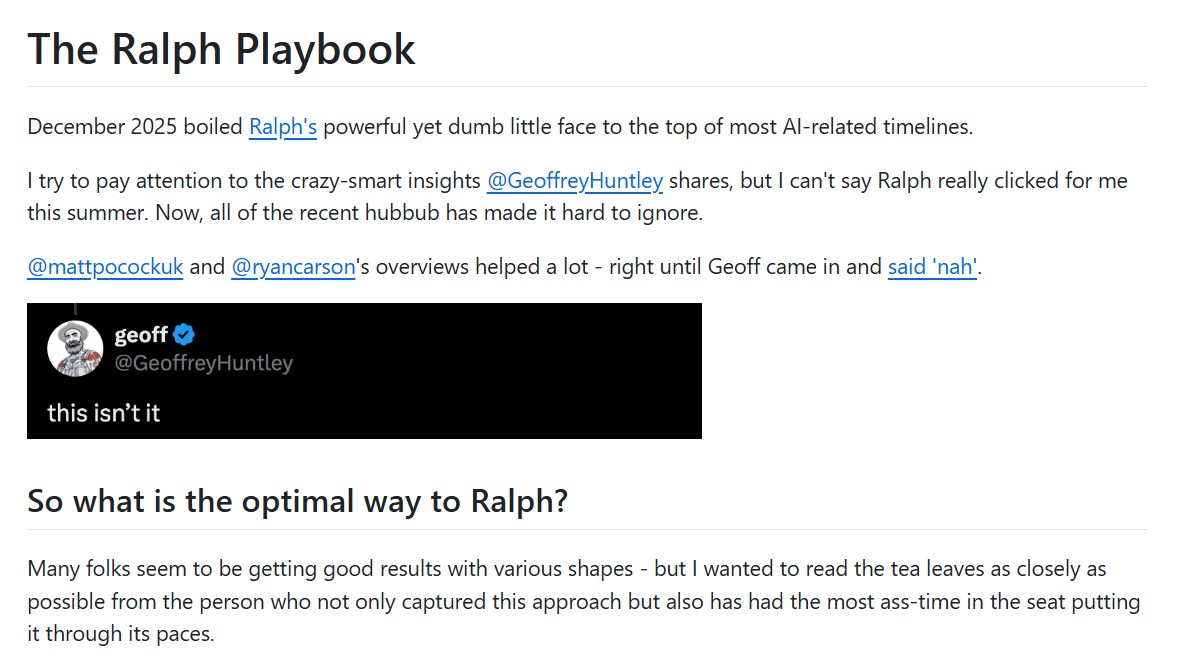
Artificial Intelligence has rapidly evolved from a helpful assistant into a powerful collaborator in software development. Yet, despite advances in large language models, most developers struggle with one fundamental issue: how to make AI code reliably, repeatedly, and autonomously without constant human correction. This is where The Ralph Playbook enters the conversation.
Popularized through the work of Geoff Huntley and later systematized by Clayton Farr, the Ralph Playbook is not a framework, tool, or library. Instead, it is a methodology—a disciplined workflow for running autonomous AI coding loops that emphasizes determinism, feedback, and iteration. It transforms AI from a chat-based helper into a self-correcting engineering agent.
What Is the Ralph Playbook?
The Ralph Playbook is a structured approach to autonomous AI-driven software development built around one core idea:
AI performs best when it works in small, isolated tasks with fresh context and strong feedback loops.
Rather than asking an AI model to build an entire application in one session, Ralph breaks work into discrete, testable tasks that are executed in a repeatable loop. Each iteration starts with a clean context window, reads the same files from disk, completes one task, commits the result, and exits.
This design prevents hallucinations, reduces context pollution, and creates eventual consistency through repetition.
The Three Phases of Ralph
The Ralph methodology is best understood as three phases, two prompts, and one loop.
Phase 1: Define Requirements
This phase happens outside the automated loop and involves a human and an AI model collaborating in conversation.
Key steps include:
- Identifying Jobs to Be Done (JTBD), which describe the outcomes users want.
- Breaking each JTBD into topics of concern.
- Writing one specification file per topic in a
specs/directory.
Each specification describes what the system should do, not how it should be implemented. A simple rule applies: if a topic requires the word “and” to describe it, it should probably be split into multiple specs.
Phase 2: Planning Mode
In planning mode, the Ralph loop runs with a planning prompt. The AI performs gap analysis between the specifications and the existing codebase.
The result is an IMPLEMENTATION_PLAN.md file containing a prioritized list of tasks. No code is written, and no commits are made during this phase. The plan is considered disposable and can be regenerated whenever it becomes stale or incorrect.
Phase 3: Building Mode
In building mode, the same loop runs with a different prompt. The AI:
- Reads the specifications.
- Reads the implementation plan.
- Selects the single most important task.
- Searches the codebase to confirm what exists.
- Implements the task.
- Runs tests and validation.
- Updates the plan and commits the change.
Each iteration completes exactly one task and then exits, ensuring a fresh context for the next loop.
The One Loop That Powers Everything
At the heart of Ralph is a deceptively simple shell loop:
while true; do
  cat PROMPT.md | claude
done
This loop continuously restarts the AI agent. The shared state lives on disk, not in the model’s memory. Each iteration rereads the same prompt files, specifications, and plans, making behavior deterministic and reproducible.
This simplicity is intentional. No orchestration layer, queue system, or task scheduler is required.
Key Files in a Ralph Project
A standard Ralph project follows a predictable structure:
loop.sh– Runs the autonomous loopPROMPT_plan.md– Instructions for planning modePROMPT_build.md– Instructions for building modeAGENTS.md– Operational guide for build, test, and run commandsIMPLEMENTATION_PLAN.md– Task list generated and updated by the AIspecs/– Source of truth for requirementssrc/andsrc/lib/– Application code and shared utilities
Among these, AGENTS.md plays a critical role. It defines how the AI validates its work, including test commands, build steps, and linting rules. This is how backpressure is applied.
Backpressure: Steering AI Without Micromanagement
Ralph does not rely on stricter prompts to control behavior. Instead, it uses backpressure.
Backpressure includes:
- Unit tests
- Integration tests
- Type checking
- Linting
- Build failures
- Performance constraints
If the AI produces incorrect or incomplete work, these systems fail, forcing correction before a commit can be made. This approach shifts control from instructions to outcomes.
For subjective criteria such as tone, UX quality, or aesthetics, the Ralph Playbook introduces LLM-as-judge tests. These tests return a simple pass/fail signal, allowing even creative work to be validated within the loop.
Letting Ralph Work Autonomously
One of the most important principles of the Ralph Playbook is often summarized as:
“Let Ralph Ralph.”
This means:
- Trust the loop.
- Avoid micromanaging tasks.
- Observe failure patterns instead of reacting emotionally.
- Add guardrails only when repeated failures occur.
The plan is disposable, the loop is cheap, and iteration is the mechanism through which correctness emerges.
Security and Sandbox Requirements
Because Ralph requires auto-approving tool calls, it must be run in a sandboxed environment. Without isolation, it could access sensitive credentials, files, or network resources.
Recommended safeguards include:
- Running in Docker or ephemeral VMs
- Using minimal API keys
- Avoiding personal machines
- Restricting network access
The guiding philosophy is to minimize the blast radius when—not if—something goes wrong.
Why the Ralph Playbook Matters
Traditional AI-assisted coding struggles with scale, consistency, and reliability. The Ralph Playbook addresses these issues by treating AI like a junior engineer who:
- Works on one task at a time
- Must pass tests before committing
- Learns from the existing codebase
- Operates within a clear operational environment
This makes Ralph especially powerful for large refactors, greenfield projects, infrastructure work, and long-running autonomous development.
Conclusion
The Ralph Playbook is not about smarter prompts or more powerful models. It is about engineering discipline applied to AI workflows. By combining fresh context, small tasks, strong backpressure, and disposable plans, Ralph enables AI to operate autonomously while remaining aligned with real-world software standards.
As AI continues to reshape development, methodologies like Ralph offer a glimpse into a future where engineers design systems, environments, and constraints while AI does the execution.
Follow us for cutting-edge updates in AI & explore the world of LLMs, deep learning, NLP and AI agents with us.
Related Reads
- CSM: Conversational Speech Model by Sesame AI Labs
- SimpleMem: Efficient Lifelong Memory for LLM Agents
- Llama-3.1-8B-Instruct: A Powerful Open Large Language Model for Scalable AI Applications
- The Ralph Playbook: A Complete Guide to Autonomous AI Coding Loops
- Qwen2.5-3B-Instruct: A Powerful Lightweight Language Model for Modern AI Applications