
As artificial intelligence systems become more advanced, the quality of data used to train, evaluate and guide these systems has become more important than ever. Data labeling, preprocessing, and structured reasoning are no longer simple, one-time tasks. Instead, they are continuous processes that require adaptability, intelligence, and reliability.
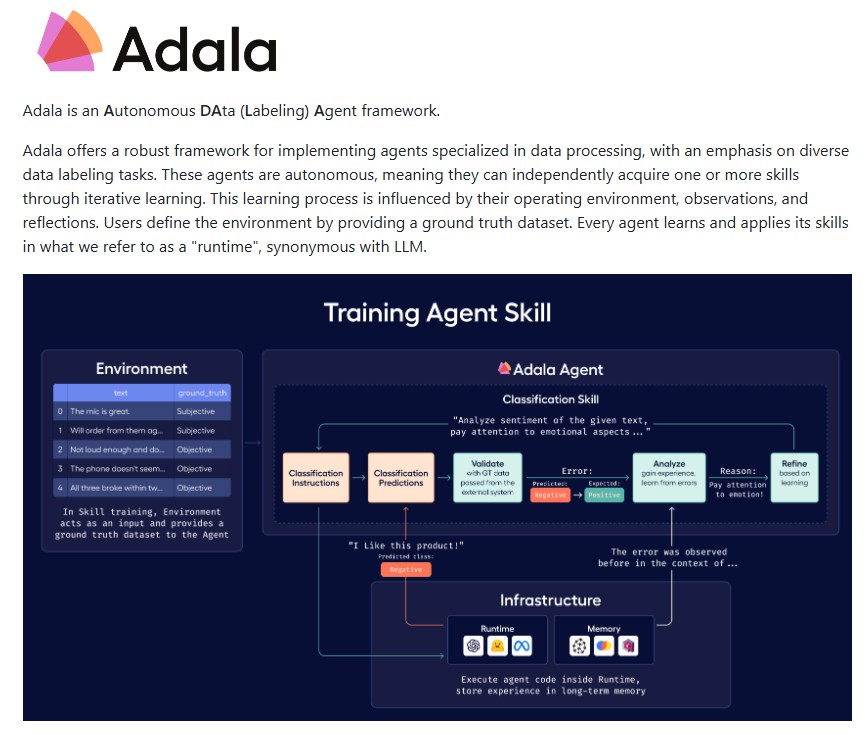
Adala is an open-source framework designed to address these challenges by introducing autonomous data labeling agents. Built by HumanSignal, Adala focuses on creating agents that can learn, improve, and apply specialized data processing skills with minimal human intervention. Rather than relying on static pipelines, Adala agents evolve through iterative learning cycles powered by large language models (LLMs).
With a strong emphasis on autonomy, controllability, and grounded learning using real datasets, Adala represents a new approach to building intelligent data-centric AI systems.
What Is Adala?
Adala is an Autonomous DAta (Labeling) Agent framework that enables developers to build intelligent agents specialized in data processing tasks. These tasks primarily include data labeling, classification, summarization, translation, question answering, and structured text generation.
At its core, Adala allows users to define:
- An environment based on ground truth data
- One or more skills the agent must learn
- One or more runtimes, typically powered by LLMs
- A learning loop that enables iterative improvement
Unlike traditional rule-based or static pipelines, Adala agents are designed to learn and adapt by observing outputs, comparing them to ground truth, and refining their behavior over time.
Core Concepts in Adala
Adala is built around several foundational concepts that work together to create autonomous agents.
1. Agents
An agent in Adala is the central entity responsible for learning and executing tasks. It combines skills, environments, and runtimes into a single intelligent system.
Agents are autonomous, meaning they can iteratively improve their performance without constant human supervision.
2. Environments
An environment defines the context in which an agent learns. Typically, this is a dataset containing ground truth labels.
For example, a sentiment classification agent might learn from a labeled dataset of text and sentiment values. The environment provides feedback that guides learning.
3. Skills
Skills represent specific capabilities, such as:
- Text classification
- Summarization
- Translation
- Question answering
- Text generation
Each skill includes instructions, input templates, output templates, and constraints. Skills can be reused across agents and runtimes, making them modular and extensible.
4. Runtimes
Runtimes define how skills are executed. Most commonly, runtimes are LLM-powered, such as OpenAI, Claude, Gemini, or other compatible models.
Adala supports multiple runtimes per agent, enabling advanced architectures such as teacher-student learning and cross-model evaluation.
Autonomous Learning in Adala
One of Adala’s defining features is its autonomous learning loop. Rather than executing a task once, agents repeatedly:
- Observe the data
- Apply a skill using an LLM runtime
- Compare outputs against ground truth
- Reflect on errors
- Refine prompts and behavior
- Repeat until accuracy thresholds are met
This iterative process allows agents to improve performance over time, making them more reliable and consistent than one-shot prompt-based systems.
Key Features of Adala
1. Grounded and Reliable Agents
Adala agents are trained against real datasets, ensuring that outputs are measurable, verifiable, and repeatable. This makes them suitable for production-grade data workflows.
2. Controllable Output Constraints
For every skill, developers can define strict or flexible output formats. This is especially important for structured data labeling tasks where consistency is critical.
3. Specialized Data Processing Focus
While many agent frameworks aim to solve general reasoning tasks, Adala is purpose-built for data-centric AI workflows, making it particularly strong in preprocessing and annotation pipelines.
4. Flexible Runtime Architecture
A single skill can be deployed across multiple runtimes. This enables experimentation with different LLM providers and supports advanced learning patterns such as teacher-guided training.
5. Extensibility and Customization
Adala is designed to be easily extended. Developers can create new skills, runtimes, environments, and learning strategies tailored to their domain-specific needs.
Installation and Setup
Adala is available via PyPI and supports modern Python environments.
Standard Installation
pip install adala
Installation from GitHub
pip install git+https://github.com/HumanSignal/Adala.git
Developer Installation
git clone https://github.com/HumanSignal/Adala.git

cd Adala
poetry install
Users must configure an API key for supported LLMs, such as OpenAI or OpenRouter, before running agents.
Supported LLM Providers
Adala supports multiple LLM providers through a unified runtime interface, including:
- OpenAI
- Claude
- Gemini
- Any OpenAI-compatible model via OpenRouter
This flexibility allows developers to avoid vendor lock-in and experiment with different models easily.
Practical Use Cases
Adala is well-suited for a wide range of AI and data workflows, including:
- Automated data labeling for machine learning
- Sentiment analysis pipelines
- Text summarization and transformation
- Question answering over structured datasets
- Research experiments in autonomous learning
- Teaching and academic projects
Its Python-native design makes it especially appealing for data scientists and ML researchers working in notebooks and pipelines.
Research and Educational Value
Beyond production use, Adala serves as a powerful research platform. Its clear abstractions around agents, skills, and learning loops make it ideal for:
- Studying autonomous agents
- Exploring causal reasoning
- Teaching agent-oriented programming
- Experimenting with prompt optimization strategies
This dual focus on practice and research sets Adala apart from many other agent frameworks.
Conclusion
Adala introduces a thoughtful and robust approach to autonomous data labeling and processing through intelligent agents. By grounding learning in real datasets, enforcing structured outputs and supporting iterative improvement, it addresses many limitations of traditional prompt-based AI systems.
Its modular architecture, runtime flexibility and strong emphasis on data-centric workflows make it a valuable tool for AI engineers, data scientists, researchers and educators alike. As the demand for reliable and scalable AI systems continues to grow, frameworks like Adala will play an increasingly important role in shaping the future of intelligent automation.
For anyone building AI systems where data quality and learning consistency matter, Adala is a framework worth serious consideration.
Follow us for cutting-edge updates in AI & explore the world of LLMs, deep learning, NLP and AI agents with us.
Related Reads
- Breaking Language Barriers with AI: The Power of LFM2-ColBERT-350M in Multilingual Search
- AutoGen: Microsoft’s Framework for Building Powerful Multi-Agent AI Applications
- Gradio: The Easiest Way to Build and Share Machine Learning Web Apps
- AutoGPT: The Complete Guide to Building, Deploying and Running AI Agents
- AI Engineering Hub: The Ultimate Resource for Building Modern AI Systems
2 thoughts on “Adala: An Autonomous Data Labeling Agent Framework for Intelligent AI Systems”