
Artificial Intelligence is evolving rapidly from prompt-based chatbots to autonomous AI agents capable of reasoning, planning, using tools, and collaborating with other agents. As this shift accelerates, developers and AI practitioners need a clear, structured roadmap to understand and build agentic AI systems.
To address this need, Microsoft has released an open-source course titled “AI Agents for Beginners” – a comprehensive learning program designed to help learners move from foundational concepts to real-world agent development using modern AI frameworks.
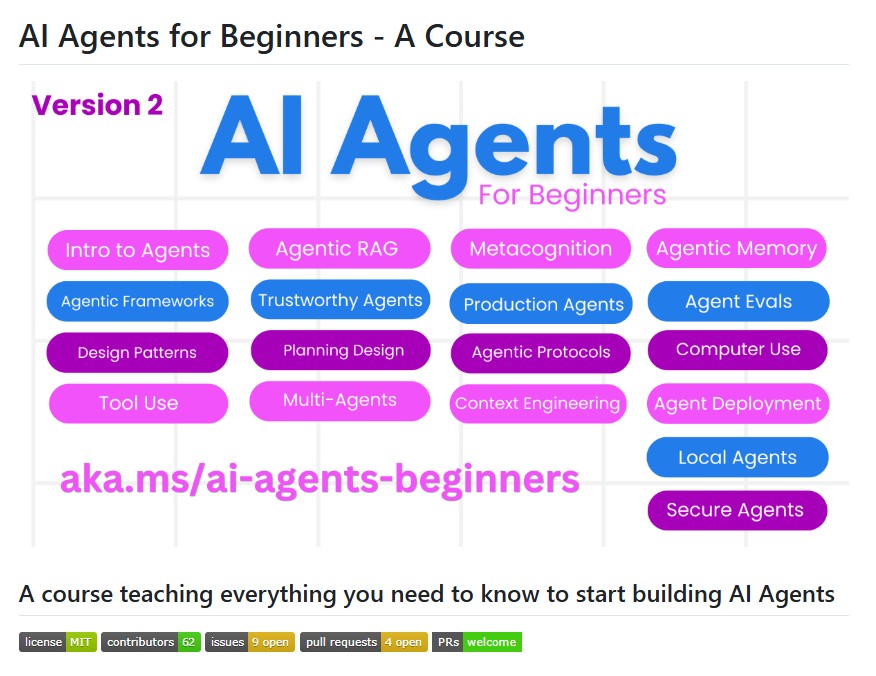
In this blog, we present a complete overview of the course structure, highlighting all the chapters covered in this learning path. This serves as a quick reference for anyone exploring agentic AI or planning a structured learning journey.
Why AI Agents Are the Future of AI Systems
Traditional AI applications respond to single prompts. AI agents, on the other hand, are systems that can:
- Understand goals
- Plan multiple steps
- Use tools and APIs
- Retrieve and store memory
- Interact with other agents
These capabilities make AI agents ideal for enterprise automation, AI copilots, research assistants, workflow orchestration, and decision-making systems. As organizations adopt these architectures, learning how to build AI agents is becoming a must-have skill.
Microsoft’s AI Agents for Beginners course is designed to meet this demand with practical, production-focused content.
AI Agents for Beginners: Chapter List
Below is the complete list of chapters included in the course, covering the full lifecycle of agentic AI development from fundamentals to production readiness.
Chapters Covered in the Course
- Introduction to AI Agents
- Exploring Agentic Frameworks
- Agentic Design Patterns
- Tool Use Design Pattern
- Agentic RAG (Retrieval-Augmented Generation)
- Building Trustworthy AI Agents
- Planning Design Pattern
- Multi-Agent Design Pattern
- Metacognition Design Pattern
- AI Agents in Production
- Agentic Protocols
- Context Engineering
- Agent Memory
- Microsoft Agent Framework
- Browser and Computer Use Agents
- Deploying Scalable Agents (Coming Soon)
- Creating Local AI Agents (Coming Soon)
- Securing AI Agents (Coming Soon)
What Makes This Course Valuable
The AI Agents for Beginners course stands out because it is:
- Free and open-source (MIT License)
- Backed by Microsoft
- Built with real-world agent frameworks
- Supported by Azure AI Foundry and GitHub Models
- Translated into 50+ languages
- Designed for both beginners and professionals
Each chapter is paired with hands-on code samples, making it easier to move from theory to implementation.
Who Should Follow This Learning Path?
This course is ideal for:
- AI and ML learners
- Software engineers
- Data scientists
- GenAI developers
- Startup founders
- Product teams exploring autonomous AI
If you already understand basic Python and large language models, this course helps you transition into advanced agentic AI system design.
Conclusion
AI Agents for Beginners by Microsoft is more than a course—it’s a blueprint for the next generation of AI systems. By covering everything from agent fundamentals to production deployment, it equips learners with the skills needed to build intelligent, autonomous, and scalable AI agents.
If you want to stay ahead in AI, learning agentic systems is no longer optional and this course is one of the best places to start.
Follow us for cutting-edge updates in AI & explore the world of LLMs, deep learning, NLP and AI agents with us.
Related Reads
- A Complete Guide to the Made With ML Repository: Designing and Deploying Production-Grade Machine Learning Systems
- A Complete Guide to the GenAI Agents Repository: Building Generative AI Agents from Beginner to Advanced
- Microsoft’s AI Agents for Beginners: A Complete Guide to Building Your First AI Agent
- The Ultimate Guide to Prompt Engineering: A Deep Dive into DAIR.AI’s Leading Resource
- Parlant: The AI Agent Framework Built for Real-World Reliability