
Artificial Intelligence is evolving at a remarkable pace, and staying updated with the latest tools, workflows and real-world engineering practices has become essential for developers, students, and professionals. AI is no longer limited to research labs; it is being used in production systems, content generation workflows, advanced automation and agent-based architectures. For anyone looking to master AI engineering in a structured, hands-on way, the AI Engineering Hub on GitHub has emerged as one of the most comprehensive open-source collections available today.
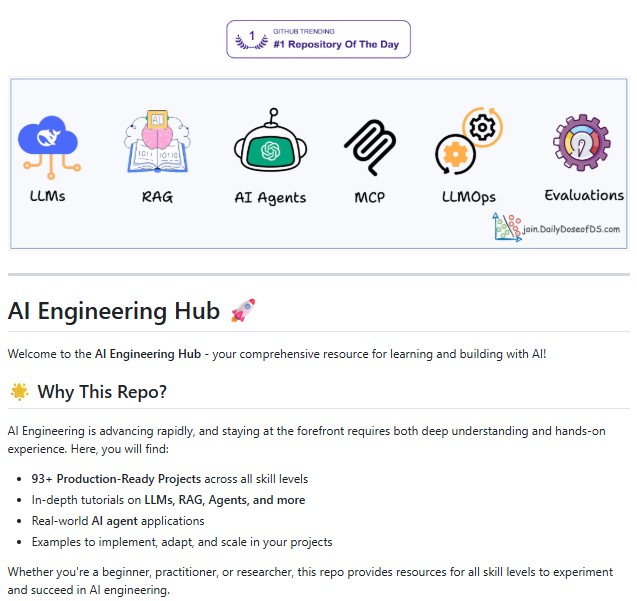
The AI Engineering Hub brings together more than 90 production-ready projects, ranging from beginner-level applications to advanced agentic systems. It acts as a complete learning hub covering LLMs, RAG, AI agents, multimodal applications, fine-tuning and real-world deployment frameworks. Whether you are just starting your journey or you are already working on enterprise AI systems, this repository provides practical, well-documented and reusable code that accelerates learning and development.
This blog explores the structure, features, benefits and scope of the AI Engineering Hub and explains why it has become a go-to resource for anyone interested in AI engineering.
What Is the AI Engineering Hub?
The AI Engineering Hub is an open-source GitHub repository curated to help developers learn, build and deploy modern AI applications. It contains a vast collection of projects, guides and tutorials organized by difficulty level, covering topics such as:
- Large Language Models
- Retrieval-Augmented Generation (RAG)
- Multimodal AI
- AI agents and workflows
- Voice, audio, and video AI
- Model comparison and evaluation
- Fine-tuning and model-building
- Production-level AI systems
Its goal is to bridge the gap between theoretical AI concepts and real-world engineering by offering practical implementations that can be studied, adapted, and integrated into any project.
Projects Categorized by Difficulty
One of the strongest features of the AI Engineering Hub is its structured categorization. Projects are divided into three clear difficulty levels.
Beginner Projects
Beginner projects are designed for users who want to understand fundamental AI components. They include:
- OCR and vision tools such as Llama OCR and Qwen OCR
- Local ChatGPT-style applications
- Basic RAG implementations
- Simple GitHub RAG tools
- Image generation demos
- Audio transcription and structured text extraction
These projects are easy to run and help beginners build confidence using modern AI models.
Intermediate Projects
Intermediate projects introduce more complex workflows and multi-component systems. These include:
- AI agents using CrewAI
- Brand monitoring and hotel booking agents
- Agentic RAG workflows
- Voice agents and real-time AI interactions
- SQL-powered RAG
- Multimodal RAG frameworks
- MCP-enabled agents for advanced reasoning and memory
These projects closely resemble real-world applications and help developers learn how different AI components interact in a full system.
Advanced Projects
Advanced projects are targeted at professionals, researchers, and engineers who want to work on high-complexity systems. They include:
- Fine-tuning LLMs
- Building reasoning models
- Implementing core Transformer architecture
- Multi-agent deep research systems
- MCP-based production workflows
- Model comparison pipelines
- Document processing pipelines for enterprise use
- Complete NotebookLM clone with citations and audio podcast generation
These projects require deeper knowledge of machine learning, distributed systems, and advanced AI engineering workflows.
Key Features of the AI Engineering Hub
1. Real-World Use Cases
The repository is built around practical, real-world use cases such as:
- Customer support automation
- Content creation and planning
- Legal assistants
- Data analysis pipelines
- Website-to-API transformation
- Multimodal document understanding
- Video and audio search
Developers get ready-made systems that mirror actual industry applications.
2. Rich Learning Resources
The repository includes:
- The AI Engineering Roadmap
- Detailed documentation
- Complete tutorials on RAG, LLMs, and Agents
- Step-by-step implementation guidance
- Clear explanations of each module
This makes it easier for beginners and professionals to learn systematically.
3. Wide Technology Coverage
The projects cover a wide range of technologies, including:
- Llama
- DeepSeek
- Gemini
- Qwen
- CrewAI
- LlamaIndex
- Milvus and Qdrant
- MCP (Model Context Protocol)
- Streamlit
- FastAPI
- GroundX and other enterprise tools
This breadth allows engineers to explore and master multiple AI frameworks.
Conclusion
The AI Engineering Hub is one of the most comprehensive and practical open-source resources available for anyone learning or working in AI engineering. It provides a complete ecosystem of projects, tutorials and advanced systems that cover every aspect of LLMs, RAG, agentic workflows, voice and multimodal AI and full-scale production systems. Whether you are a beginner trying to understand the basics or a professional building state-of-the-art AI applications, this repository offers immense value.
Its structured learning path, extensive project library and real-world examples make it an essential tool for mastering AI engineering. With rapid advancements in AI, resources like this ensure that developers stay updated, skilled and ready to build the next generation of intelligent systems.
Follow us for cutting-edge updates in AI & explore the world of LLMs, deep learning, NLP and AI agents with us.
Related Reads
- 500+ AI Agent Projects: A Complete Guide to Industry Use Cases and Practical Applications
- Polyfire JS: The Complete Guide to Building AI-Powered Applications Without a Backend
- DIVER: A Multi-Stage Retrieval System for Complex, Reasoning-Intensive Search
- Microsoft UFO³: The Future of Multi-Device AI Agent Automation
- A Complete Guide to the Made With ML Repository: Designing and Deploying Production-Grade Machine Learning Systems
2 thoughts on “AI Engineering Hub: The Ultimate Resource for Building Modern AI Systems”