
Artificial Intelligence is rapidly shifting from single-model workflows to complex, coordinated systems powered by multiple intelligent agents. As organizations build increasingly sophisticated AI solutions, the need for structured, scalable, and extensible agent frameworks has never been greater. Microsoft’s AutoGen framework stands at the center of this evolution. Designed for building both autonomous and human-in-the-loop agentic applications, AutoGen simplifies the development of multi-agent workflows while offering the flexibility needed for advanced use cases.
With support for Python, .NET, AI model integrations, tool execution, and no-code development environments through AutoGen Studio, the framework is shaping the next wave of agent-based AI development. This blog provides a comprehensive, an overview of the AutoGen ecosystem, its capabilities, installation process, benefits, and why it has become one of the most widely adopted frameworks among AI developers and researchers.
What Is AutoGen?
It is an open-source framework by Microsoft that enables developers to build multi-agent AI systems capable of working autonomously or collaboratively with human users. Its primary purpose is to make multi-agent workflows simple, modular, and production-ready.
The framework provides three major layers:
- Core API – The foundational layer responsible for message passing, event-driven agent behavior, runtime orchestration, and support for both local and distributed systems.
- AgentChat API – A higher-level, opinionated API designed for rapid prototyping of common multi-agent patterns such as expert groups, assistant-user chats, and multi-role orchestration.
- Extensions API – Enables integration of external tools, custom LLM clients, code execution, web browsing capabilities, and advanced model behaviors.
This layered system allows developers to choose between high-level simplicity and low-level customization depending on their project requirements.
Installation and Setup
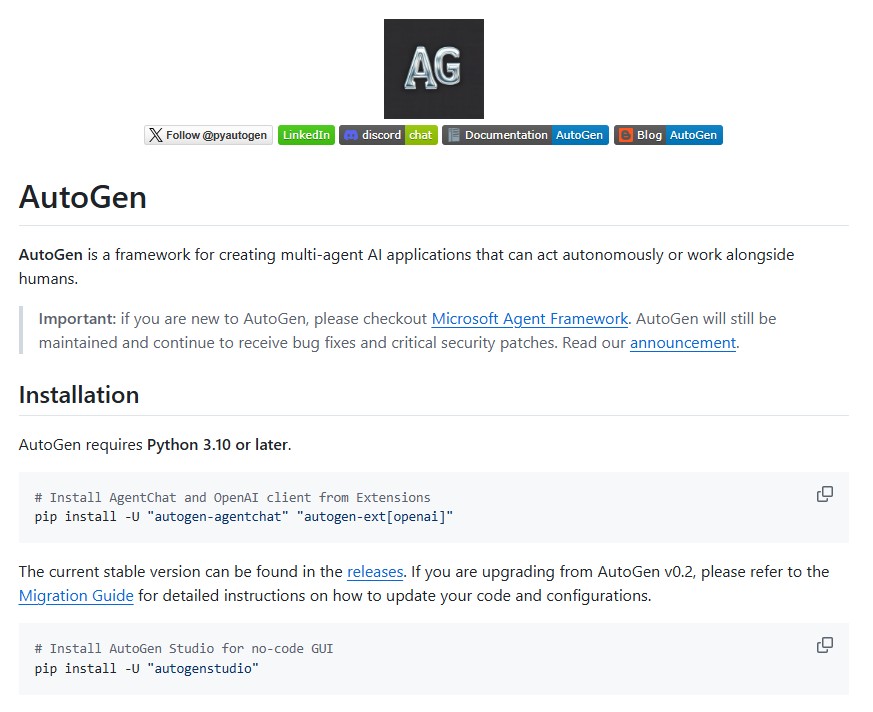
AutoGen requires Python 3.10 or later. Installation is straightforward and modular, allowing users to install only the components they need.
Install AgentChat and OpenAI Extensions
pip install -U “autogen-agentchat” “autogen-ext[openai]”
This installs the core AgentChat environment along with OpenAI model support. Developers upgrading from older versions can refer to the Migration Guide for version-specific instructions.
Install AutoGen Studio
For users interested in a no-code environment:
pip install -U “autogenstudio”
AutoGen Studio lets users create multi-agent applications visually without writing Python code.
Quickstart Examples
1. Hello World Using an Assistant Agent
Developers can create an assistant agent powered by an OpenAI model in just a few lines of code:
model_client = OpenAIChatCompletionClient(model="gpt-4.1")

agent = AssistantAgent("assistant", model_client=model_client)

print(await agent.run(task="Say 'Hello World!'"))
This simple example demonstrates how AutoGen abstracts complex model interactions into readable, maintainable code.
2. Web Browsing Agent Using Playwright MCP
AutoGen supports MCP (Model Context Protocol) servers, allowing agents to perform tool-enabled tasks such as web browsing:
async with McpWorkbench(server_params) as mcp:

    agent = AssistantAgent(

        "web_browsing_assistant",

        model_client=model_client,

        workbench=mcp,

        max_tool_iterations=10,

    )
This level of extensibility allows agents to retrieve web data, interact with pages, and support search workflows.
3. Multi-Agent Orchestration
One of AutoGen’s strongest capabilities is multi-agent collaboration. Developers can create domain-expert agents in math, chemistry, code execution, or any specialized field and allow a main assistant to interact with them.
math_agent = AssistantAgent("math_expert", model_client=model_client)

chemistry_agent = AssistantAgent("chemistry_expert", model_client=model_client)
Both agents can be wrapped as tools, enabling a master agent to delegate tasks based on context.
This architecture mirrors how human teams operate, making it ideal for research, enterprise AI pipelines, and domain-specific automation.
AutoGen Studio: No-Code Multi-Agent Development
AutoGen Studio brings a graphical interface to the framework. Users can design agent workflows, define triggers, add tools, and test interactions visually.
Start the interface with:
autogenstudio ui --port 8080 --appdir ./my-app
This makes the framework accessible to business teams, analysts, and non-programmers who wish to prototype multi-agent systems.
Why Developers Prefer AutoGen
1. Extensible Layered Architecture
AutoGen’s architecture is highly modular, allowing developers to start with simple agent interactions and gradually move to advanced orchestrations using the Core API.
2. Multi-Language Support
Although primarily built for Python, AutoGen also supports .NET environments, enabling cross-language agent communication and broader adoption.
3. Tool and Model Integration
The Extensions API allows seamless integration with:
- OpenAI models
- Azure OpenAI
- Web browsing tools
- Code execution environments
- MCP servers
This significantly expands agent capabilities.
4. Rich Ecosystem
This ecosystem includes:
- AutoGen Studio for no-code workflows
- AutoGen Bench for benchmarking agent performance
- Community-driven tutorials, GitHub discussions, and weekly office hours
These resources create a supportive environment for developers learning the framework.
5. Production-Ready and Scalable
AutoGen supports distributed execution, runtime monitoring, and event-driven behavior, making it suitable for enterprise-grade applications.
The Future of Agentic AI with AutoGen
AutoGen is not just a framework; it represents the shift toward agentic AI systems where models collaborate, execute tasks autonomously, and interact intelligently with tools and environments. From text analysis to web browsing, data processing, and complex research tasks, AutoGen enables developers to build systems that mimic real-world problem-solving.
The popularity of the framework, large contributor base, active community, and ongoing updates demonstrate Microsoft’s commitment to shaping the future of agentic AI.
Conclusion
Microsoft’s AutoGen framework is transforming how multi-agent AI systems are built, tested, and deployed. Its layered architecture, extensive tool integrations, cross-language support, and no-code development environment make it one of the most powerful frameworks available today. Whether you are a researcher exploring agentic intelligence, a developer building autonomous workflows, or an enterprise team deploying AI systems, AutoGen offers the flexibility, scalability, and simplicity needed to bring complex agent applications to life. As the ecosystem continues to expand, AutoGen is positioned to remain at the forefront of modern AI development.
Follow us for cutting-edge updates in AI & explore the world of LLMs, deep learning, NLP and AI agents with us.
Related Reads
- Gradio: The Easiest Way to Build and Share Machine Learning Web Apps
- AutoGPT: The Complete Guide to Building, Deploying and Running AI Agents
- AI Engineering Hub: The Ultimate Resource for Building Modern AI Systems
- 500+ AI Agent Projects: A Complete Guide to Industry Use Cases and Practical Applications
- Polyfire JS: The Complete Guide to Building AI-Powered Applications Without a Backend
1 thought on “AutoGen: Microsoft’s Framework for Building Powerful Multi-Agent AI Applications”