
Speech generation has become a crucial component of modern AI systems, powering virtual assistants, interactive demos, accessibility tools, and conversational agents. While many text-to-speech models focus on reading text aloud, fewer models truly address conversational speech—where context, speaker identity, and dialogue flow matter. Sesame AI Labs’ CSM (Conversational Speech Model) is designed specifically to fill this gap.
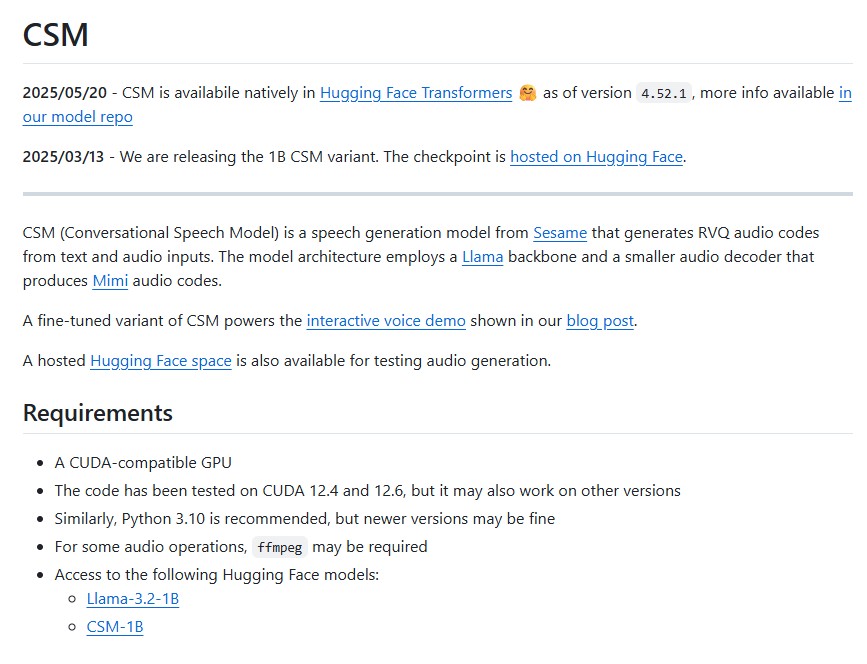
CSM is an open-source conversational speech generation model that converts text and audio inputs into high-quality speech outputs using advanced neural architectures. Built with research and experimentation in mind, CSM represents a major step forward in controllable, context-aware speech synthesis. With native support in Hugging Face Transformers and an Apache 2.0 license, CSM is accessible to researchers, developers, and AI enthusiasts worldwide.
This blog provides a complete overview of CSM, including its architecture, features, setup process, use cases, limitations, and ethical considerations.
What Is CSM?
CSM, short for Conversational Speech Model, is a speech generation model developed by Sesame AI Labs. Unlike traditional text-to-speech systems, CSM is designed to handle conversational scenarios. It generates RVQ (Residual Vector Quantization) audio codes from text and audio inputs, allowing it to produce speech that aligns more naturally with dialogue-based interactions.
The model uses a Llama-based backbone for language understanding combined with a specialized audio decoder that outputs Mimi audio codes. This architecture allows CSM to maintain linguistic coherence while producing realistic and expressive audio outputs.
As of 2025, CSM is available natively in Hugging Face Transformers starting from version 4.52.1, making it easier than ever to integrate into existing AI workflows.
Key Features of CSM
Conversational Speech Generation
CSM is optimized for dialogue. It supports multi-speaker conversations where each speaker can have a distinct identity. By using speaker IDs and contextual audio segments, the model can generate responses that sound consistent within a conversation.
Context-Aware Audio Output
One of CSM’s strongest capabilities is its use of context. When provided with prior audio and text segments, the model produces more natural and coherent speech. This makes it particularly useful for applications such as interactive voice demos, AI companions, and conversational agents.
Open-Source and Research-Friendly
CSM is released under the Apache 2.0 license, allowing broad usage and modification. Researchers can inspect the architecture, experiment with fine-tuning, and integrate the model into new applications without restrictive licensing constraints.
Hugging Face Integration
The availability of CSM directly within Hugging Face Transformers significantly lowers the barrier to entry. Developers can access pretrained checkpoints, download models easily, and integrate them into Python-based pipelines with minimal effort.
Model Variants and Availability
Sesame AI Labs has released a 1B parameter variant of CSM, known as CSM-1B. This checkpoint is hosted on Hugging Face and is suitable for high-quality speech generation on CUDA-compatible GPUs.
A fine-tuned version of CSM powers the interactive voice demo showcased in Sesame’s official blog, demonstrating its real-world conversational capabilities. Additionally, a hosted Hugging Face Space is available for users who want to test audio generation without setting up the environment locally.
System Requirements
To run CSM effectively, certain hardware and software requirements must be met:
- A CUDA-compatible GPU is required for practical inference.
- The model has been tested on CUDA versions 12.4 and 12.6.
- Python 3.10 is recommended, though newer versions may work.
- ffmpeg may be required for certain audio processing operations.
- Access to the Llama-3.2-1B and CSM-1B models on Hugging Face is necessary.
Windows users should note that the standard triton package is not supported. Instead, the triton-windows package must be installed.
Installation and Setup
Setting up CSM involves cloning the repository, creating a virtual environment, installing dependencies, and logging into Hugging Face to access the required models. The process is straightforward for users familiar with Python and GPU-based ML workflows.
An important setup step is disabling lazy compilation in Mimi by setting the appropriate environment variable. This ensures smoother execution during inference.
Once installed, users can quickly verify the setup by running the provided example script, which generates a conversation between two characters.
How CSM Is Used
Basic Speech Generation
CSM can generate a single spoken sentence from text using a randomly selected speaker identity. This is useful for testing and simple audio generation tasks where no prior context is required.
Contextual Conversation Generation
For higher-quality results, CSM supports contextual input through audio and text segments. By feeding previous utterances into the model, developers can simulate natural conversations where responses build on what was previously said.
This approach is especially valuable for dialogue systems, voice-based storytelling, and conversational AI research.
Limitations of CSM
Despite its strengths, CSM is not a general-purpose multimodal language model. It does not generate text and should be paired with a separate large language model for text-based reasoning or dialogue planning.
Language support is also limited. While the model may produce non-English speech in some cases due to training data contamination, it is primarily optimized for English and may not perform well in other languages.
Additionally, CSM does not come with pre-defined or branded voices. It is a base generation model capable of producing varied voices, but it has not been fine-tuned to replicate specific individuals or styles.
Ethical Use and Misuse Prevention
Sesame AI Labs places strong emphasis on responsible usage. CSM is intended for research and educational purposes, and misuse is explicitly prohibited.
Disallowed uses include impersonating real individuals without consent, generating deceptive or misleading content, and engaging in illegal or harmful activities. Users are expected to comply with all applicable laws and ethical standards when deploying the model.
By clearly outlining these restrictions, the project reinforces the importance of ethical AI development in the speech generation domain.
Conclusion
CSM by Sesame AI Labs is a powerful and research-focused conversational speech generation model that addresses the growing need for context-aware, multi-speaker audio synthesis. With its Llama-based architecture, strong Hugging Face integration, and open-source licensing, CSM provides a solid foundation for experimenting with conversational voice AI. While it has clear limitations and ethical boundaries, its design and capabilities make it an important contribution to the evolving speech AI landscape. For developers and researchers exploring next-generation conversational audio systems, CSM stands out as a robust and forward-looking solution.
Follow us for cutting-edge updates in AI & explore the world of LLMs, deep learning, NLP and AI agents with us.
Related Reads
- Orion: The Next Evolution in Visual AI for Advanced Reasoning and Multi-Modal Intelligence
- Fara-7B: Microsoft’s Breakthrough Agentic Model for Real-World Computer Use
- MiniMax-M2.1: An Open-Source Leap Toward Enterprise-Grade Agentic AI
- Supabase: The Complete Guide to the Open-Source Postgres Development Platform
- K-EXAONE-236B-A23B: A Deep Dive into LG AI Research’s Frontier Multilingual Reasoning Model
2 thoughts on “CSM: Conversational Speech Model by Sesame AI Labs”