In today’s digital era, organizations around the world deal with vast numbers of documents – PDFs, scanned images, reports, invoices and forms in multiple languages and formats. Extracting, understanding, and organizing this information efficiently has become a crucial challenge. Optical Character Recognition (OCR) has been a long-standing solution, but traditional OCR tools often struggle with complex layouts, multilingual text, and mixed content like tables or formulas.
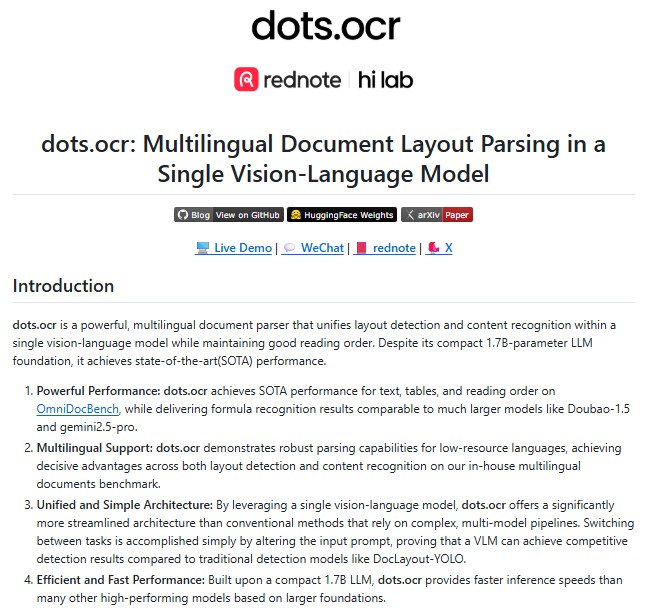
To address these limitations, dots.ocr, developed by rednote-hilab, has emerged as a powerful multilingual document layout parser. Unlike conventional OCR tools, dots.ocr unifies layout detection and content recognition within a single Vision-Language Model (VLM), making it one of the most advanced solutions for document intelligence. Despite being based on a relatively compact 1.7-billion-parameter model, dots.ocr achieves state-of-the-art (SOTA) results across multiple benchmarks.
Let’s explore how dots.ocr is transforming the future of document understanding through its efficiency, multilingual capabilities, and innovative architecture.
What is dots.ocr?
dots.ocr is a cutting-edge AI model designed to read, understand, and interpret complex documents across multiple languages. It combines computer vision and natural language understanding into one unified architecture. This allows it to handle tasks such as:
- Detecting document layouts (paragraphs, tables, formulas, images)
- Recognizing text content in multiple languages
- Maintaining correct reading order for better document comprehension
Unlike traditional OCR systems that rely on multi-model pipelines, dots.ocr performs all these tasks within a single VLM. This simplicity improves both speed and accuracy while making the system easier to deploy and maintain.
Unified and Simple Architecture
Traditional OCR systems often depend on several models – one for detecting text boxes, another for recognizing characters, and yet another for reconstructing the layout. dots.ocr replaces this complex approach with a unified architecture.
By using a Vision-Language Model (VLM) as the foundation, dots.ocr processes both visual and textual elements simultaneously. This means it can “see” how text, tables and formulas are structured while “understanding” the linguistic meaning behind them.
Switching between different parsing tasks (like text detection or formula recognition) is as simple as changing the input prompt, eliminating the need for additional models or configurations.
Multilingual Capability
One of the biggest strengths of dots.ocr is its multilingual performance. Most OCR tools perform well in English but struggle with other languages, especially low-resource ones like Tibetan, Kannada, or Russian.
dots.ocr changes this by offering robust multilingual parsing capabilities. In evaluations across 100 languages, it consistently achieved superior results in both layout detection and content recognition. Whether it’s a scanned Chinese academic paper or a handwritten Arabic note, dots.ocr maintains high accuracy in text extraction and reading order.
This makes it an ideal solution for global organizations, publishers and researchers who deal with multilingual archives or international document processing.
Performance Benchmarks
dots.ocr has demonstrated exceptional performance on widely recognized datasets like OmniDocBench and olmOCR-bench.
- On OmniDocBench, dots.ocr outperformed popular models like Gemini2.5-Pro, Qwen2.5-VL-72B and GPT-4o, achieving the lowest error rates in both English and Chinese document parsing.
- It scored 88.6% for layout accuracy and 0.125 overall edit distance, setting new records in document understanding benchmarks.
- In its in-house dots.ocr-bench, the model achieved a 79.2% TableTEDS score, proving its ability to handle even complex table and formula recognition.
Despite having just 1.7 billion parameters, dots.ocr’s accuracy rivals much larger models like Gemini2.5-Pro and Doubao-1.5, while being faster and more efficient in real-world tasks.
Efficiency and Speed
Dots.ocr is not only powerful but also efficient. Because it’s built on a compact LLM backbone, it delivers faster inference speeds than other large-scale models.
Users can deploy it using vLLM (a lightweight inference engine) or Hugging Face Transformers depending on their environment. The model supports both GPU and CPU inference, offering flexibility for research, enterprise, and edge applications.
This efficiency makes it suitable for high-volume document processing, such as large-scale scanning projects or enterprise document management systems.
Real-World Applications
1. Enterprise Automation
Businesses can use dots.ocr to automatically extract structured data from invoices, reports, and forms. Its ability to maintain correct reading order and detect layout elements ensures cleaner, more reliable outputs.
2. Research and Education
Academic institutions can use it to digitize multilingual books and papers with precise formula and table recognition—tasks that have traditionally been difficult for OCR systems.
3. Multilingual Archiving
Libraries and governments that preserve multilingual records can rely on dots.ocr to create searchable digital archives, improving accessibility for users across different regions and languages.
4. AI and Data Annotation
For AI developers, dots.ocr can be integrated into pipelines for document-level data extraction, semantic search, and knowledge base creation, making it a strong tool for training other AI systems.
Installation and Deployment
Deploying dots.ocr is straightforward. Developers can install it via GitHub using Python or Docker. The model integrates smoothly with vLLM for optimal performance or with Hugging Face Transformers for CPU-based inference.
It supports both image and PDF parsing, allowing users to process pages with simple commands. For large documents, multiple threads can be used to accelerate parsing. The flexibility and ease of setup make it ideal for both beginners and advanced AI practitioners.
Limitations and Future Directions
While dots.ocr achieves excellent results, the developers acknowledge certain limitations. It may face challenges with highly complex tables and formulas or images with extremely high resolutions. Additionally, it currently does not parse images embedded within documents.
The team behind dots.ocr plans to expand the model’s capabilities by improving image captioning, table detection, and formula recognition, and by developing a more general-purpose perception model that integrates multiple visual and linguistic tasks into one framework.
This vision suggests a future where one AI system can understand not only text but also the visual meaning of entire documents – an exciting step toward true artificial document intelligence.
Conclusion
It represents a major leap forward in document understanding. By merging layout detection, text recognition and multilingual parsing into a single Vision-Language Model, it eliminates the need for complex multi-stage pipelines. Its performance, simplicity and speed make it an ideal choice for businesses, researchers, and developers working with global document data.
With ongoing improvements and growing community support, dots.ocr is poised to redefine how organizations handle digital documents transforming unstructured pages into structured, searchable, and intelligent data.
Follow us for cutting-edge updates in AI & explore the world of LLMs, deep learning, NLP and AI agents with us.
Related Reads
- The Ultimate AI & Machine Learning Roadmap: A Complete Guide for Beginners
- S3PRL Toolkit: Advancing Self-Supervised Speech Representation Learning
- How to Run and Fine-Tune Kimi K2 Thinking Locally with Unsloth
- IndicWav2Vec: Building the Future of Speech Recognition for Indian Languages
- Distil-Whisper: Faster, Smaller, and Smarter Speech Recognition by Hugging Face
2 thoughts on “dots.ocr: The Future of Multilingual Document Understanding with Vision-Language Models”