
The rapid evolution of artificial intelligence has reshaped how people interact with computers, websites, and digital tools. However, most AI models are still limited to text generation, leaving a gap between intelligence and true digital action. Microsoft’s latest innovation, Fara-7B, bridges this gap by introducing a small yet powerful agentic model designed specifically for computer use.
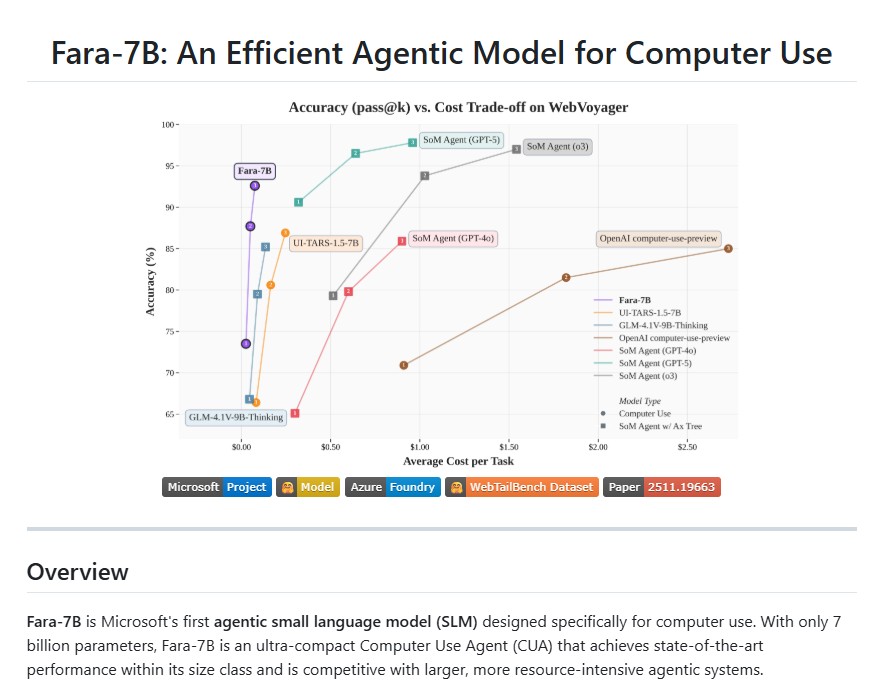
Fara-7B stands out because it is capable of controlling a computer the way a human does. It performs tasks by visually understanding websites and interacting using predicted mouse clicks, keyboard inputs, scrolling, and web navigation. With only 7 billion parameters, this efficient and lightweight model delivers state-of-the-art computer-use performance that rivals larger and more resource-heavy agents.
This blog explores the key features, capabilities, performance benchmarks, installation methods, and real-world applications of Fara-7B. Whether you are a developer, AI researcher, or tech enthusiast, understanding this model will help you stay ahead in the emerging world of agentic AI.
What Is Fara-7B?
Fara-7B is Microsoft’s first agentic small language model (SLM) developed specifically for real-world computer interactions. Unlike traditional chat-based models, Fara-7B does not stop at generating text responses. Instead, it interacts with the computer through mouse and keyboard actions, making it function more like a digital assistant capable of performing tasks directly on websites.
Built on Qwen2.5-VL-7B, Fara-7B is fine-tuned using 145,000 high-quality synthetic trajectories generated through Microsoft’s Magentic-One framework. This means the model is trained on diverse scenarios across real websites, giving it the practical knowledge required for real-time web actions.
Why Fara-7B Is Unique
Human-like Interactions
Fara-7B sees web pages visually and understands them as a human would. Unlike systems that rely on accessibility trees or parsing HTML, this model acts based on visual perception.
On-device Efficiency
With just 7B parameters, Fara-7B can be deployed on a local machine or lightweight cloud infrastructure. This enhances privacy and reduces latency as user data does not need to be sent to large external servers.
Fewer Steps, Faster Task Completion
The average agentic model uses more than 40 steps to complete a web-based task. Fara-7B does it in approximately 16 steps, thanks to its optimized action prediction system.
Competitive Performance for Its Size
Despite being compact, Fara-7B outperforms larger models in multiple real-world benchmarks, making it ideal for developers and organizations seeking efficient AI automation.
Key Capabilities of Fara-7B
Fara-7B is designed to automate everyday activities carried out on websites. Some of its major capabilities include:
- Searching for information online and summarizing results
- Filling out digital forms and managing account dashboards
- Booking hotels, flights, movie tickets, and events
- Comparing prices and completing shopping tasks
- Searching for job listings and real estate properties
- Navigating multi-step tasks across different websites
With its ability to interact visually and take direct actions, Fara-7B functions as a practical assistant that can perform complex web operations with precision.
Performance Benchmark Analysis
Microsoft evaluated Fara-7B across widely respected agent benchmarks such as WebVoyager, Online-Mind2Web, DeepShop, and WebTailBench. In many categories, Fara-7B outperforms both similar-sized models and large proprietary systems.
For example:
- WebVoyager score: 73.5 percent
- Online-Mind2Web score: 34.1 percent
- DeepShop score: 26.2 percent
- WebTailBench score: 38.4 percent
These numbers place Fara-7B at the top of its class for agentic performance, especially among models built for real-world web navigation.
Installation and Setup Options
1. Azure Foundry Hosting
Azure Foundry allows you to run Fara-7B instantly without downloading large model files or managing GPUs. Developers can deploy the model, add the endpoint configuration, and begin using the fara-cli tool to perform tasks on live websites.
2. Self-Hosting with VLLM
For users with GPU resources, Fara-7B can be hosted locally using VLLM. The server can be launched with a simple command:
vllm serve "microsoft/Fara-7B" --port 5000 --dtype auto
This provides full control of the environment while ensuring low-latency interaction.
Real-World Applications
Fara-7B can be used in various sectors:
- E-commerce: Automate product searches, comparisons, and checkouts.
- Travel Industry: Search flights, book hotels, and compare prices.
- Customer Support: Perform actions inside portals and dashboards.
- Research Assistance: Gather data from multiple websites.
- Workflow Automation: Streamline repetitive browser tasks.
For organizations seeking privacy, cost savings, and efficient browser automation, Fara-7B presents a strong solution.
Conclusion
Fara-7B marks a significant step forward in how AI interacts with digital environments. By combining visual perception, agentic behavior, and lightweight architecture, Microsoft has created a model that can automate complex computer tasks with speed and accuracy. Its outstanding performance across key benchmarks proves that even small language models can handle real-world web automation effectively. As agentic AI continues to evolve, Fara-7B stands as one of the most promising tools for intelligent computer use in both personal and professional settings.
Follow us for cutting-edge updates in AI & explore the world of LLMs, deep learning, NLP and AI agents with us.
Related Reads
- Orion: The Next Evolution in Visual AI for Advanced Reasoning and Multi-Modal Intelligence
- Fara-7B: Microsoft’s Breakthrough Agentic Model for Real-World Computer Use
- MiniMax-M2.1: An Open-Source Leap Toward Enterprise-Grade Agentic AI
- Supabase: The Complete Guide to the Open-Source Postgres Development Platform
- K-EXAONE-236B-A23B: A Deep Dive into LG AI Research’s Frontier Multilingual Reasoning Model
16 thoughts on “Fara-7B: Microsoft’s Breakthrough Agentic Model for Real-World Computer Use”