
As artificial intelligence continues to evolve, building applications powered by large language models (LLMs) is no longer limited to highly specialized AI engineers. Developers, product teams, and even non-technical users are increasingly looking for tools that simplify the creation of intelligent systems without sacrificing flexibility or control.
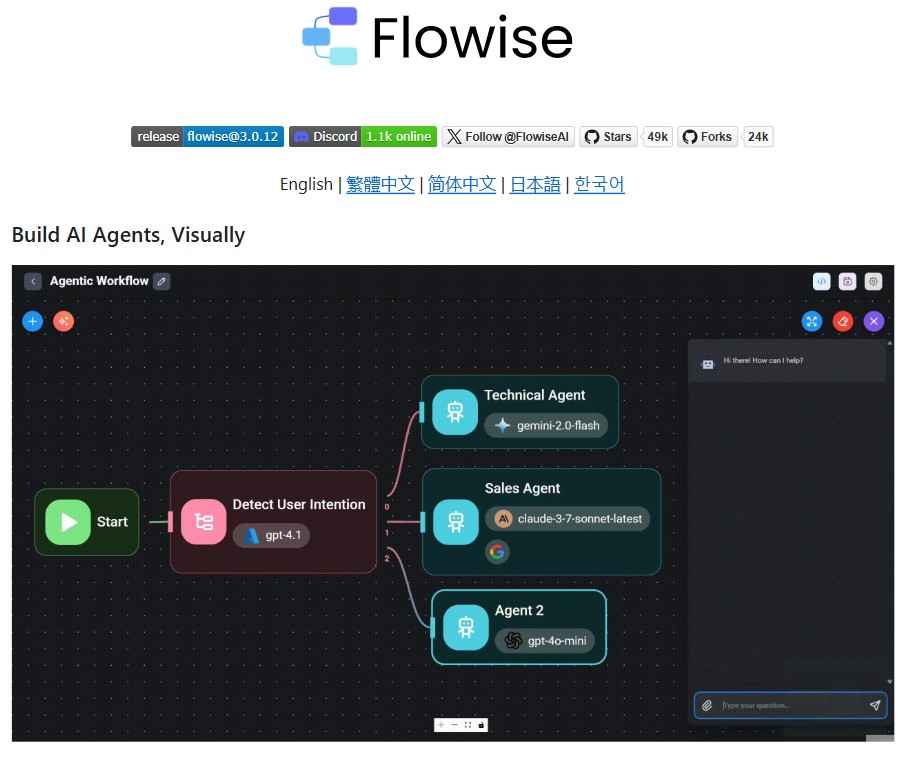
Flowise is one such tool that has rapidly gained popularity in the AI ecosystem. Designed as a low-code and no-code platform, Flowise allows users to build AI agents, chatbots, and retrieval-augmented generation (RAG) workflows visually using a drag-and-drop interface. Built on top of modern LLM tooling such as LangChain, Flowise abstracts away much of the complexity involved in orchestrating models, memory, tools, and data sources.
With over 48,000 GitHub stars and a thriving open-source community, Flowise has become one of the most widely adopted visual builders for agentic AI workflows.
What Is Flowise?
Flowise is an open-source visual workflow builder for creating AI-powered applications. It enables users to design complex LLM pipelines by connecting pre-built nodes representing models, prompts, memory, tools, vector databases, and APIs.
Rather than writing extensive code, users construct workflows visually, making Flowise accessible to:
- Developers who want to prototype faster
- AI engineers building agentic systems
- Startups experimenting with LLM products
- Non-technical users exploring AI automation
Flowise supports both self-hosted deployments and a managed cloud offering, giving teams flexibility in how they deploy and scale their applications.
Core Philosophy of Flowise
Flowise is built around three main principles:
- Visual-first development
AI workflows should be easy to understand, modify, and debug visually. - Low-code, not no-control
While Flowise reduces the need for code, it still allows deep customization for advanced users. - Agentic and modular design
Components are reusable, composable, and designed for modern AI agents.
This philosophy allows Flowise to serve both beginners and advanced practitioners.
How Flowise Works
At its core, Flowise provides a node-based editor where each node represents a functional component in an AI workflow. These components can include:
- LLMs (OpenAI, Anthropic, Mistral, etc.)
- Prompt templates
- Memory and chat history
- Tools and function calls
- Vector databases
- APIs and custom logic
Users connect these nodes to define how data flows through the system. Once deployed, Flowise exposes APIs that can be consumed by front-end applications, chat interfaces, or external services.
This approach makes it easy to iterate, experiment, and deploy AI workflows without rewriting code.
Key Features
1. Visual AI Agent Builder
Flowise’s drag-and-drop interface allows users to create AI agents visually. Each workflow can represent a chatbot, an autonomous agent, or a multi-step reasoning pipeline.
This visual representation improves clarity and reduces development time.
2. Built-in Support for LangChain Concepts
Flowise is deeply inspired by LangChain and supports its core concepts, including:
- Chains
- Agents
- Tools
- Memory
- Prompt templates
Users can leverage LangChain-style logic without manually writing Python or JavaScript code.
3. Retrieval-Augmented Generation (RAG)
Flowise makes it easy to build RAG pipelines by integrating with vector databases and embedding models. Common use cases include:
- Document question answering
- Knowledge base chatbots
- Internal enterprise assistants
Users can connect data sources, embeddings, and retrievers visually.
4. Self-Hosting and Cloud Deployment
Flowise supports multiple deployment options:
- Local development
- Docker and Docker Compose
- Cloud providers such as AWS, Azure, and GCP
- Flowise Cloud (managed service)
This flexibility makes it suitable for both hobby projects and enterprise systems.
5. API-First Architecture
Every Flowise workflow can be exposed as an API endpoint. This allows seamless integration with:
- Web applications
- Mobile apps
- Backend services
- Automation platforms
Flowise can function as a backend intelligence layer for modern applications.
6. Multi-Agent and Agentic Workflows
Recent versions of Flowise emphasize agentic AI, enabling workflows where agents can:
- Use tools
- Maintain memory
- Make decisions across multiple steps
- Collaborate with other agents
This positions Flowise as a strong platform for advanced AI automation.
Installation and Getting Started
Flowise requires Node.js 18.15.0 or higher.
Global Installation
npm install -g flowise

npx flowise start
Once started, Flowise runs on:
http://localhost:3000
Docker Installation
Flowise provides Docker support for easier deployment:
- Clone the repository
- Configure environment variables
- Run using Docker Compose
This approach is recommended for production environments.
Developer Architecture
Flowise is built as a monorepo with multiple modules:
- Server: Node.js backend for APIs and workflow execution
- UI: React-based front-end
- Components: Third-party node integrations
- API Documentation: Auto-generated Swagger UI
The project uses PNPM for dependency management and supports modern development workflows.
Use Cases
Flowise is commonly used for:
- AI chatbots and virtual assistants
- Knowledge base search and Q&A
- Customer support automation
- Internal tools for employees
- AI-powered workflow automation
- Rapid prototyping of LLM applications
Its flexibility makes it suitable for startups, enterprises, and individual developers alike.
Flowise vs Traditional Coding Approaches
Compared to building LLM workflows entirely in code, Flowise offers:
- Faster iteration
- Better visibility into logic
- Lower barrier to entry
- Easier collaboration between technical and non-technical teams
Rather than replacing code-based frameworks, Flowise complements them by accelerating development and experimentation.
Conclusion
Flowise has established itself as one of the most powerful visual platforms for building AI agents and LLM-powered workflows. By combining a low-code interface with deep support for agentic AI, retrieval-augmented generation, and modern deployment strategies, Flowise enables teams to move from idea to production faster than ever.
Its open-source foundation, strong community, and flexible architecture make it suitable for a wide range of use cases from simple chatbots to complex multi-agent systems. As AI workflows continue to grow in complexity, tools like Flowise will play a critical role in making advanced AI accessible, understandable, and scalable.
Follow us for cutting-edge updates in AI & explore the world of LLMs, deep learning, NLP and AI agents with us.
Related Reads
- Adala: An Autonomous Data Labeling Agent Framework for Intelligent AI Systems
- Breaking Language Barriers with AI: The Power of LFM2-ColBERT-350M in Multilingual Search
- AutoGen: Microsoft’s Framework for Building Powerful Multi-Agent AI Applications
- Gradio: The Easiest Way to Build and Share Machine Learning Web Apps
- AutoGPT: The Complete Guide to Building, Deploying and Running AI Agents
2 thoughts on “Flowise: A Visual Platform for Building AI Agents and LLM Workflows”