
Artificial Intelligence is rapidly evolving, and large language models (LLMs) are becoming an essential part of education, business, research, and daily digital interactions. While many advanced AI models require expensive hardware and cloud infrastructure, Google has introduced a powerful alternative called Gemma-3-1B-IT. This model is designed to be lightweight, open, and accessible while still delivering strong performance.
Gemma-3-1B-IT is part of Google DeepMind’s Gemma 3 family, which is built using the same research foundations as the Gemini models. Unlike closed or API-restricted systems, Gemma models are openly available, making them ideal for developers, students, startups, and researchers with limited resources.
This blog explains Gemma-3-1B-IT in detail, including its features, architecture, training process, use cases, benefits, limitations, and why it is an important step toward democratizing AI.
What Is Gemma-3-1B-IT?
Gemma-3-1B-IT is an instruction-tuned, open-weight language model developed by Google DeepMind. The model contains 1 billion parameters, making it compact and efficient compared to very large models.
The term “IT” (Instruction Tuned) means the model has been specifically trained to follow user instructions more accurately. Instead of only predicting text, it understands commands such as “summarize,” “explain,” “write,” or “analyze,” which makes it suitable for real-world applications like chatbots, assistants, and content tools.
Key Features
Lightweight and Resource Efficient
With only 1 billion parameters, Gemma-3-1B-IT can run on laptops, desktops, and small servers. This makes it accessible to users who cannot afford high-end GPUs or cloud computing resources.
Long Context Window
The model supports up to 32,000 tokens of input context. This allows it to understand long documents, research papers, conversations, or large code files in a single prompt.
Multimodal Capability
Gemma 3 models are multimodal, meaning they can process both text and image inputs and generate text outputs. This enables tasks such as image description, document understanding, and visual question answering.
Multilingual Support
Gemma-3-1B-IT supports more than 140 languages, making it useful for global applications, multilingual education, and regional content creation, including Indic languages.
Open and Responsible AI
The model is released with open weights under Google’s Gemma license, along with detailed documentation, safety evaluations, and responsible AI guidelines.
Architecture and Training Overview
Gemma-3-1B-IT is based on a transformer architecture, which is the standard backbone for modern language models. It was trained using JAX and ML Pathways, Google’s advanced machine learning frameworks, and optimized for TPU hardware.
Training Data
The model was trained on approximately 2 trillion tokens, sourced from:
- Web documents
- Programming code
- Mathematical content
- Multilingual text
- Image-text data
This diverse dataset enables the model to perform well across reasoning, language understanding, coding assistance, and general knowledge tasks.
Data Safety and Filtering
Google applied multiple layers of filtering during training:
- CSAM (Child Sexual Abuse Material) filtering
- Removal of sensitive and personal information
- Content quality and safety checks
These measures ensure the model aligns with ethical AI standards.
Performance and Benchmarks
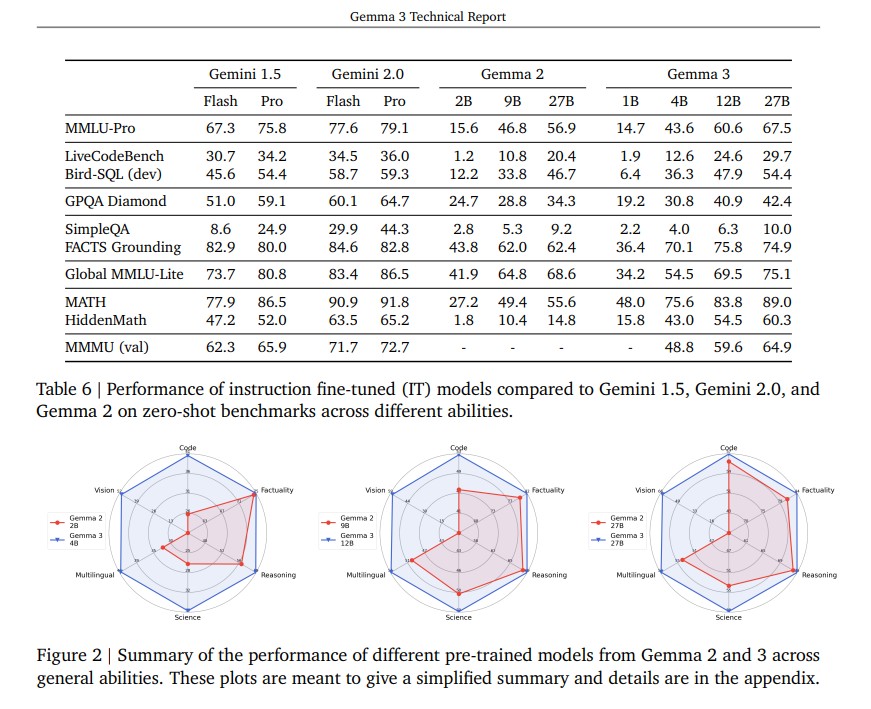
Gemma-3-1B-IT has been evaluated across a wide range of benchmarks covering reasoning, language understanding, multilingual tasks, coding, and multimodal performance.
Despite its small size, it shows strong results in:
- Question answering
- Reading comprehension
- Logical reasoning
- Code understanding
- Image-based text extraction
While larger Gemma models (4B, 12B, 27B) naturally perform better, the 1B version offers an excellent balance between performance and efficiency.
Practical Use Cases
Education and Learning
Students can use Gemma-3-1B-IT for:
- Explaining complex topics
- Summarizing notes
- Language learning and grammar correction
- Homework assistance
Chatbots and Virtual Assistants
Its instruction-tuned nature makes it ideal for:
- Customer support bots
- Website assistants
- Internal company tools
Content Creation
The model can generate:
- Blog drafts
- Emails
- Marketing copy
- Poems and stories
Research and Development
Researchers and developers can use Gemma-3-1B-IT for:
- NLP experiments
- Multilingual research
- Prototyping AI applications
- On-device AI solutions
Limitations of Gemma-3-1B-IT
While powerful, the model has some limitations:
- It may generate incorrect or outdated information
- It can struggle with sarcasm, humor, or deep common-sense reasoning
- Performance is lower than very large models in complex tasks
- Clear and well-structured prompts are required for best results
Understanding these limitations helps users deploy the model responsibly.
Benefits of Using Gemma-3-1B-IT
- Open and transparent AI model
- Low hardware requirements
- Strong multilingual and multimodal support
- Long context handling
- Suitable for on-device and edge deployment
- Backed by Google DeepMind research
Conclusion
Gemma-3-1B-IT represents a significant step toward accessible and responsible artificial intelligence. By combining strong performance, multilingual support, multimodal capabilities, and lightweight design, Google has created a model that can be used by a wide range of users, from students to startups and researchers.
While it may not replace massive enterprise-scale models, Gemma-3-1B-IT excels where efficiency, openness, and practicality matter most. It is a powerful example of how modern AI can be democratized without compromising safety or quality.
As open AI ecosystems continue to grow, Gemma-3-1B-IT stands out as a reliable, ethical and future-ready language model.
Follow us for cutting-edge updates in AI & explore the world of LLMs, deep learning, NLP and AI agents with us.
Related Reads
- LobeChat: A Modern Open-Source AI Agent Workspace for the Super Individual
- MetaGPT: The Multi-Agent Framework Redefining AI-Driven Software Development
- Open Interpreter: Bringing Natural Language Control to Your Local Computer
- GPT-Engineer: A Powerful Foundational Tool in AI-Driven Software Development
- LlamaIndex: The Leading Data Framework for Building LLM Applications
1 thought on “Gemma-3-1B-IT: A Complete Guide to Google’s Lightweight Open AI Model”