
The rapid evolution of large language models has shifted expectations from simple text generation to full-fledged agentic intelligence systems that can reason, plan, use tools, and execute complex workflows. In this landscape, GLM-4.7, developed by Z.ai (zai-org), emerges as a major milestone. Released as part of the GLM (General Language Model) family, GLM-4.7 is designed not just as a conversational AI, but as a powerful coding partner and autonomous agent foundation model.
With significant improvements over its predecessor GLM-4.6, GLM-4.7 demonstrates strong gains across coding benchmarks, multilingual tasks, terminal-based environments, tool usage, and complex mathematical reasoning. Backed by a massive 358 billion parameter Mixture-of-Experts (MoE) architecture and trained for long-context, multi-turn stability, GLM-4.7 positions itself as a serious competitor to leading proprietary and open models in both research and production environments.
This blog explores GLM-4.7’s capabilities, benchmark performance, architecture innovations, deployment options, and real-world use cases, offering a complete SEO-focused overview from introduction to conclusion.
What Is GLM-4.7?
GLM-4.7 is a next-generation text generation and coding model built on the GLM-4.x ARC (Agentic, Reasoning, and Coding) foundation. It supports both English and Chinese, with strong multilingual generalization, and is optimized for conversational AI, agentic coding, and tool-augmented reasoning.
Key highlights include:
- Massive 358B parameter MoE model
- MIT open-source license
- Native support for thinking before acting
- Strong performance in coding agents, terminal tasks, and tool usage
- Designed for integration with modern agent frameworks
GLM-4.7 is available on Hugging Face as zai-org/GLM-4.7 and supports inference via Transformers, vLLM, and SGLang.
Core Coding and Agentic Improvements
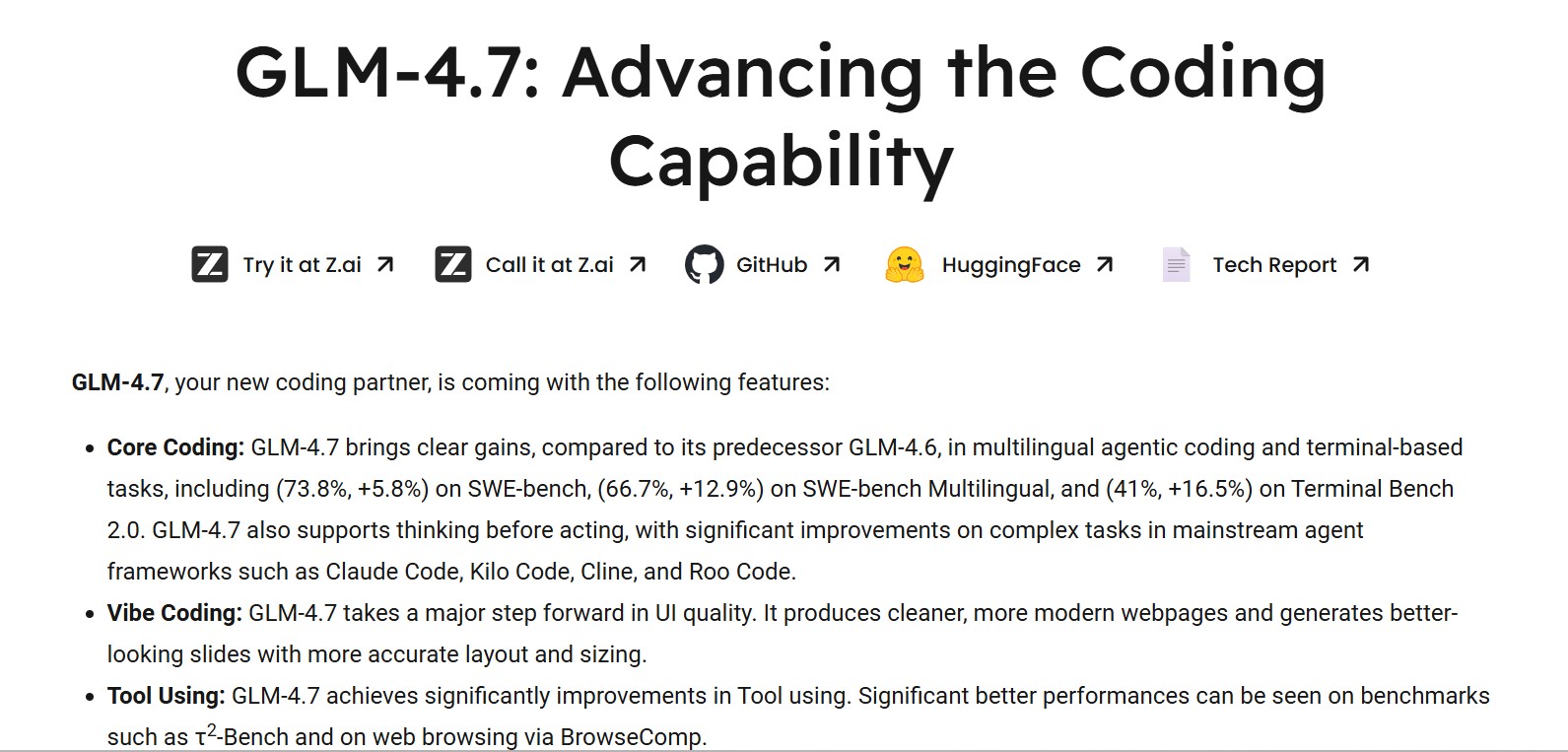
One of the most important upgrades in GLM-4.7 is its performance in agentic coding scenarios, where models must reason across multiple steps, interact with tools, and modify codebases iteratively.
Compared to GLM-4.6, GLM-4.7 achieves:
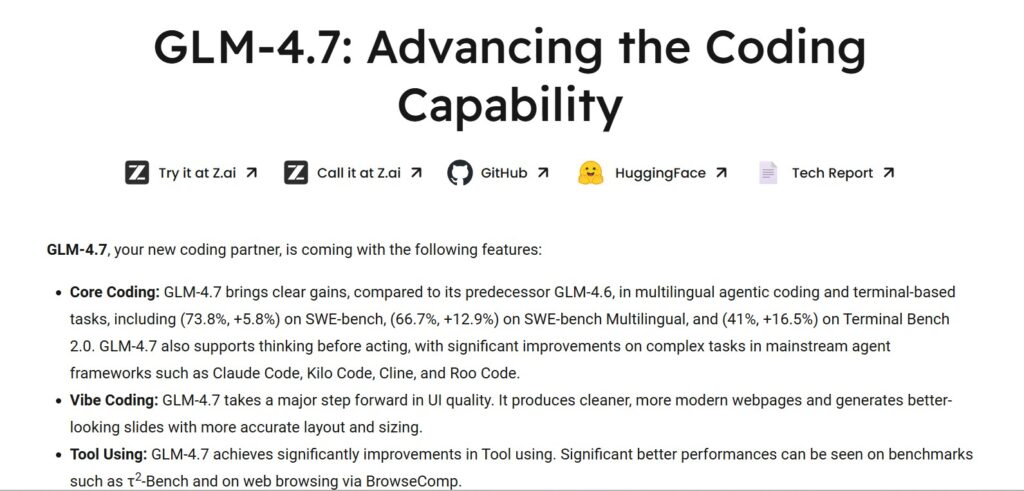
- 73.8% on SWE-bench Verified (+5.8%)
- 66.7% on SWE-bench Multilingual (+12.9%)
- 41% on Terminal Bench 2.0 (+16.5%)
These gains reflect a stronger understanding of real-world software engineering workflows, including debugging, refactoring, shell interaction, and multilingual code reasoning. GLM-4.7 also integrates smoothly with popular agent frameworks such as Claude Code, Kilo Code, Cline and Roo Code, making it suitable for autonomous coding agents.
Vibe Coding and UI Generation
Beyond backend engineering, GLM-4.7 introduces major improvements in UI and frontend generation, often referred to as “vibe coding.” The model produces:
- Cleaner and more modern HTML/CSS layouts
- Better spacing, sizing, and visual hierarchy
- Higher-quality slide generation with improved layout accuracy
This makes GLM-4.7 particularly useful for developers and designers who want AI assistance in building user interfaces, dashboards, landing pages and presentation assets.
Advanced Tool Usage and Web Interaction
Tool usage is a defining feature of modern agentic AI, and GLM-4.7 shows significant progress in this area. The model performs strongly on benchmarks such as:
- τ²-Bench (87.4%)
- BrowseComp and BrowseComp-Zh
- Web browsing and tool-driven reasoning tasks
GLM-4.7 supports OpenAI-style tool calling formats, making it compatible with existing agent pipelines. When deployed with vLLM or SGLang, tool calling and reasoning parsers are enabled by default, allowing the model to seamlessly combine natural language reasoning with structured actions.
Complex Reasoning and Mathematics
GLM-4.7 delivers a substantial boost in reasoning-heavy benchmarks, demonstrating its strength beyond coding:
- HLE (Humanity’s Last Exam): 42.8% with tools (+12.4%)
- AIME 2025: 95.7%
- HMMT Feb 2025: 97.1%
- Strong results on GPQA, MMLU-Pro, and IMO-style benchmarks
These results highlight GLM-4.7’s ability to handle advanced mathematics, logic and multi-step problem solving, especially when tool usage and preserved reasoning are enabled.
Interleaved, Preserved and Turn-Level Thinking
GLM-4.7 introduces a sophisticated thinking system that improves stability and controllability in long-horizon tasks:
- Interleaved Thinking: The model reasons before each response or tool call.
- Preserved Thinking: In agentic coding tasks, reasoning blocks are retained across turns, reducing inconsistency and information loss.
- Turn-Level Thinking: Developers can enable or disable reasoning per turn to balance accuracy, latency, and cost.
This makes GLM-4.7 especially effective for complex, multi-step workflows such as software development, research agents, and enterprise automation.
Deployment and Inference Options
GLM-4.7 is designed for flexible deployment across research and production environments.
Transformers
- Requires Transformers version 4.57.3+
- Supports BF16 precision
- Ideal for experimentation and research
vLLM
- Optimized for high-throughput, OpenAI-compatible serving
- Supports speculative decoding and tool parsing
- Recommended for production-scale inference
SGLang
- Advanced support for preserved thinking and agent workflows
- Fine-grained control over memory and speculative algorithms
Both vLLM and SGLang support FP8 quantized variants for more efficient serving on modern hardware.
Model Specifications
- Model Size: 358B parameters (MoE)
- Tensor Types: BF16, F32
- Context Length: Up to 131K tokens
- License: MIT
- Use Cases: Coding agents, reasoning systems, tool-using AI, chat, creative writing
Conclusion
GLM-4.7 represents a significant step forward in the evolution of open, agentic large language models. By combining massive scale, strong coding performance, advanced reasoning, and robust tool usage, it bridges the gap between conversational AI and autonomous software engineering systems. Its innovations in preserved and interleaved thinking make it particularly well-suited for long-horizon, multi-turn tasks that demand consistency and control.
Whether used as a coding partner, a reasoning engine, or the backbone of an autonomous agent, GLM-4.7 demonstrates that open models can compete at the highest level. As agentic AI continues to shape the future of software development and knowledge work, GLM-4.7 stands out as a powerful and flexible foundation for the next generation of intelligent systems.
Follow us for cutting-edge updates in AI & explore the world of LLMs, deep learning, NLP and AI agents with us.
Related Reads
- Llama-3.2-1B-Instruct: A Compact, Multilingual and Efficient Open Language Model
- DistilGPT2: A Lightweight and Efficient Text Generation Model
- Ollama: The Complete Guide to Running Large Language Models Locally
- Gemma-3-1B-IT: A Complete Guide to Google’s Lightweight Open AI Model
- LobeChat: A Modern Open-Source AI Agent Workspace for the Super Individual
2 thoughts on “GLM-4.7: A New Benchmark in Agentic Coding, Reasoning and Tool-Driven AI”