
Artificial intelligence is rapidly transforming the way software is designed, written, and maintained. What once required hours of manual coding and architectural planning can now begin with a simple natural language prompt. Among the earliest tools to explore this idea in depth is GPT-Engineer, an open-source project that helped define the concept of autonomous AI coding agents.
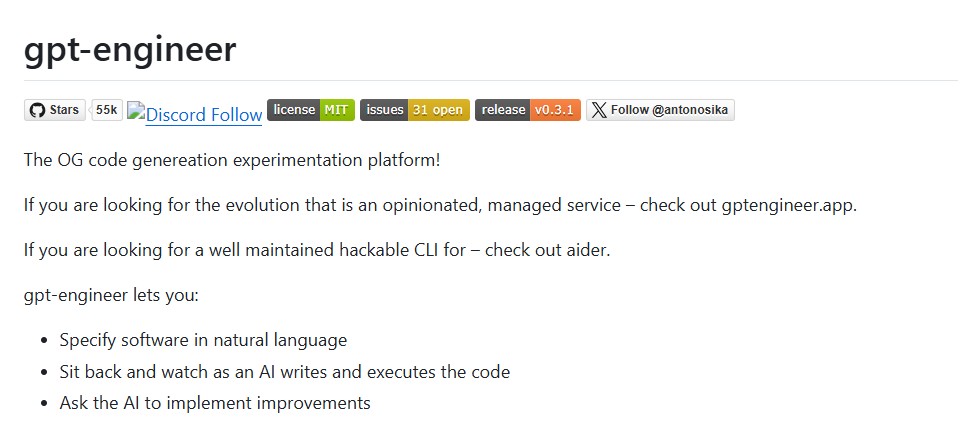
Developed by Anton Osika, GPT-Engineer introduced a workflow where developers describe software requirements in plain language and allow an AI system to generate an entire codebase. At a time when most AI coding tools focused on autocomplete or small snippets, GPT-Engineer explored a more ambitious goal: end-to-end software generation.
Today, GPT-Engineer remains a widely referenced project in the AI developer ecosystem, with tens of thousands of GitHub stars and an active community. It continues to influence how modern AI coding agents are designed and evaluated.
Understanding GPT-Engineer
It is a command-line based AI code generation tool that converts written requirements into functioning software projects. Instead of manually creating files, folders, and boilerplate logic, developers provide instructions through a prompt file, and the tool handles the rest.
The philosophy behind GPT-Engineer is centered on experimentation and transparency. Unlike closed or hosted platforms, it runs locally and exposes its reasoning process, allowing developers to understand how AI agents interpret instructions and structure software systems.
This makes GPT-Engineer particularly appealing to engineers, researchers, and AI practitioners who want fine-grained control over the development process.
How GPT-Engineer Generates Code
The workflow of GPT-Engineer is intentionally minimal and efficient:
- A developer creates a new project directory.
- Inside that directory, a file named prompt is added.
- The prompt contains a natural language description of the software to be built.
- The gpte command is executed with the project path.
- The AI plans the architecture and generates a complete codebase.
Developers can then review the output, run the code, and issue follow-up instructions to refine or expand the project. This iterative approach closely mirrors real-world software development cycles.
Core Features
Natural Language-First Development
GPT-Engineer allows developers to define applications using everyday language, reducing the cognitive load associated with initial project setup.
Fully Local Execution
Because it runs locally, developers retain full ownership of their code, files, and data, without relying on cloud-hosted execution environments.
Iterative Refinement
Projects can be improved incrementally by re-running GPT-Engineer with updated instructions, making it suitable for long-term experimentation.
Customizable Agent Behavior
By editing pre-prompt files, developers can control how the AI reasons, remembers context, and structures its output.
Broad Model Compatibility
GPT-Engineer supports OpenAI, Azure OpenAI, Anthropic models, and configurable open-source alternatives.
Installation and Environment Setup
GPT-Engineer is actively maintained and supports modern Python versions.
Standard Installation
python -m pip install gpt-engineer
Development Setup
git clone https://github.com/gpt-engineer-org/gpt-engineer.git

cd gpt-engineer

poetry install

poetry shell
The tool officially supports Python versions 3.10 through 3.12. Users must configure an API key to connect to their preferred language model provider.
Building New Applications with GPT-Engineer
Creating a new project is straightforward:
- Create an empty folder for the project.
- Add a file named prompt inside it.
- Write clear and structured requirements.
- Run:
gpte <project_directory>
GPT-Engineer will generate the full project structure, including source files, logic, and documentation where applicable. This makes it ideal for rapid prototyping and proof-of-concept development.
Enhancing Existing Codebases
GPT-Engineer is not limited to new projects. It can also be applied to existing codebases to:
- Add new features
- Improve code quality
- Refactor architecture
- Fix bugs or inefficiencies
Using the improvement mode, developers can guide the AI to modify existing files rather than generating a new project from scratch.
Benchmarking and AI Research Use Cases
One of GPT-Engineer’s most important contributions is its role in AI research. The included bench tool allows developers to benchmark custom agents against standard datasets such as APPS and MBPP.
This functionality makes GPT-Engineer valuable not only for application development but also for evaluating AI reasoning, planning, and coding accuracy in controlled experiments.
Vision and Multimodal Support
GPT-Engineer supports vision-enabled models, allowing developers to include images such as wireframes, system diagrams, or UI mockups as part of the prompt context.
This feature bridges the gap between design and implementation, enabling AI agents to interpret visual concepts alongside textual instructions.
GPT-Engineer Compared to Commercial Tools
While commercial platforms provide polished interfaces and managed workflows, GPT-Engineer prioritizes flexibility and transparency. It is best suited for:
- Developers exploring AI coding agents
- Researchers testing agent architectures
- Engineers who prefer local tooling
- Open-source contributors and educators
Rather than replacing commercial platforms, GPT-Engineer serves as a foundational tool for understanding how AI-driven software generation works at a deeper level.
Conclusion
It stands as a landmark project in the evolution of AI-assisted software development. By introducing a natural language-first approach to full project generation, it reshaped expectations around what AI coding agents could achieve.
Its emphasis on local execution, open-source collaboration and experimentation makes it a valuable resource for developers and researchers alike. Even as newer tools and frameworks emerge, GPT-Engineer remains a critical reference point for anyone studying or building autonomous AI coding systems.
For developers seeking to understand the roots and mechanics of AI-driven software creation, GPT-Engineer continues to offer lasting value.
Follow us for cutting-edge updates in AI & explore the world of LLMs, deep learning, NLP and AI agents with us.
Related Reads
- LlamaIndex: The Leading Data Framework for Building LLM Applications
- Qwen3-VL-Embedding and Qwen3-VL-Reranker: A New Standard for Multimodal Retrieval
- Flowise: A Visual Platform for Building AI Agents and LLM Workflows
- Adala: An Autonomous Data Labeling Agent Framework for Intelligent AI Systems
- Breaking Language Barriers with AI: The Power of LFM2-ColBERT-350M in Multilingual Search
2 thoughts on “GPT-Engineer: A Powerful Foundational Tool in AI-Driven Software Development”