
As artificial intelligence systems grow more powerful, building applications around large language models (LLMs) has become both an opportunity and a challenge. Developers today are not just prompting models; they are creating complex AI-powered systems that interact with real-time data, external tools, memory, vector databases, and even other agents. This growing complexity demands a robust framework and this is exactly where LangChain excels.
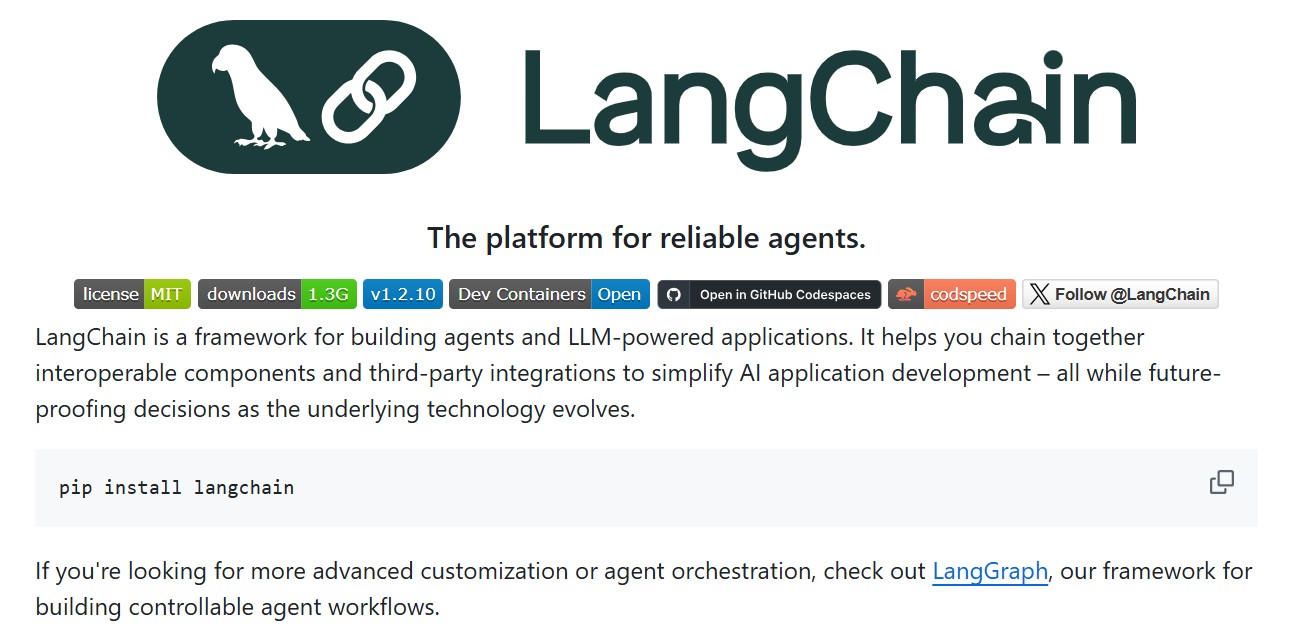
LangChain is one of the most widely adopted open-source frameworks for developing LLM-powered applications and AI agents. With over 125,000 GitHub stars and adoption by hundreds of thousands of developers worldwide, LangChain has become a foundational layer in modern AI application development. From rapid prototyping to production-grade systems, LangChain provides the abstractions, integrations, and tooling required to build reliable and scalable AI solutions.
What Is LangChain?
LangChain is an open-source Python framework designed to help developers build applications powered by large language models. Instead of interacting with LLMs through raw prompts alone, LangChain allows developers to chain together modular components such as models, prompts, tools, retrievers, memories, and agents.
At its core, LangChain provides:
- A standard interface for LLMs and embeddings
- Tools for connecting models to external data sources
- Agent frameworks for reasoning and decision-making
- Production-ready observability and evaluation integrations
LangChain is maintained by the langchain-ai organization and continues to evolve rapidly to match the fast-moving AI ecosystem.
Why LangChain Is Important in Modern AI Development
1. Abstraction Without Lock-In
One of LangChain’s biggest advantages is model interoperability. Developers can switch between OpenAI, Anthropic, Gemini, local models, or Ollama-backed models without rewriting core logic. This flexibility future-proofs applications as new models emerge.
2. Real-Time Data Augmentation
LangChain enables LLMs to access live data, APIs, databases, files, and vector stores. This is critical for building Retrieval-Augmented Generation (RAG) systems that deliver accurate, up-to-date answers instead of hallucinations.
3. Agent-Based Architecture
LangChain allows developers to build agents that can reason, plan, and take actions using tools. This moves beyond simple chatbots into autonomous or semi-autonomous AI systems.
4. Production Readiness
With integrations like LangSmith, LangChain supports debugging, monitoring, evaluation, and performance optimization features essential for enterprise deployments.
Core Components of LangChain
Models and Embeddings
LangChain provides a unified interface for:
- Chat models
- Completion models
- Embedding models
This standardization makes experimentation and scaling significantly easier.
Prompts and Prompt Templates
Developers can create reusable, parameterized prompts that are easy to manage, version, and optimize across applications.
Chains
Chains allow multiple steps to be connected together, such as:
- Prompt → LLM → Parser
- Retrieval → Context Injection → LLM
This modular approach simplifies complex workflows.
Memory
LangChain supports different memory strategies, enabling applications to remember:
- Previous conversation turns
- Summaries of interactions
- Long-term contextual information
This is essential for conversational agents and assistants.
Tools and Toolkits
Tools allow agents to interact with:
- APIs
- Databases
- File systems
- Search engines
- Calculators and code interpreters
This transforms LLMs from passive responders into active problem-solvers.
Agents
Agents are one of LangChain’s most powerful features. They allow models to:
- Decide what actions to take
- Choose which tools to use
- Iterate until a task is completed
This makes Lang Chain ideal for multi-step reasoning tasks.
LangChain Ecosystem
LangChain is not just a library—it is an ecosystem.
LangGraph
LangGraph is a low-level framework built for controllable agent workflows. It supports:
- Stateful agents
- Human-in-the-loop processes
- Long-running tasks
It is trusted in production by companies like LinkedIn, Uber, Klarna, and GitLab.
LangSmith
LangSmith is LangChain’s observability and evaluation platform. It enables developers to:
- Trace agent behavior
- Debug failures
- Compare prompt versions
- Evaluate model performance
This is especially valuable in production environments.
Deep Agents
Deep Agents extend LangChain’s agent capabilities by allowing:
- Planning with sub-agents
- File system interaction
- Advanced reasoning strategies
They are designed for complex, enterprise-level AI systems.
Use Cases of LangChain
LangChain is used across a wide range of industries and applications, including:
- Retrieval-Augmented Generation (RAG) chatbots
- AI-powered customer support systems
- Knowledge base and document Q&A tools
- Coding assistants and developer copilots
- Multi-agent research assistants
- Workflow automation and orchestration
- Enterprise internal AI tools
Its flexibility makes it suitable for both startups and large organizations.
LangChain vs Traditional LLM Integration
Traditional LLM integration often involves:
- Hardcoded prompts
- Tight coupling to a single model provider
- Limited observability
- Minimal reasoning capability
LangChain, by contrast, offers:
- Modular design
- Model-agnostic architecture
- Tool usage and agent reasoning
- Production-grade monitoring
This makes LangChain far more suitable for real-world AI systems.
Future of LangChain
LangChain continues to evolve alongside advancements in:
- Multi-agent systems
- Long-context models
- Local and hybrid AI deployment
- Enterprise AI governance
- Evaluation and safety tooling
As AI systems grow more autonomous and complex, frameworks like LangChain will play a critical role in making them reliable, observable, and controllable.
Conclusion
LangChain has established itself as a cornerstone framework for building LLM-powered applications and AI agents. By offering flexible abstractions, deep integrations, and production-ready tooling, it empowers developers to move beyond simple prompts and create intelligent, scalable AI systems.
Whether you are building a RAG chatbot, an enterprise-grade AI agent, or experimenting with multi-agent workflows, LangChain provides the structure and reliability required in modern AI development. As the AI ecosystem continues to mature, LangChain is well-positioned to remain a foundational platform for reliable agent-based applications.
Follow us for cutting-edge updates in AI & explore the world of LLMs, deep learning, NLP and AI agents with us.
Related Reads
- Dolphin 2.9.1 Yi 1.5 34B : A Complete Technical and Practical Overview
- GLM-4.7: A New Benchmark in Agentic Coding, Reasoning and Tool-Driven AI
- Llama-3.2-1B-Instruct: A Compact, Multilingual and Efficient Open Language Model
- DistilGPT2: A Lightweight and Efficient Text Generation Model
- Ollama: The Complete Guide to Running Large Language Models Locally
4 thoughts on “LangChain: The Ultimate Framework for Building Reliable LLM and AI Agent Applications”