
As artificial intelligence continues to reshape industries, one major challenge remains building reliable, stateful and long-running AI agents that can handle complex workflows over time. Traditional AI frameworks often focus on short interactions, lacking the infrastructure to manage persistent states, durable memory or human feedback loops.
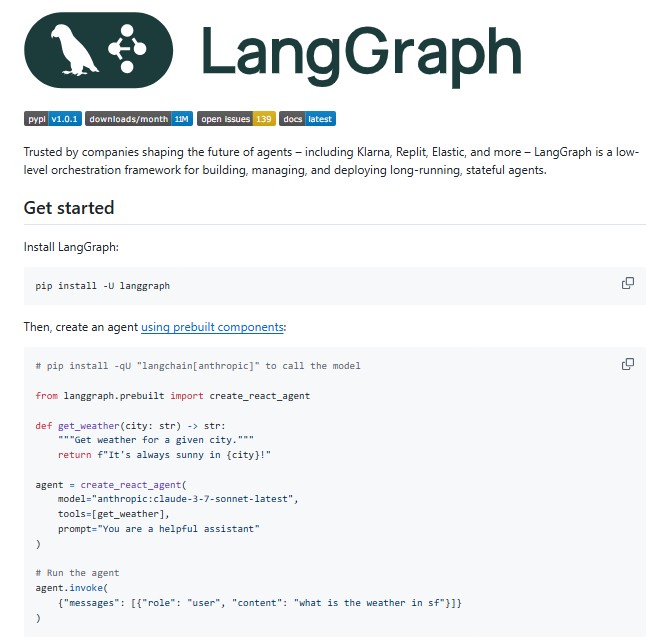
That’s where LangGraph from LangChain-AI steps in. Trusted by top innovators like Klarna, Replit and Elastic, LangGraph is a low-level orchestration framework built specifically for stateful agent development. It empowers developers to create robust, production-ready AI systems capable of reasoning, remembering and evolving without losing context or reliability.
What Is LangGraph?
It is an open-source framework designed to build, manage and deploy long-running AI agents as dynamic computational graphs.
Unlike typical language model (LLM) tools that focus on prompt chaining, it focuses on durable execution, persistent state management and fault-tolerant workflows. This makes it a go-to solution for developers aiming to build advanced, memory-rich AI systems that can resume operations after interruptions and maintain complex multi-step reasoning over time.
LangGraph can be installed directly via pip:
pip install -U langgraph
You can immediately create an AI agent using prebuilt components:
from langgraph.prebuilt import create_react_agent

def get_weather(city: str) -> str:
    return f"It's always sunny in {city}!"

agent = create_react_agent(
    model="anthropic:claude-3-7-sonnet-latest",
    tools=[get_weather],
    prompt="You are a helpful assistant"
)

agent.invoke(
    {"messages": [{"role": "user", "content": "what is the weather in sf"}]}
)
With just a few lines of code, developers can spin up an intelligent, state-aware AI agent capable of reasoning through tasks and persisting its execution context.
Core Benefits of LangGraph
It isn’t just another orchestration library, it provides a solid, production-ready foundation for agentic AI systems. Here are its standout features:
1. Durable Execution
It enables persistent workflows that continue seamlessly even after failures, interruptions or restarts. This “checkpoint-and-resume” ability ensures that agents can run for hours, days or even weeks without losing their state.
This durability makes LangGraph ideal for:
- Long-term research assistants
- AI customer service bots
- Multi-stage data analysis pipelines
- Continuous autonomous agents
2. Human-in-the-Loop Control
In complex systems, human oversight remains crucial. It supports human-in-the-loop (HITL) functionality, allowing humans to inspect, pause or modify the agent’s state during execution.
Developers can easily monitor decision paths, review intermediate steps and fine-tune responses before the agent proceeds ensuring safety, accuracy and accountability in production environments.
3. Comprehensive Memory System
It offers both:
- Short-term working memory for active reasoning, and
- Long-term persistent memory across sessions.
This means agents don’t just process one query at a time, they remember past interactions, recall facts and adapt over time.
The framework’s built-in memory system transforms traditional prompt-response agents into context-aware AI companions capable of learning from experience.
4. Deep Observability with LangSmith
It integrates seamlessly with LangSmith, LangChain-AI’s observability suite for AI applications.
LangSmith provides:
- Execution tracing
- State transition visualization
- Detailed runtime metrics
Together, LangGraph + LangSmith give developers complete transparency into how an AI agent thinks, evolves and makes decisions essential for debugging, optimization, and compliance.
5. Production-Ready Deployment
It is engineered for real-world reliability. With its scalable backend, developers can confidently deploy agents to production environments that demand continuous uptime, monitoring and resilience.
It supports:
- Parallelized workflows
- Persistent storage
- Multi-agent coordination
- Integration with external APIs
This makes LangGraph an ideal backbone for enterprise-grade AI solutions.
LangGraph Ecosystem
It fits perfectly within the broader LangChain-AI ecosystem, creating a complete development pipeline for intelligent agents:
LangChain
Provides composable LLM tools and integrations, helping developers connect models, tools and APIs.
LangSmith
Adds observability, evaluation and debugging capabilities for LLM apps built with LangGraph.
LangSmith Deployment
A full deployment platform for stateful agents, supporting visual prototyping, sharing and scaling within organizations.
Together, these tools form an end-to-end ecosystem for designing, testing and deploying reliable, stateful AI systems.
Developer Resources
It’s repository is packed with valuable resources for both beginners and advanced users:
- Quickstart Guides: Fast examples to build agents, add persistence or stream outputs.
- Reference Docs: API-level documentation for classes, checkpointing and prebuilt components.
- Examples: Real-world tutorials covering ReAct agents, memory integration and branching workflows.
- Templates: Ready-to-clone app blueprints for ReAct agents, retrieval systems and chatbots.
- Case Studies: Insights from enterprises using LangGraph to deploy scalable AI solutions.
- LangChain Forum: Community discussions for troubleshooting and best practices.
- LangChain Academy: Free educational course for learning LangGraph fundamentals.
These resources make LangGraph not only powerful but also developer-friendly and educational.
Who Is LangGraph For?
It is designed for:
- AI Engineers building multi-step reasoning systems
- Data Scientists automating analysis workflows
- Developers integrating LLMs into business applications
- Researchers experimenting with long-term agentic behavior
Whether you’re building a customer support agent, a code-review assistant or a scientific research AI, LangGraph provides the state management, reliability and modularity needed to scale.
Why LangGraph Matters ?
As AI agents evolve beyond simple Q&A systems, the need for persistent, trustworthy and interpretable workflows grows exponentially. It addresses this by introducing a graph-based architecture that mirrors real reasoning nodes represent actions and edges represent transitions between thought states.
By structuring agent logic as a graph, developers gain unparalleled flexibility enabling branching workflows, conditional reasoning, and dynamic task allocation.
This model not only improves performance but also enhances transparency and debuggability making AI systems easier to trust and manage.
Conclusion
LangGraph by LangChain-AI represents the next evolution of agentic AI development – a framework that turns traditional stateless LLM applications into resilient, stateful and intelligent agents.
With features like durable execution, human oversight, persistent memory and deep observability, it sets a new standard for how we design and deploy AI in production.
If you’re ready to move beyond basic chatbots and build sophisticated, long-running agents capable of real reasoning and persistence, LangGraph is the foundation you need.
Follow us for cutting-edge updates in AI & explore the world of LLMs, deep learning, NLP and AI agents with us.
Related Reads
- OpenSearch for AI Agents: Empowering Intelligent Search and Automation
- AgentFly: The Future of Reinforcement Learning for Intelligent Language Model Agents
- Unlocking Creativity with Awesome ChatGPT Prompts: The Ultimate Guide for AI Enthusiasts
- LandingAI ADE Python SDK: Streamlining AI-Powered Document Understanding
- The Ultimate #1 Collection of AI Books In Awesome-AI-Books Repository
5 thoughts on “LangGraph by LangChain-AI: The Framework Powering Stateful, Long-Running AI Agents”