
As large language models (LLMs) become more powerful, the challenge for developers is no longer model capability but how to connect these models to real-world data. While LLMs excel at reasoning and language generation, they are trained on static public datasets and lack direct access to private, proprietary, or constantly changing information.
This is where LlamaIndex comes in.
Formerly known as GPT Index, LlamaIndex is an open-source data framework designed to bridge the gap between large language models and external data sources. It provides developers with the tools needed to ingest, structure, index, and retrieve data in ways that LLMs can understand and reason over.
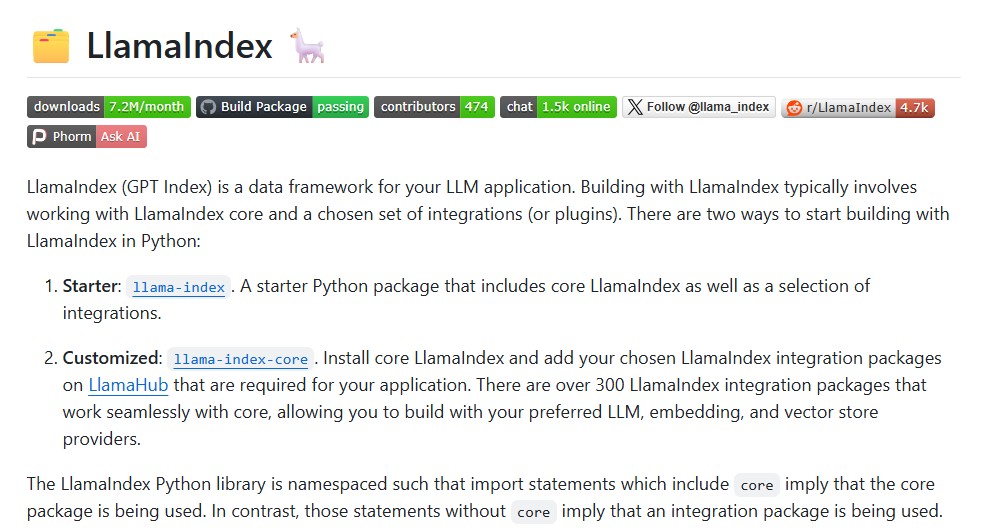
With over 46,000 GitHub stars, thousands of production deployments, and a rapidly growing ecosystem, LlamaIndex has become one of the most trusted frameworks for building retrieval-augmented generation (RAG) systems, AI agents, and knowledge-driven LLM applications.
What Is LlamaIndex?
It is a data framework for LLM-powered applications. Its core purpose is to help developers connect large language models to their own data sources such as documents, databases, APIs and files while maintaining structure, performance and accuracy.
Rather than being a standalone chatbot or model provider, LlamaIndex acts as an orchestration layer between data and LLMs. It enables applications to retrieve relevant context from external sources and feed it into an LLM prompt in a structured, reliable way.
LlamaIndex is commonly used for:
- Retrieval-augmented generation (RAG)
- Knowledge assistants and internal chatbots
- AI agents with memory and tools
- Document question-answering systems
- Search and analytics over unstructured data
Core Design Philosophy
LlamaIndex is built around three guiding principles:
- Data-first architecture
It prioritizes data ingestion, transformation, and indexing before LLM interaction. - Modularity and extensibility
Developers can use high-level APIs for rapid prototyping or low-level components for full customization. - LLM-agnostic design
It works with OpenAI, Anthropic, Hugging Face, Replicate, Azure OpenAI, and other providers.
This philosophy makes Llama Index suitable for both beginners and advanced AI engineers.
How LlamaIndex Works
At a high level, LlamaIndex follows a structured pipeline:
- Data Ingestion
Data is loaded from various sources such as PDFs, text files, SQL databases, APIs, or cloud storage. - Data Structuring
The ingested data is transformed into nodes, chunks, or graphs that LLMs can efficiently process. - Indexing
Data is stored in indices such as vector indexes, keyword indexes, or graph-based structures. - Retrieval and Querying
When a user submits a query, LlamaIndex retrieves the most relevant data and augments the LLM prompt with that context. - Response Generation
The LLM generates an informed response based on both the query and retrieved data.
This architecture allows applications to scale while maintaining accuracy and relevance.
Key Features
1. Extensive Data Connectors
It supports a wide range of data sources, including:
- PDFs, Word files, and Markdown
- SQL and NoSQL databases
- APIs and web content
- Cloud storage services
- Custom enterprise data sources
These connectors significantly reduce the effort required to integrate real-world data.
2. Flexible Indexing Options
Developers can choose from multiple indexing strategies:
- Vector store indexes
- Keyword-based indexes
- Tree and graph indexes
- Hybrid retrieval pipelines
This flexibility allows LlamaIndex to adapt to different data types and application needs.
3. Advanced Retrieval and Query Engines
It provides powerful retrieval mechanisms, including:
- Semantic search
- Hybrid search
- Reranking and post-processing
- Multi-step query reasoning
These features are essential for building production-grade RAG systems.
4. Integration-Friendly Architecture
It integrates easily with:
- LangChain
- Flask and FastAPI
- Docker and Kubernetes
- Chat interfaces and enterprise platforms
This makes it suitable for both research prototypes and large-scale deployments.
5. Support for AI Agents
Beyond retrieval, LlamaIndex enables developers to build LLM-powered agents with:
- Memory
- Tool usage
- Multi-step reasoning
- Autonomous task execution
This positions LlamaIndex as a foundation for next-generation AI systems.
Installation and Package Structure
LlamaIndex offers two main installation approaches:
Starter Installation
pip install llama-index
This installs core functionality along with a curated set of integrations.
Custom Installation
pip install llama-index-core
Developers can then selectively install integrations such as:
pip install llama-index-llms-openai

pip install llama-index-embeddings-huggingface
This modular approach keeps projects lightweight and maintainable.
Example Use Case: Building a RAG System
A common use case for LlamaIndex is building a document-based question-answering system:
- Load documents from a directory.
- Create a vector store index.
- Query the index using natural language.
- Receive context-aware responses from an LLM.
This workflow can be implemented in just a few lines of Python code, making Llama Index ideal for rapid development.
LlamaIndex vs Other Frameworks
Compared to alternatives, LlamaIndex stands out for its:
- Data-centric design
- Fine-grained control over retrieval pipelines
- Strong support for enterprise data
- Deep focus on RAG and agent workflows
Rather than replacing other frameworks, Llama Index often complements them, especially in complex AI systems.
Conclusion
It has established itself as one of the most important frameworks in the LLM ecosystem. By solving the critical problem of connecting language models to real-world data, it enables developers to build intelligent, reliable, and scalable AI applications.
Its modular architecture, extensive integrations, and strong open-source community make it suitable for everything from small prototypes to enterprise-grade systems. As retrieval-augmented generation and AI agents become standard components of modern applications, LlamaIndex will continue to play a foundational role.
For developers serious about building data-aware LLM applications, LlamaIndex is not just a tool – it is an essential part of the modern AI stack.
Follow us for cutting-edge updates in AI & explore the world of LLMs, deep learning, NLP and AI agents with us.
Related Reads
- Qwen3-VL-Embedding and Qwen3-VL-Reranker: A New Standard for Multimodal Retrieval
- Flowise: A Visual Platform for Building AI Agents and LLM Workflows
- Adala: An Autonomous Data Labeling Agent Framework for Intelligent AI Systems
- Breaking Language Barriers with AI: The Power of LFM2-ColBERT-350M in Multilingual Search
- AutoGen: Microsoft’s Framework for Building Powerful Multi-Agent AI Applications
2 thoughts on “LlamaIndex: The Leading Data Framework for Building LLM Applications”