
Artificial Intelligence has rapidly evolved from rule-based programs into systems capable of learning, adapting, and reasoning. However, most AI models today operate within specific boundaries—they can play chess, drive a car, or generate text but they struggle to perform in open, unpredictable environments where complex reasoning and real-time actions are required.
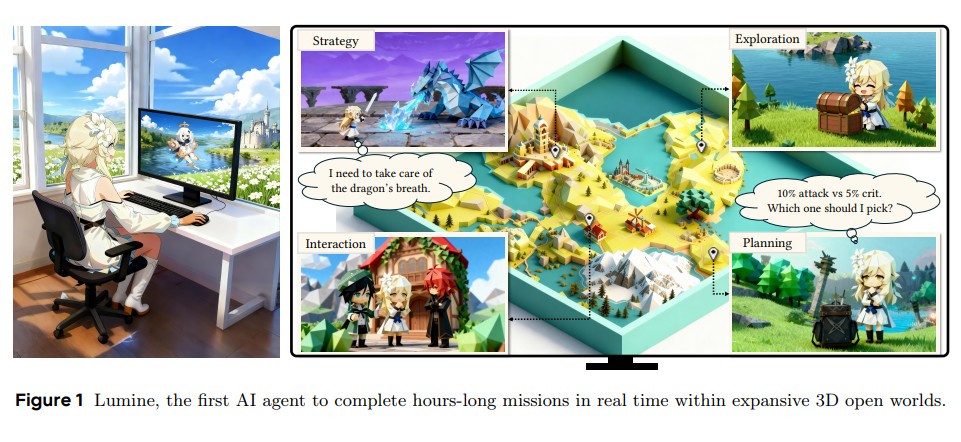
Enter Lumine, a groundbreaking AI model developed by researchers at ByteDance Seed. Lumine is the first open recipe for building generalist AI agents that can function in 3D open-world environments—the kind found in immersive games like Genshin Impact. This research introduces an AI that not only perceives and reasons but also acts with human-like precision and flexibility, marking a major step toward true general intelligence.
What Makes Lumine Unique?
It is designed to think, plan, and act in dynamic environments where no two moments are alike. Unlike older AI systems that operate in controlled or pre-defined conditions, Lumine functions in large, unpredictable virtual worlds, learning directly from visual and interactive experiences.
Here are some of the core innovations that make Lumine special:
1. A Unified System for Perception, Reasoning, and Action
Traditional AI models handle these three steps separately – seeing, thinking and doing are divided into distinct modules. Lumine unifies them into a single, end-to-end system. It processes visual inputs (pixels) from a game screen, reasons internally about what’s happening, and then performs actions using simulated keyboard and mouse controls.
This design mimics how humans interact with digital environments, allowing the model to learn naturally from gameplay experiences.
2. Training in Real 3D Worlds
It was trained primarily in Genshin Impact, one of the most complex and realistic open-world games. The AI completed the full five-hour Mondstadt storyline and even adapted to other games like Wuthering Waves and Honkai: Star Rail without retraining.
This cross-game generalization shows that Lumine doesn’t just memorize—it understands how to transfer its skills to new settings, just like humans do when playing new games.
3. Human-Like Thinking Pattern
Lumine uses a hybrid reasoning approach. It doesn’t overthink every move but instead reasons only when necessary like when solving puzzles, planning long-term actions, or facing unexpected challenges. This adaptive “thinking mode” saves time while keeping decisions accurate and context-aware.
4. Real-Time Decision Making
One of Lumine’s most impressive achievements is its real-time performance. It processes visual input five times per second (5 Hz) and outputs keyboard–mouse actions thirty times per second (30 Hz). Thanks to optimized inference techniques, it reacts as quickly as a human player – crucial for handling fast-paced scenarios like combat or puzzle solving in open-world games.
The Training Process
Building Lumine required an extensive three-stage training pipeline using over 2,400 hours of gameplay data collected from real human players.
Stage 1: Pre-Training
In this phase, Lumine learned the basic mechanics of gameplay – movement, interaction and combat by watching humans play. It observed screen pixels and corresponding actions, developing the ability to link what it saw with how players responded.
Stage 2: Instruction Following
Next, Lumine was trained to understand natural language commands. Researchers taught it to follow textual instructions such as “collect the treasure” or “talk to the NPC.” This stage helped Lumine connect language with actions, bridging perception and linguistic understanding.
Stage 3: Reasoning
Finally, Lumine was taught to reason and plan using “inner monologues.” Human annotators wrote short, first-person thoughts explaining decisions during gameplay—like “I must defeat the monsters to open the chest.” This helped Lumine learn when and how to reason, enabling it to reflect and adapt during complex missions.
By combining these three stages, Lumine became capable of not just imitating actions but understanding the logic behind them.
Why Genshin Impact?
The researchers selected Genshin Impact because it provides a rich, dynamic world that mirrors real-life complexity. It includes open-world exploration, combat, puzzles, and interactions with hundreds of characters.
Each mission requires observation, planning, and coordination making it a perfect testbed for studying embodied intelligence (AI that can sense and act in its environment).
By mastering the game’s challenges, Lumine proved its ability to handle long-term goals, complex reasoning, and precise control – all key ingredients of general intelligence.
Real-World Implications
Although Lumine was trained in a virtual environment, its design has powerful implications for the future of AI and robotics.
- Autonomous Robots: The same architecture can help physical robots navigate complex spaces, make decisions, and act safely in real time.
- AI Companions and Assistants: Lumine’s reasoning ability could enhance digital assistants, allowing them to understand context, remember past actions, and make more human-like decisions.
- Education and Simulation: In training simulations, Lumine-like agents could help model human behavior, assist in virtual teaching, or provide intelligent in-game tutoring.
- Cross-Domain Intelligence: Since Lumine generalizes between games, it offers insights into how AI can transfer learning between tasks—an essential step toward Artificial General Intelligence (AGI).
Challenges and Future Directions
While Lumine’s performance is groundbreaking, challenges remain. The AI still depends on high computing power, and its reasoning can occasionally fail in highly unpredictable scenarios. Future research aims to make such agents more efficient, adaptable, and capable of long-term memory across sessions.
The project also raises questions about ethics, data privacy, and the boundaries between human and artificial cognition – areas that researchers must address as AI becomes more human-like.
Conclusion
It represents a major milestone in AI research, combining perception, reasoning, and action in one unified model capable of operating autonomously in complex 3D environments. By mastering the open-world challenges of Genshin Impact, Lumine demonstrates that AI can now perform extended, real-time missions with human-like adaptability and intelligence.
As AI agents like Lumine continue to evolve, they bring us closer to the vision of machines that can not only think and act but also understand and collaborate in dynamic, open-ended worlds. The line between digital intelligence and human creativity is becoming ever thinner and Lumine is a shining example of this transformation.
Follow us for cutting-edge updates in AI & explore the world of LLMs, deep learning, NLP and AI agents with us.
Related Reads
- dots.ocr: The Future of Multilingual Document Understanding with Vision-Language Models
- The Ultimate AI & Machine Learning Roadmap: A Complete Guide for Beginners
- S3PRL Toolkit: Advancing Self-Supervised Speech Representation Learning
- How to Run and Fine-Tune Kimi K2 Thinking Locally with Unsloth
- IndicWav2Vec: Building the Future of Speech Recognition for Indian Languages
1 thought on “Lumine: The Next Step Toward Human-Like AI Agents in 3D Worlds”