
As AI systems evolve, developers are increasingly building tools that go beyond simple chat interactions. Modern AI agents need access to real capabilities such as file systems, memory, search, automation, and external services. The Model Context Protocol (MCP) was created to standardize how AI models interact with tools, but MCP servers typically run over raw input and output streams. While functional, this approach introduces security risks, integration challenges, and limited compatibility with existing ecosystems.
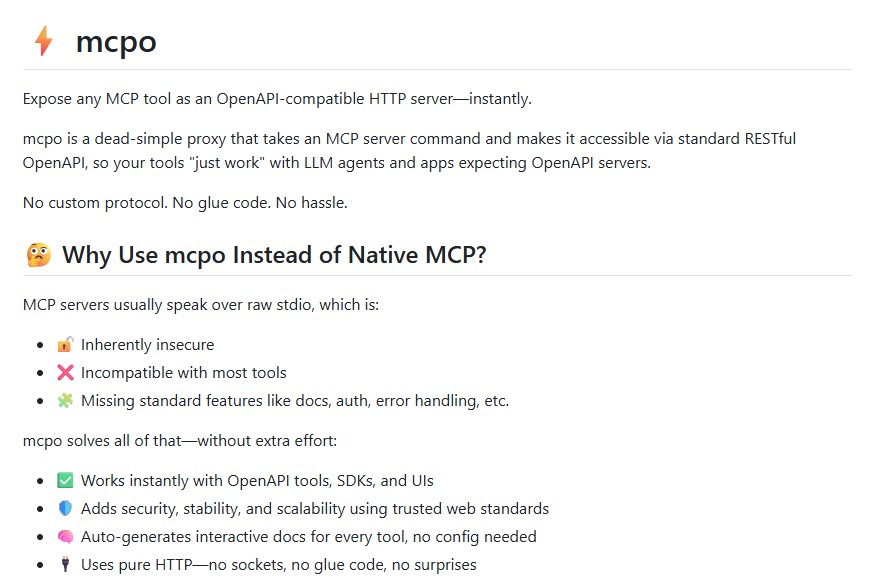
This is where mcpo comes in. mcpo is a lightweight, open-source proxy that converts any MCP tool into an OpenAPI-compatible HTTP server instantly. Developed by the Open WebUI community, mcpo bridges the gap between MCP-based tools and the vast ecosystem of REST APIs, SDKs, user interfaces, and authentication systems.
This blog explores what mcpo is, why it exists, how it works, its key features, real-world use cases, and why it is becoming a critical building block for interoperable AI tooling.
What Is mcpo
mcpo is a simple MCP-to-OpenAPI proxy server. It takes an existing MCP server command and exposes it as a standard HTTP REST API with a fully generated OpenAPI schema. Once running, the tool can be accessed by browsers, AI agents, SDKs, and applications that expect OpenAPI-compliant endpoints.
Instead of rewriting tools, adding custom glue code, or adopting proprietary protocols, mcpo allows developers to reuse existing MCP tools and instantly make them compatible with modern web infrastructure.
In practical terms, mcpo transforms MCP tools into production-ready services.
Why Native MCP Alone Is Not Enough
MCP servers traditionally communicate over raw standard input and output. While this works for local experimentation, it introduces several problems in real-world environments.
First, raw stdio communication is inherently insecure. It lacks authentication, authorization, and encryption. Second, most existing tools and platforms do not support raw MCP communication, making integration difficult. Third, features such as interactive documentation, structured error handling, monitoring, and scaling are missing.
mcpo solves these issues by wrapping MCP servers in a clean HTTP layer. This layer follows OpenAPI standards, making the tools immediately usable across a wide range of systems.
Key Features of mcpo
One of mcpo’s most powerful features is instant OpenAPI compatibility. As soon as the proxy starts, it generates a full OpenAPI schema and interactive documentation. Developers can test endpoints directly from the browser without writing additional configuration.
mcpo also adds security through API key authentication and OAuth 2.1 support. This makes MCP tools suitable for both local and production environments.
Another important feature is protocol flexibility. mcpo supports standard MCP over stdio, Server-Sent Events (SSE), and streamable HTTP-based MCP servers. This ensures compatibility with both legacy and modern MCP implementations.
mcpo is transport-agnostic and relies purely on HTTP. There are no sockets, no custom clients, and no hidden dependencies. This design makes it easy to deploy behind reverse proxies, load balancers, or API gateways.
Quick Setup and Usage
mcpo is designed to be dead simple to use. Developers can start it using uv for fast startup or install it via pip. With a single command, an MCP tool becomes an OpenAPI server.
mcpo can also be run entirely through Docker, requiring no local installation. This is especially useful for teams that want consistent environments or container-based deployments.
Once started, mcpo exposes a base URL where the tool endpoints are available. Interactive API documentation is automatically generated and accessible through a browser, making testing and exploration effortless.
Supporting Multiple MCP Tools with Configuration Files
mcpo supports configuration files that follow the Claude Desktop MCP format. This allows multiple MCP tools to be served simultaneously from a single mcpo instance.
Each tool is exposed under its own route, complete with its own OpenAPI schema and documentation. Tools can be enabled or disabled individually, and specific tool functions can be selectively hidden if needed.
Hot-reload mode allows developers to update configurations without restarting the server, ensuring zero downtime during development or experimentation.
OAuth 2.1 Authentication
Security is a critical concern when exposing AI tools as web services. mcpo includes built-in support for OAuth 2.1, enabling secure access to protected MCP servers.
The OAuth implementation defaults to dynamic client registration, reducing configuration overhead. For legacy systems that do not support dynamic registration, mcpo also supports static client metadata.
Once authenticated, tokens are securely stored and reused automatically for future requests. This makes mcpo suitable for enterprise environments and integrations that require strong authentication guarantees.
Integration with Open WebUI and AI Agents
mcpo is designed to work seamlessly with Open WebUI and AI agents that rely on OpenAPI-compatible tools. By exposing MCP tools through OpenAPI, mcpo enables agents to discover, understand, and use tools without custom adapters.
This interoperability is essential for building scalable agent systems where tools can be added, removed, or updated without breaking existing workflows.
Development and Testing
mcpo is developer-friendly and easy to extend. Contributors can clone the repository, install dependencies using uv, and run tests locally with pytest.
Developers can run mcpo directly from their local codebase to test changes in real time. This tight feedback loop encourages experimentation and community contributions.
The project follows open-source best practices and welcomes pull requests, bug reports, and feature suggestions.
Real-World Use Cases
mcpo is ideal for developers building AI agents that rely on external tools. It is commonly used to expose memory servers, time utilities, search tools, and custom MCP services to LLMs.
It is also useful for teams transitioning from experimental MCP tools to production-ready APIs. By using mcpo, teams can avoid rewriting tools and instead focus on scaling, security, and user experience.
For platform builders, mcpo enables rapid prototyping of AI tool ecosystems using familiar web standards.
Conclusion
mcpo represents a crucial step toward making AI tools interoperable, secure, and production-ready. By transforming MCP servers into OpenAPI-compatible HTTP services, mcpo eliminates friction, improves security, and unlocks integration with modern AI platforms and applications.
Its simplicity, flexibility, and strong adherence to open standards make it an essential utility for developers working with MCP-based tools. As AI systems continue to evolve toward tool-driven and agent-based architectures, mcpo stands out as a foundational component for the next generation of AI infrastructure.
Follow us for cutting-edge updates in AI & explore the world of LLMs, deep learning, NLP and AI agents with us.
Related Reads
- Orion: The Next Evolution in Visual AI for Advanced Reasoning and Multi-Modal Intelligence
- Fara-7B: Microsoft’s Breakthrough Agentic Model for Real-World Computer Use
- MiniMax-M2.1: An Open-Source Leap Toward Enterprise-Grade Agentic AI
- Supabase: The Complete Guide to the Open-Source Postgres Development Platform
- K-EXAONE-236B-A23B: A Deep Dive into LG AI Research’s Frontier Multilingual Reasoning Model