
Artificial Intelligence is rapidly transforming the way software is built, but most AI tools still work as isolated assistants rather than coordinated teams. This is where MetaGPT stands out. MetaGPT is an open-source multi-agent framework that simulates an entire software company powered by Large Language Models (LLMs). Instead of relying on a single AI model to generate code, MetaGPT assigns specialized roles such as product manager, architect, project manager and engineer to multiple agents that collaborate to complete complex tasks.
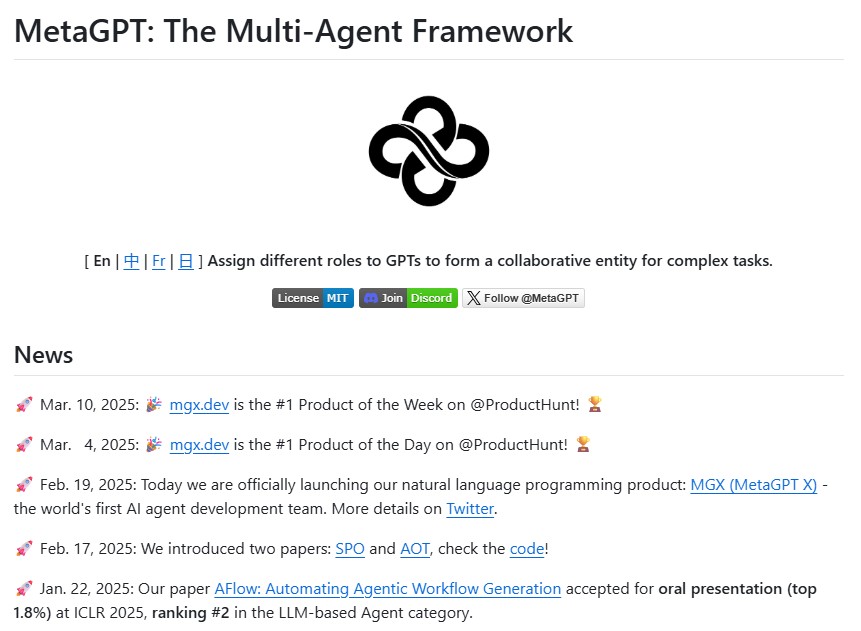
Developed by the FoundationAgents team and released under the MIT license, MetaGPT has quickly gained massive attention in the AI and developer communities. With over 63,000 GitHub stars and thousands of contributors and forks, MetaGPT is emerging as one of the most influential agent-based AI frameworks available today.
What Is MetaGPT?
MetaGPT is a multi-agent collaborative framework designed to transform natural language requirements into structured software artifacts. Unlike traditional AI coding tools that generate code directly from prompts, MetaGPT follows a software company workflow. A single user prompt is treated as a product requirement, and a team of AI agents collaborates to produce:
- User stories
- Product requirement documents
- System architecture designs
- API specifications
- Data structures
- Source code repositories
The core philosophy of MetaGPT is “Code = SOP (Standard Operating Procedures)”. This means real-world software development processes are encoded into structured workflows and executed by AI agents working together.
How MetaGPT Works
MetaGPT internally simulates a complete software organization. Each agent has a defined role and responsibility:
- Product Manager – Analyzes user requirements and creates user stories
- Architect – Designs system architecture and technology stack
- Project Manager – Organizes timelines and development plans
- Engineer – Writes clean, modular and documented code
These agents communicate with each other through predefined workflows, ensuring logical consistency and higher-quality outputs. This approach significantly reduces hallucinations and fragmented results that are common in single-agent AI systems.
Key Features
1. Multi-Agent Collaboration
MetaGPT’s strongest feature is its agent collaboration model. Each role works independently yet synchronizes with others, mimicking real human teams.
2. Natural Language Programming
Users can describe software requirements in plain English. MetaGPT translates these into technical artifacts automatically.
3. End-to-End Software Generation
From idea to repository structure, MetaGPT handles the full lifecycle of software development.
4. Flexible LLM Support
MetaGPT supports multiple LLM providers, including OpenAI, Azure, Ollama, and Groq, making it adaptable to different environments.
5. Open-Source and Extensible
With an MIT license and an active contributor community, MetaGPT is easy to customize and extend.
Installation and Setup
MetaGPT requires Python 3.9 or later but below 3.12. Users can install it via pip or directly from GitHub.
Basic installation command:
pip install --upgrade metagpt
After installation, users must initialize the configuration file:
metagpt --init-config
This creates a configuration file at ~/.metagpt/config2.yaml where users can define their LLM provider, API key, model, and base URL.
Meta GPT also supports Docker-based installation for users who prefer containerized environments.
Using MetaGPT CLI Usage
MetaGPT can be used directly from the command line:
metagpt "Create a 2048 game"
This command automatically generates a structured project repository inside the workspace directory.
Python Library Usage
Developers can also integrate MetaGPT into their own Python workflows:
from metagpt.software_company import generate_repo

repo = generate_repo("Create a 2048 game")

print(repo)
This makes MetaGPT suitable for automation, experimentation and research.
Data Interpreter and Advanced Agents
MetaGPT includes specialized agents such as the Data Interpreter, which can perform data analysis tasks, generate plots, and interpret datasets programmatically. This expands MetaGPT beyond software engineering into data science and analytics workflows.
Additional agent types include:
- Researcher
- Debate Agent
- Receipt Assistant
- Workflow Automation Agents
This modularity makes MetaGPT a powerful foundation for building custom AI agent systems.
Use Cases
MetaGPT can be applied across multiple domains including:
- Startup prototyping
- Automated software development
- AI agent research
- Educational tools for learning software architecture
- Data analysis and visualization
- Enterprise workflow automation
Its ability to scale from small demos to enterprise-level systems makes it highly versatile.
Conclusion
MetaGPT represents a significant evolution in how AI systems approach software development. By moving beyond single-agent prompt responses and embracing a structured, role-based multi-agent architecture, MetaGPT delivers more reliable, scalable, and realistic outputs. It mirrors how real software companies operate, bringing order and collaboration into AI-generated development workflows.
For developers, researchers, and organizations seeking to explore the future of natural language programming and agent-based systems, MetaGPT offers a powerful and flexible foundation. As AI continues to advance frameworks like MetaGPT are likely to define the next generation of intelligent software creation.
Follow us for cutting-edge updates in AI & explore the world of LLMs, deep learning, NLP and AI agents with us.
Related Reads
- Open Interpreter: Bringing Natural Language Control to Your Local Computer
- GPT-Engineer: A Powerful Foundational Tool in AI-Driven Software Development
- LlamaIndex: The Leading Data Framework for Building LLM Applications
- Qwen3-VL-Embedding and Qwen3-VL-Reranker: A New Standard for Multimodal Retrieval
- Flowise: A Visual Platform for Building AI Agents and LLM Workflows
2 thoughts on “MetaGPT: The Multi-Agent Framework Redefining AI-Driven Software Development”