
Artificial Intelligence is evolving rapidly, and one of the most transformative concepts emerging from this evolution is the rise of AI agents. These are intelligent systems capable of performing tasks, reasoning about goals, interacting with tools, and autonomously completing complex workflows. To help new learners enter this exciting domain, Microsoft has introduced the AI Agents for Beginners course, an open-source learning resource designed to teach anyone the fundamentals of designing, building, and deploying AI agents.
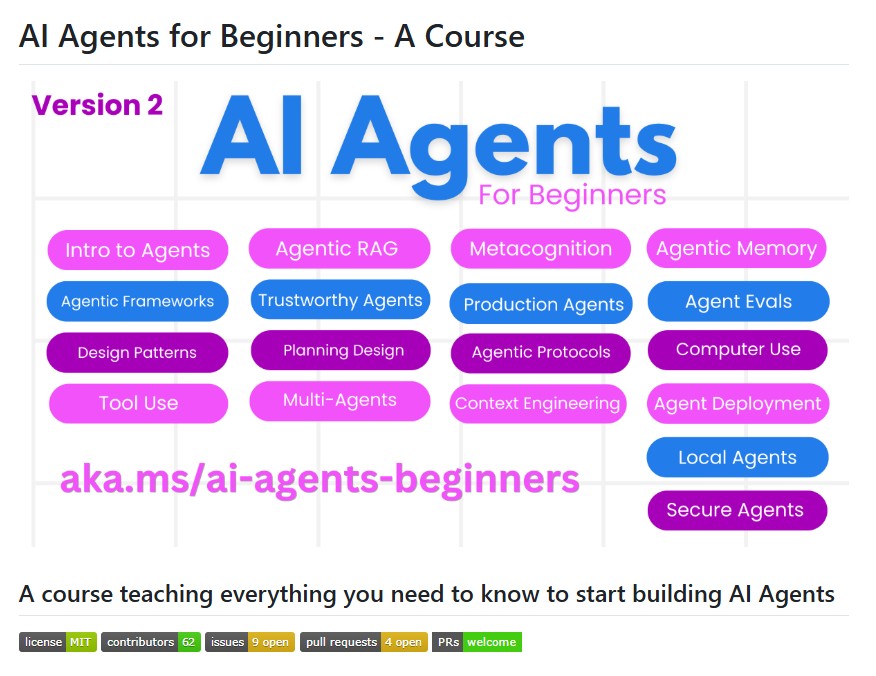
Hosted on GitHub, this course has quickly become one of the most comprehensive and accessible resources for developers, students, and professionals who want to work with agentic AI systems. Packed with lessons, code samples, videos, frameworks, and hands-on examples, it guides beginners through each aspect of agent development from understanding what an agent is to using multi-agent workflows in production-level applications.
This blog explores the structure, lessons, tools, and real-world applications of Microsoft’s AI Agents for Beginners course, showing why it has become a trusted resource for learning agentic AI.
Understanding Microsoft’s AI Agents for Beginners Course
The AI Agents for Beginners repository consists of a structured set of 12+ lessons that introduce learners to the essential ideas behind agent-based systems. Each lesson includes:
- Written explanations
- Short educational videos
- Python code samples
- Extra learning resources
- Exercises using Azure AI Foundry and GitHub Models
The course is designed with accessibility in mind. It supports numerous languages including Hindi, Tamil, German, French, Arabic, Spanish, and many more. This makes it one of the most inclusive AI learning paths available.
Key Lessons and What You Will Learn
1. Introduction to AI Agents and Use Cases
This opening lesson explains what AI agents are and how they differ from traditional chatbots or static language model interfaces. Learners understand why agents must reason, plan, and interact with external tools, making them ideal for automation in domains such as customer service, research, finance, and healthcare.
2. Exploring Agentic Frameworks
The course introduces several Microsoft-powered agent frameworks including:
- Microsoft Agent Framework
- Azure AI Agent Service
- Semantic Kernel
- AutoGen
These frameworks provide the tools needed to orchestrate model reasoning, tool usage, planning capabilities, and conversation state across an agent-driven workflow.
3. Understanding AI Agentic Design Patterns
Learners explore common design patterns including:
- Reactive agents
- Planning-based agents
- Tool-using agents
- Hierarchical multi-agent systems
This lesson helps clarify how modern AI agents break down problems and select the appropriate actions.
4. Tool Use Design Pattern
Tool use is a defining characteristic of agentic workflows. This lesson explains how agents:
- Call APIs
- Access databases
- Retrieve data
- Execute code
- Interact with external systems
By learning how agents use real-world tools, students can build systems capable of meaningful, actionable operations.
5. Agentic RAG
Retrieval-Augmented Generation is a powerful technique that enhances model accuracy and reduces hallucinations. The course teaches:
- How to integrate search into an agent
- How to fetch facts in real-time
- How to build RAG pipelines inside an agentic structure
This lesson is essential for creating agents that handle business data or knowledge-intensive tasks.
6. Building Trustworthy AI Agents
A responsible AI foundation is critical when building autonomous systems. This lesson covers:
- Safety considerations
- Risk assessment
- Guardrails
- Mitigation of harmful outputs
- Principles of transparency and trust
Microsoft places a strong emphasis on creating safe and fair agents.
7. Planning Design Pattern
Planning-based agents evaluate a user’s request, break it down, choose an approach, and execute a task sequence. This lesson explains how planning improves reliability and consistency.
8. Multi-Agent Design Pattern
Modern AI systems often use multiple agents working together. This lesson explores how agents can collaborate through:
- Role-based interactions
- Cooperative workflows
- Supervisor-worker models
- Expert-specialist architectures
This is useful for building scalable, modular agent environments.
9. Metacognition Design Pattern
Metacognition allows agents to reflect on their own reasoning, verify their steps, and improve accuracy. This enhances model reliability and transparency.
10. AI Agents in Production
Learners understand how to deploy agents safely, monitor performance, handle errors, manage logs, and scale workloads. This lesson prepares learners for real-world deployment.
11. Agentic Protocols
Protocols like MCP, A2A, and NLWeb define how agents communicate. This lesson explains protocol usage and when they are needed.
12. Context Engineering and Memory
These lessons dive into the importance of long-term context, memory retrieval, and how agents store and recall information to maintain coherent interactions.
Tools and Frameworks Used in the Course
The course integrates multiple Microsoft AI tools including:
- Microsoft Agent Framework (MAF)
- Azure AI Foundry
- GitHub Model Catalog
- Semantic Kernel
- AutoGen
These tools allow learners to experiment with both free and enterprise-grade models. Every lesson provides ready-to-run code samples so beginners can immediately practice and build working agents.
Why This Course Stands Out
The AI Agents for Beginners course is popular because it is:
- Completely free
- Continuously updated
- Beginner-friendly
- Backed by Microsoft experts
- Supported by video lessons
- Focused on real-world applications
- Available in dozens of languages
- Accompanied by actionable code samples
With more than forty thousand stars on GitHub and thousands of active learners, it has become one of the most trusted entry points into agentic AI education.
Conclusion
Microsoft’s AI Agents for Beginners course is an exceptional starting point for anyone looking to understand and build modern AI agents. From foundational concepts to advanced design patterns and deployment strategies, the course provides a complete learning journey. Its combination of detailed lessons, real-world code examples, and high-quality educational support makes it suitable for developers, students, and professionals at all skill levels.
Whether you want to build a simple tool-using agent, experiment with RAG workflows, or develop full-scale multi-agent systems, this repository offers everything you need. As AI agents become core components of intelligent applications across industries, mastering these concepts will position you at the forefront of future AI innovation.
Follow us for cutting-edge updates in AI & explore the world of LLMs, deep learning, NLP and AI agents with us.
Related Reads
- The Ultimate Guide to Prompt Engineering: A Deep Dive into DAIR.AI’s Leading Resource
- Parlant: The AI Agent Framework Built for Real-World Reliability
- Motif-2-12.7B: A Breakthrough in Efficient Large Language Model Architecture
- Lumine: The Next Step Toward Human-Like AI Agents in 3D Worlds
- dots.ocr: The Future of Multilingual Document Understanding with Vision-Language Models
2 thoughts on “Microsoft’s AI Agents for Beginners: A Complete Guide to Building Your First AI Agent”