
The rapid evolution of large language models (LLMs) has redefined how industries approach automation, content creation, data analysis, and decision-making. While tech giants have been scaling models with billions of parameters to achieve superior performance, an equally important challenge has emerged: how do we make LLMs more efficient without compromising their reasoning ability and accuracy? Motif-2-12.7B, a new open-weight foundation model, addresses this very challenge. It represents a significant step forward in efficient model design, offering exceptional performance while operating under constrained computational resources.
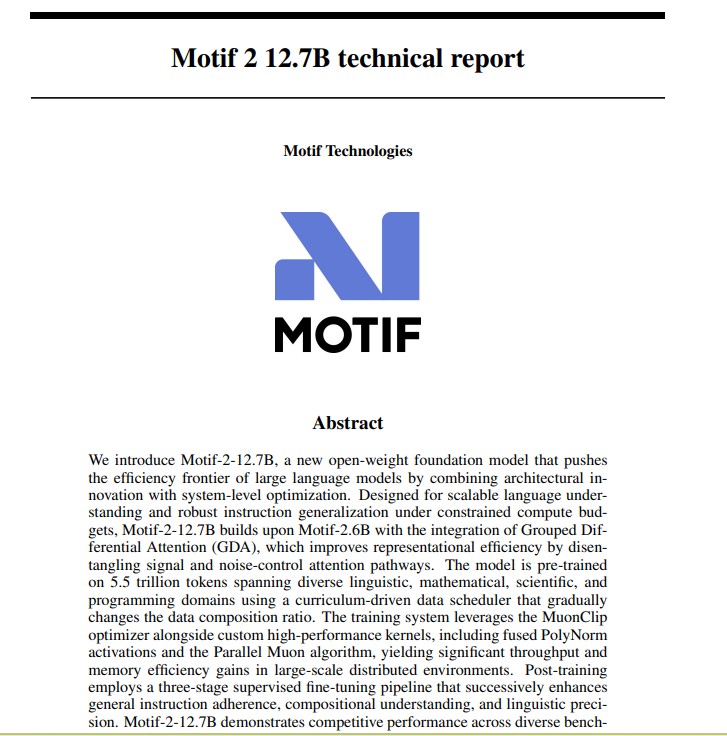
Motif-2-12.7B is developed as a successor to Motif-2.6B, improving scalability, reasoning capabilities, and training efficiency. Through innovative architectural choices, specialized optimization methods, and a structured training pipeline, this model competes with much larger models while being more resource-friendly. This blog explores what makes Motif-2-12.7B unique, how it was built, and why it matters for the future of AI development.
What Is Motif-2-12.7B?
Motif-2-12.7B is an open-weight language model built to deliver strong instruction-following, multi-step reasoning, and advanced comprehension. Unlike models that rely heavily on massive parameter scaling, Motif-2-12.7B focuses on architecture refinement and system-level optimization to achieve competitive performance. It is trained on 5.5 trillion tokens across diverse domains including general English data, STEM, multilingual content, mathematics, and programming.
The standout feature of this model is its ability to rival significantly larger models like Qwen-3 32B and Gemma-3 27B while maintaining a smaller footprint. This is achieved using modern training strategies and a powerful attention mechanism known as Grouped Differential Attention (GDA).
Key Architectural Innovations
1. Grouped Differential Attention (GDA)
GDA is the core improvement that enhances how the model processes information. It introduces specialized attention head groups: one for amplifying relevant signals and another for suppressing noise. This leads to improved representation quality without increasing computational cost.
2. Hypercloning for Efficient Scaling
Motif-2-12.7B uses a width-preserving hypercloning technique. Instead of training a wider model from scratch, weights are replicated in a controlled way that maintains consistency with the original model. This results in improved capacity while keeping training efficient.
3. Extended Depth with LLaMA-Pro Framework
The model’s depth is expanded using the LLaMA-Pro block expansion strategy. This ensures alignment with modern transformer improvements and helps the model handle longer context lengths—up to 32,768 tokens.
Training Methodology
A Data-Driven Curriculum Approach
The pre-training process relies on a curriculum scheduler that introduces data categories gradually. Early stages focus on general English language understanding, while later phases emphasize mathematics, reasoning, and code.
This method ensures:
- Smooth convergence
- Strong foundational language skills
- Robust reasoning abilities
Large-Batch Optimization with Muon-Clip
Muon-Clip, an improved optimizer known for stability under massive training batches, is used to train the model efficiently. The team further enhanced it with Parallel Muon technology, allowing distributed computation and reducing memory overhead.
Long-Context Adaptation
Toward the end of training, the sequence length is gradually increased to 16,384 and then 32,768 tokens, enabling the model to manage long documents and complex reasoning tasks with ease.
Three-Stage Fine-Tuning Pipeline
After base training, Motif-2-12.7B undergoes a structured three-stage supervised fine-tuning process:
Stage 1: General Instruction Alignment
Trained on 28 million high-quality instruction samples to build conversational and task-following ability.
Stage 2: Synthetic and Targeted Reasoning Enhancement
Incorporates curated datasets and synthetic reasoning samples to boost algorithmic, mathematical, and compositional reasoning.
Stage 3: Data-Pruned Refinement
Removes low-utility synthetic data to prevent overfitting and sharpen linguistic coherence.
This multistage approach ensures the model excels not only in regular conversations but also in advanced reasoning and domain-specific tasks.
Performance Benchmark Results
Motif-2-12.7B delivers exceptional results across math, reasoning, coding, and general knowledge evaluations. It performs competitively with significantly larger models:
- GSM8K: 96+
- MATH: 97
- HumanEval: 93.2
- LiveCodeBench: 61+
- AIME24 & AIME25: Strong performance without RL enhancement
These metrics demonstrate its superior reasoning and coding capabilities despite being trained on fewer total tokens compared to many competing models.
Why Motif-2-12.7B Matters
Motif-2-12.7B stands out for three primary reasons:
1. Efficiency Over Raw Size
It challenges the belief that bigger is always better, showing that architectural improvements and curated training can outperform brute-force scaling.
2. Open-Weight Accessibility
Researchers and developers can freely use, modify, or build on top of it, encouraging innovation in the AI community.
3. Versatility and Practical Use Cases
Its strengths in reasoning, coding, long-context understanding, and multilingual support make it suitable for:
- Enterprise automation
- Research applications
- Education and tutoring
- Software development assistance
- Data analysis and scientific exploration
Conclusion
Motif-2-12.7B is more than just another large language model. It represents a new direction in AI development—one where efficiency, precision, and architectural innovation can match or even surpass the capabilities of massive models. By combining Grouped Differential Attention, optimized training systems, and a robust fine-tuning strategy, Motif-2-12.7B proves that thoughtful design can achieve exceptional performance.
As the developers prepare to release Motif-2-12.7B-Reasoning, an enhanced version optimized with reinforcement learning, this model sets a strong foundation for future advancements. Motif-2-12.7B shows that the future of LLMs lies not just in size, but in smarter, more optimized intelligence.
Follow us for cutting-edge updates in AI & explore the world of LLMs, deep learning, NLP and AI agents with us.
Related Reads
- Lumine: The Next Step Toward Human-Like AI Agents in 3D Worlds
- dots.ocr: The Future of Multilingual Document Understanding with Vision-Language Models
- The Ultimate AI & Machine Learning Roadmap: A Complete Guide for Beginners
- S3PRL Toolkit: Advancing Self-Supervised Speech Representation Learning
- How to Run and Fine-Tune Kimi K2 Thinking Locally with Unsloth
2 thoughts on “Motif-2-12.7B: A Breakthrough in Efficient Large Language Model Architecture”