
As artificial intelligence systems grow more advanced, the challenges around controlling them become more critical. Developers building customer-facing AI agents consistently struggle with issues like hallucinations, poor rule-following, unpredictable behavior, and inconsistency across conversations. Traditional prompt-engineering approaches are no longer enough to build trustworthy, production-ready AI agents. This is where Parlant, an open-source AI agent framework, stands out. Designed for reliability, transparency, and behavioral consistency, it ensures that agents genuinely follow rules, handle edge cases responsibly, and deliver predictable performance.
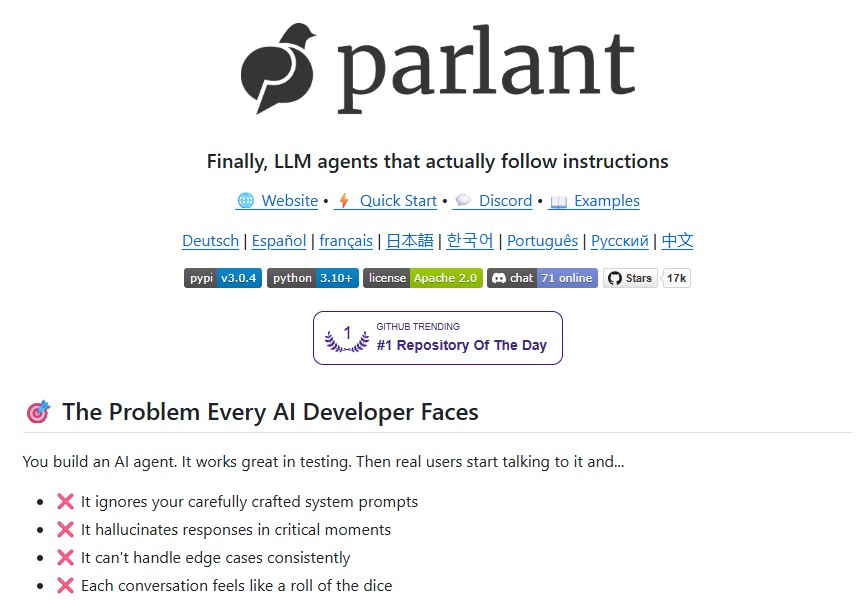
This blog explores the features, architecture, and real-world advantages of Parlant, while outlining why thousands of developers and enterprises are shifting to this framework for building robust AI systems.
What Is Parlant?
It is an AI agent development framework designed to eliminate unpredictable model behavior and ensure strict rule compliance. Unlike traditional LLM prompting, where developers hope the system obeys instructions, Parlant introduces a structure that enforces behavioral guidelines, manages conversational journeys, and integrates tools with high reliability.
The project is open-source under the Apache-2.0 license and is maintained by a growing community of developers and enterprises. Its core purpose is simple: to make AI agents that behave consistently across every conversation, under every condition.
Why Traditional AI Agents Fail
Many developers build agents by writing long system prompts, followed by long-form rules the model should follow. But LLMs often diverge from these rules, leading to several problems:
- Ignoring system instructions
- Hallucinatory responses during critical moments
- Inability to maintain consistency across conversations
- Poor handling of complex or edge-case inputs
These failures are not due to poor development but due to the limitations of relying solely on prompt engineering. Parlant addresses these challenges at the framework level rather than at the prompt level.
How Parlant Solves These Problems
It introduces a structured, principle-driven approach to agent development. Instead of writing large system prompts, developers define guidelines that act as enforceable behavior rules. Parlant then contextually applies the correct guideline at the correct moment.
1. Behavioral Guidelines
Developers specify behavioral rules using natural language. For example:
- Condition: “User asks about refunds”
- Action: “Check order status before answering”
Parlant guarantees that these rules are followed consistently, creating predictable behavior.
2. Conversational Journeys
It allows developers to create step-by-step user journeys. This is especially powerful for:
- Customer onboarding
- Troubleshooting flows
- E-commerce support
- Healthcare intake
- Financial assistance workflows
Each step of the journey is structured, ensuring the AI agent never drifts off-topic.
3. Precise Tool Integration
You can attach external APIs, databases, and backend services to specific contexts. This ensures the agent only uses tools under the correct conditions.
4. Domain Adaptation
Parlant allows fine-grained domain guidance. Whether building a financial compliance agent or a medical assistant, developers can define domain-specific rules, terminology, and structured responses.
5. Canned Responses and Style Consistency
To eliminate hallucinations entirely, Parlant supports templated responses. This guarantees that the agent always responds in an approved and consistent format.
6. Explainability and Transparency
One of the strongest features of Parlant is the ability to inspect why an agent made a specific decision. Developers can see which guideline was matched, when it was applied, and why it was selected. This level of explainability is essential when deploying AI agents in regulated industries.
Parlant vs. Traditional Frameworks
Most traditional frameworks rely on prompt engineering. Parlant replaces this guesswork with structured rules and guaranteed compliance.
| Traditional AI Frameworks | Parlant |
| Prompt-heavy | Rule-driven |
| Behavior unpredictable | Behavior guaranteed |
| Difficult debugging | Fully explainable |
| Scaling requires more prompts | Scaling requires more guidelines |
| Inconsistent tool usage | Context-aware tool activation |
These differences make it ideal for mission-critical environments where mistakes are unacceptable.
Who Uses Parlant?
It is built for production environments across multiple industries:
Financial Services
- Compliance-first design
- Fraud-sensitive workflows
- Transparent auditing capabilities
Healthcare
- HIPAA-aligned architecture
- Patient-safe conversational journeys
- Strict adherence to medical guidelines
E-commerce
- Automated customer support
- Order tracking and returns
- Context-aware recommendations
Legal Technology
- Document review
- Contract analysis
- Consistent legal reasoning flows
Enterprises prioritize Parlant for its reliability and explainability—qualities essential for trust-based sectors.
Developer Experience and Quick Start
Parlant is beginner-friendly but powerful enough for enterprise-scale AI deployments. A complete agent can be launched in under a minute using Python:
pip install parlant
Developers then define tools, guidelines, and agent behavior in a clean, simple structure. Parlant also provides a built-in testing server and a drop-in React widget for front-end integration.
Its combination of ease-of-use and production-grade control makes Parlant particularly attractive for startups, research teams, and enterprise AI departments.
Why Parlant Is Becoming the Preferred Framework
Several factors explain why Parlant is gaining rapid adoption in the AI developer community:
- Reliability in real-world environments
- Predictable behavioral patterns
- Reduction in hallucination risk
- Easy tool and API integration
- Complete transparency in decision-making
- Production-ready structure from day one
With more than ten thousand developers already adopting the framework, Parlant is quickly establishing itself as a leader in agent-based AI innovation.
Conclusion
It represents a new generation of AI agent frameworks. Instead of relying on unpredictable prompt engineering, it brings structure, reliability, and guaranteed rule compliance to LLM systems. From customer service to healthcare and financial applications, Parlant enables developers to build safe, consistent, and high-quality agents suitable for real-world deployment. Its focus on explainability, domain adaptation, behavioral guidelines, and journey mapping makes it one of the most advanced and practical solutions available in 2025. For organizations seeking reliable AI automation, it sets a new benchmark for intelligent, controlled, and trustworthy agent development.
Follow us for cutting-edge updates in AI & explore the world of LLMs, deep learning, NLP and AI agents with us.
Related Reads
- Motif-2-12.7B: A Breakthrough in Efficient Large Language Model Architecture
- Lumine: The Next Step Toward Human-Like AI Agents in 3D Worlds
- dots.ocr: The Future of Multilingual Document Understanding with Vision-Language Models
- The Ultimate AI & Machine Learning Roadmap: A Complete Guide for Beginners
- S3PRL Toolkit: Advancing Self-Supervised Speech Representation Learning
3 thoughts on “Parlant: The AI Agent Framework Built for Real-World Reliability”