
As large language models become more capable, one challenge continues to limit their real-world usefulness: memory. Most LLM-based agents operate with short-term context windows, forcing developers to either pass massive conversation histories or rely on repeated reasoning loops. This approach is inefficient, expensive, and often inaccurate. The need for a scalable, efficient, and intelligent long-term memory system has never been greater.
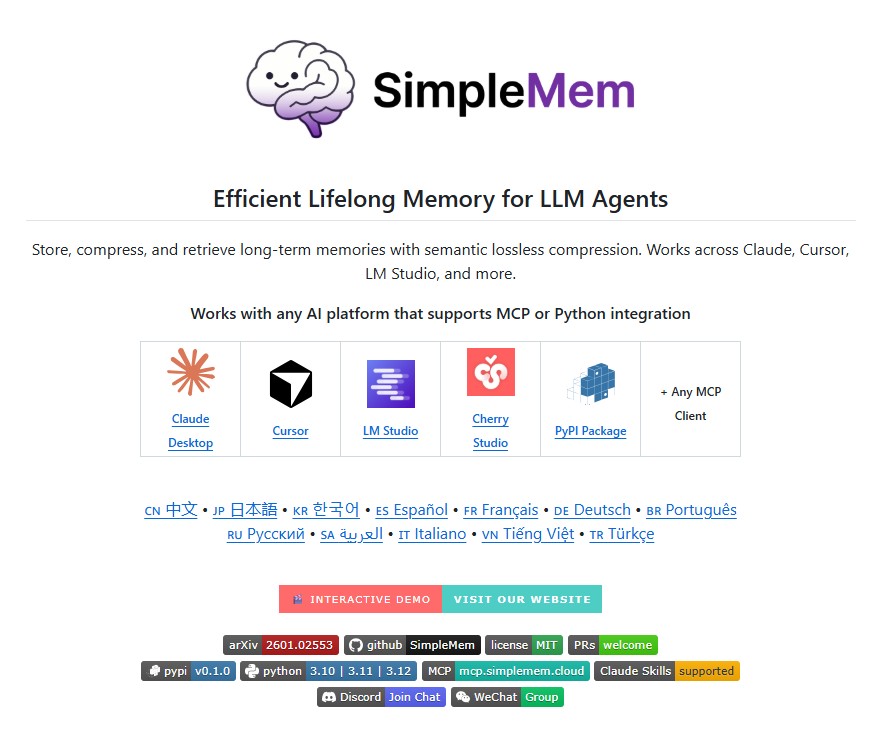
SimpleMem, developed by the Aiming Lab research team, directly addresses this problem. It introduces a principled and high-performance framework for lifelong memory in LLM agents. Instead of storing raw dialogue or bloated summaries, SimpleMem focuses on semantic lossless compression, structured indexing, and adaptive retrieval. The result is a memory system that is both highly accurate and computationally efficient.
This blog explains what SimpleMem is, how it works, why it matters, and how it compares to existing memory systems for LLM agents.
What Is SimpleMem?
SimpleMem is an open-source memory framework designed to provide long-term, lifelong memory for large language model agents. It is built on the idea that memory should not be a passive log of conversations, but an actively structured and optimized knowledge system.
The project was introduced alongside a research paper published on arXiv in early 2026. It demonstrates that high memory accuracy does not require excessive token usage or slow retrieval pipelines. By rethinking how information is stored and retrieved, SimpleMem achieves state-of-the-art performance on long-context memory benchmarks.
SimpleMem is especially suited for AI agents that must remember facts, events, and relationships over long periods, such as assistants, research agents, planning systems, and interactive AI applications.
The Core Problem SimpleMem Solves
Most existing memory systems for LLM agents fall into two categories:
Some systems store raw conversation history, which quickly becomes expensive and redundant. Others attempt iterative reasoning over compressed summaries, which introduces latency and reasoning errors.
SimpleMem solves this by focusing on information density. It ensures that every stored memory unit is precise, unambiguous, and maximally useful. Instead of remembering everything, it remembers the right things in the right format.
This approach dramatically reduces token consumption while improving factual accuracy.
SimpleMem’s Three-Stage Architecture
At the heart of SimpleMem is a carefully designed three-stage pipeline grounded in semantic lossless compression.
Stage 1: Semantic Structured Compression
The first stage transforms raw dialogue into atomic facts. These facts are self-contained, fully disambiguated, and timestamped. Relative references, unclear pronouns, and ambiguous phrasing are resolved at write time rather than query time.
For example, instead of storing a vague sentence like “He will meet Bob tomorrow at 2pm,” SimpleMem stores an absolute, unambiguous fact such as “Alice will meet Bob at Starbucks on 2025-11-16T14:00:00.”
This design choice removes the need for downstream reasoning to interpret context, saving time and tokens.
Stage 2: Structured Multi-View Indexing
Once atomic facts are created, SimpleMem indexes them across three complementary dimensions:
Semantic indexing uses dense vector embeddings to capture conceptual similarity.
Lexical indexing uses sparse keyword-based retrieval for exact term matching.
Symbolic indexing uses structured metadata such as timestamps, entities, and participants.
This multi-view indexing ensures that queries can be answered accurately whether they are conceptual, factual, or time-based.
Stage 3: Complexity-Aware Adaptive Retrieval
Instead of retrieving a fixed number of memory entries for every query, SimpleMem dynamically adjusts retrieval depth based on query complexity.
Simple questions retrieve only high-level memory headers, keeping token usage minimal. Complex queries automatically expand into deeper atomic contexts, providing comprehensive coverage without unnecessary overhead.
This adaptive strategy is a key reason SimpleMem achieves high accuracy with significantly fewer tokens.
Performance and Benchmark Results
SimpleMem has been evaluated on the LoCoMo-10 benchmark, a standard framework for long-context memory evaluation.
Compared to popular memory systems such as A-Mem, LightMem, and Mem0, SimpleMem consistently outperforms them across all major metrics. It achieves the highest average F1 score while also being the fastest in retrieval and overall processing time.
Notably, SimpleMem delivers a 43.24 percent F1 score while using approximately 30 times fewer tokens than full-context approaches. This makes it particularly attractive for production environments where cost and latency matter.
Key Advantages of SimpleMem
SimpleMem offers several practical advantages for developers and researchers.
It provides higher accuracy by storing unambiguous atomic facts rather than raw dialogue.
It significantly reduces token consumption, lowering inference costs.
It supports fast retrieval even at large memory scales.
It is compatible with both high-capability models and efficient smaller models.
These strengths make SimpleMem suitable for long-running AI agents that need reliable memory without constant reprocessing of old information.
Installation and Setup
SimpleMem is designed to be easy to install and experiment with. It requires Python 3.10 and access to an OpenAI-compatible API such as OpenAI, Qwen, or Azure OpenAI.
The setup process involves cloning the repository, installing dependencies, and configuring API credentials in a configuration file. The system supports modern embedding models such as Qwen3-Embedding, which provides high-quality semantic retrieval.
Once configured, developers can begin adding dialogues, finalizing memory encoding, and querying the system with minimal code.
Practical Use Cases
SimpleMem is ideal for a wide range of AI applications.
Personal AI assistants can remember user preferences, schedules, and historical facts.
Research agents can track experiments, hypotheses, and conclusions over time.
Customer support agents can retain accurate user histories without reloading entire conversations.
Planning and decision-making agents can reason over long-term events with precision.
Because SimpleMem separates memory construction from retrieval, it scales well as data grows.
Research and Open-Source Community
SimpleMem is released under the MIT License, making it fully open for research and commercial experimentation. The project is supported by an active research team and a growing open-source community.
The repository includes evaluation scripts, benchmarks, and reproducibility guidelines, making it especially valuable for academic research in long-term memory and agent architectures.
Acknowledgments within the project highlight its integration with strong ecosystem tools such as LanceDB, Qwen embeddings, and the LoCoMo benchmark.
Conclusion
Simple Mem represents a major step forward in long-term memory systems for LLM agents. By focusing on semantic lossless compression, structured indexing, and adaptive retrieval, it proves that memory can be both efficient and highly accurate. Its strong benchmark performance, low token usage, and clean architectural design make it one of the most promising solutions for lifelong memory in AI agents. For developers and researchers building next-generation intelligent systems, Simple Mem provides a powerful and practical foundation.
Follow us for cutting-edge updates in AI & explore the world of LLMs, deep learning, NLP and AI agents with us.
Related Reads
- Orion: The Next Evolution in Visual AI for Advanced Reasoning and Multi-Modal Intelligence
- Fara-7B: Microsoft’s Breakthrough Agentic Model for Real-World Computer Use
- MiniMax-M2.1: An Open-Source Leap Toward Enterprise-Grade Agentic AI
- Supabase: The Complete Guide to the Open-Source Postgres Development Platform
- K-EXAONE-236B-A23B: A Deep Dive into LG AI Research’s Frontier Multilingual Reasoning Model
2 thoughts on “SimpleMem: Efficient Lifelong Memory for LLM Agents”