
Artificial Intelligence and Machine Learning have become two of the most in-demand fields today, transforming industries such as healthcare, finance, retail, education and even entertainment. With new advancements happening every day, beginners often feel overwhelmed, confused about where to start and unsure of the correct learning sequence. This is exactly why a structured roadmap can make a significant difference. A well-organised learning pathway reduces confusion, builds strong fundamentals and ensures steady progress toward becoming proficient in AI and ML.
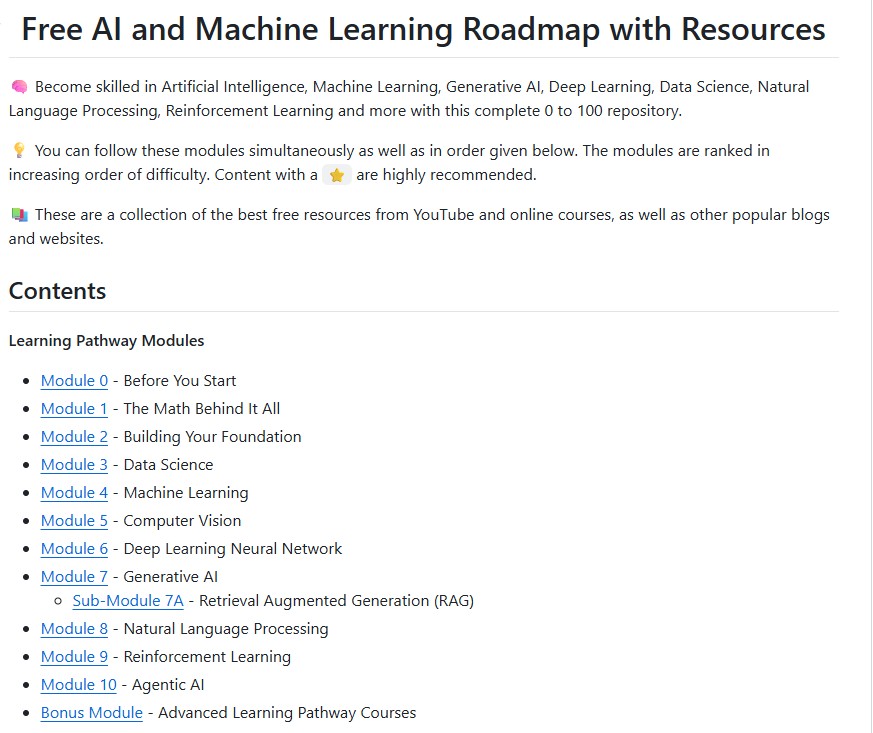
This blog provides a comprehensive step-by-step roadmap inspired by the best open-source learning repositories available online. Whether you are a student, working professional, or self-learner, this guide breaks down the entire AI/ML journey from scratch. With recommended free resources, practical learning steps, and real-world project ideas, this pathway ensures you gain skills that matter in 2025 and beyond.
Module 0: Getting Started with the Essentials
Every great journey starts with preparation, and the AI/ML path is no different. Before diving into algorithms and models, it is necessary to prepare your environment and understand the basic tools used by AI practitioners.
The first step is setting up Python, the most widely-used programming language in AI. Download Python 3.13 and install a powerful code editor such as Visual Studio Code. Additionally, install PIP, the package manager for Python, which will allow you to add essential libraries used in AI and ML such as NumPy, Pandas, Matplotlib and TensorFlow.
This stage ensures that your system is ready and you can seamlessly practice coding and mathematical operations required later in the journey.
Module 1: Understanding the Mathematics Behind AI
Mathematics is the backbone of Artificial Intelligence. While it may sound intimidating, learning applied mathematics gradually through curated playlists and free online courses makes it manageable. Areas like linear algebra, calculus, discrete mathematics, probability and statistics play a crucial role in algorithm design and model training.
Some highly recommended resources include the MIT Linear Algebra lecture series, the NPTEL Discrete Mathematics course, and foundational math courses designed specifically for machine learning enthusiasts. Having a strong grasp of these topics will allow you to better understand how algorithms work under the hood, making you a more confident AI practitioner.
Module 2: Building Your Programming Foundation in Python
Python is the language of AI for a reason – it is simple, powerful and backed by a massive ecosystem of libraries. This module focuses on helping you learn Python from scratch. Courses like MITx’s Introduction to Computer Science using Python and Harvard’s CS50 Python course are excellent starting points.
If you prefer quicker learning, platforms like W3Schools offer clear explanations, while YouTube tutorials can help you understand Python basics in a few hours. Once your fundamentals are strong, practice becomes essential. Use platforms like HackerRank to solve Python challenges and obtain a free Python certification. This practice strengthens your logical thinking and prepares you for more complex AI tasks.
Module 3: Introduction to Data Science
Data is the fuel that powers Machine Learning. Before training any model, you must understand how data works, how it is collected, and how it can be cleaned, processed, and visualised. This module covers the basics of statistics, exploratory data analysis, and Python libraries used in data science.
Free resources like the Google Data Analytics Professional Certificate and IBM Data Science courses provide hands-on experience using real-world datasets. Learning data handling through Pandas, NumPy, and Matplotlib will help you build a strong analytical mindset required for machine learning models.
Module 4: Machine Learning Fundamentals
With a good understanding of data, you can now learn how machines learn. Machine learning focuses on training algorithms to recognise patterns, make predictions, and improve automatically. This module dives into concepts such as supervised learning, unsupervised learning, regression, classification, clustering, and model evaluation.
Highly recommended resources include the Harvard Machine Learning course, Google Cloud learning paths, and the renowned Machine Learning Specialization by Andrew Ng. These courses teach ML both theoretically and practically, enabling you to build your first predictive models.
Module 5: Exploring Computer Vision
Computer Vision teaches machines to interpret and understand images and videos. From facial recognition to self-driving cars, computer vision powers some of the most advanced applications today.
Begin with crash courses on YouTube and gradually move toward structured programs like the Computer Vision Essentials course. Once comfortable, explore advanced playlists such as Stanford’s Computer Vision lectures. Hands-on practice using OpenCV will help you build projects like image classification, face detection, and object tracking.
Module 6: Deep Learning and Neural Networks
Deep Learning takes inspiration from the human brain, using artificial neural networks to process information and solve complex problems. This module introduces neural networks, convolutional networks, backpropagation, and modern deep learning frameworks like PyTorch and TensorFlow.
Resources such as the Neural Networks and Deep Learning course by DeepLearning.AI and the Zero to Hero playlist provide excellent guidance. You will learn to build models for image recognition, text classification, and more.
Module 7: Generative AI
Generative AI has become one of the most talked-about fields in 2025. It includes models like GPT, GANs, image generators, audio creators, and video synthesis tools. This module teaches the fundamentals of generative models through YouTube crash courses and learning paths from Microsoft and Google Cloud.
You will also explore introductory GAN courses, e-books on LLMs, and practical development tutorials. This knowledge prepares you to create modern AI applications used in content creation, automation, and media.
Module 8: Natural Language Processing (NLP)
NLP trains computers to understand and respond to human language. This module covers topics such as text preprocessing, sentiment analysis, language modelling, and transformers.
Free resources like TensorFlow’s NLP Zero to Hero playlist and YouTube tutorials help simplify advanced NLP topics. By the end of this module, you will be able to build applications such as chatbots, text classifiers, and summarisation models.
Module 9: Reinforcement Learning
Reinforcement Learning (RL) teaches machines to make decisions through trial and error, similar to human learning behaviour. RL powers robotics, gaming AI, and recommendation systems. Start with basic playlists and gradually explore advanced learning content provided by HuggingFace and other expert platforms.
Module 10: Agentic AI
Agentic AI represents the next era of intelligent automation, where AI systems do not just answer but act on tasks. This includes workflow automation, RAG-based applications, multi-agent systems, and no-code tools like LangFlow and n8n.
Learning from short introductory videos and hands-on tutorials allows you to build small agent-based applications even without coding expertise.
Conclusion
Starting your journey in Artificial Intelligence and Machine Learning can feel overwhelming, but a structured roadmap makes it manageable and enjoyable. By following each module gradually, building strong mathematical and programming foundations, and applying your knowledge through practical projects, you can become skilled in AI from scratch. With consistent practice and the help of high-quality free resources, you can confidently move toward becoming an AI professional in 2025. This roadmap ensures clear direction, steady growth, and the ability to create impactful AI solutions that align with industry expectations.
Follow us for cutting-edge updates in AI & explore the world of LLMs, deep learning, NLP and AI agents with us.
Related Reads
- S3PRL Toolkit: Advancing Self-Supervised Speech Representation Learning
- How to Run and Fine-Tune Kimi K2 Thinking Locally with Unsloth
- IndicWav2Vec: Building the Future of Speech Recognition for Indian Languages
- Distil-Whisper: Faster, Smaller, and Smarter Speech Recognition by Hugging Face
- Whisper by OpenAI: The Revolution in Multilingual Speech Recognition
3 thoughts on “The Ultimate AI & Machine Learning Roadmap: A Complete Guide for Beginners”