PaddleOCR-VL: Redefining Multilingual Document Parsing with a 0.9B Vision-Language Model

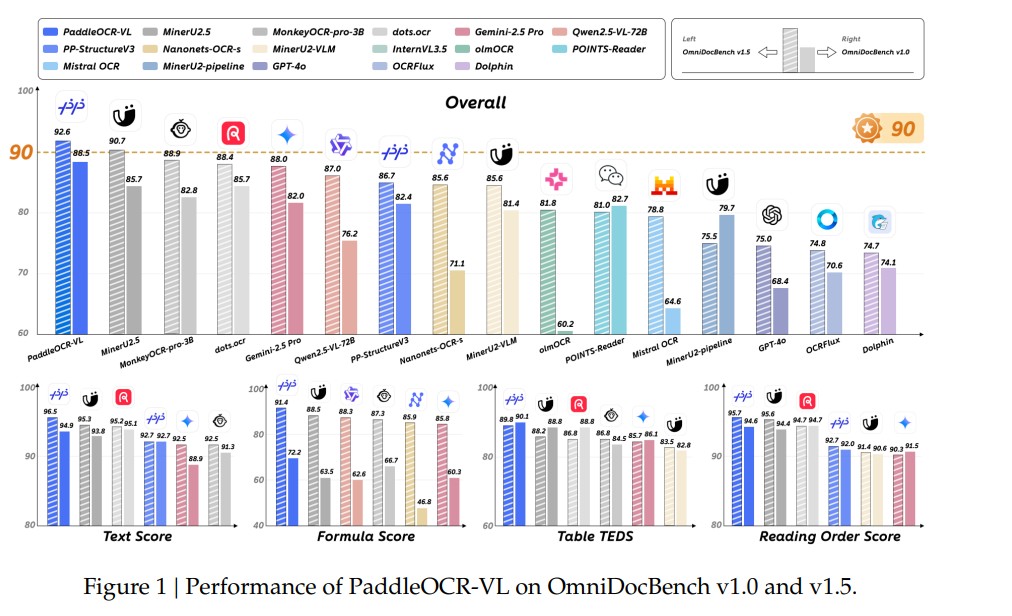
PaddleOCR-VL: Redefining Multilingual Document Parsing with a 0.9B Vision-Language Model

In an era where information is predominantly digital, the ability to extract, interpret and organize data from documents is crucial. From invoices and research papers to multilingual contracts and handwritten notes, document parsing stands at the intersection of vision and language. Traditional Optical Character Recognition (OCR) systems have made impressive strides but they often fall … Read more

MinerU2.5 by Shanghai AI Lab, Peking University & Shanghai Jiao Tong University Sets New Standard for AI-Powered Document Parsing

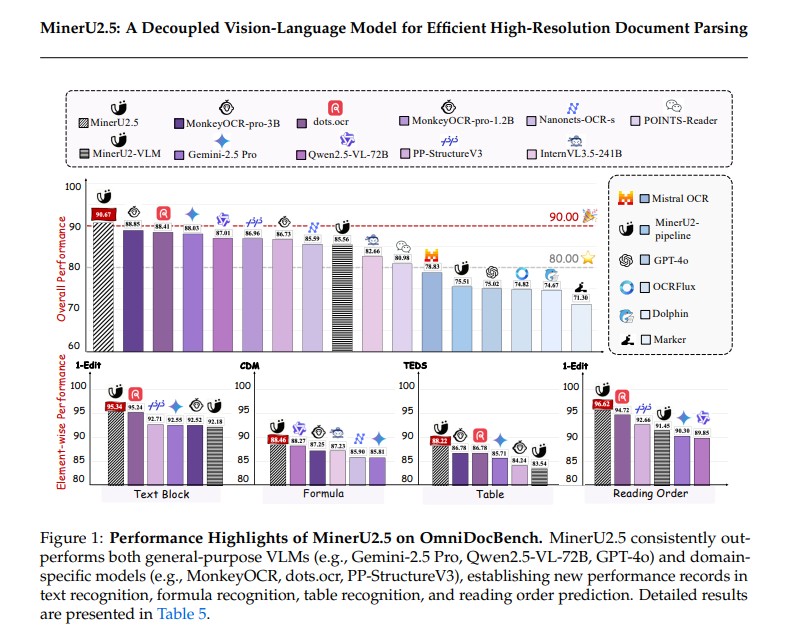
MinerU2.5 by Shanghai AI Lab, Peking University & Shanghai Jiao Tong University Sets New Standard for AI-Powered Document Parsing

In the world of digital transformation, the ability to accurately extract and interpret information from complex documents is becoming increasingly essential. Whether for academic research, financial analysis or enterprise automation, document parsing – the process of converting structured and unstructured document data into machine-readable formats plays a vital role. Enter MinerU2.5, a groundbreaking vision-language model … Read more

LLaMAX2 by Nanjing University, HKU, CMU & Shanghai AI Lab: A Breakthrough in Translation-Enhanced Reasoning Models

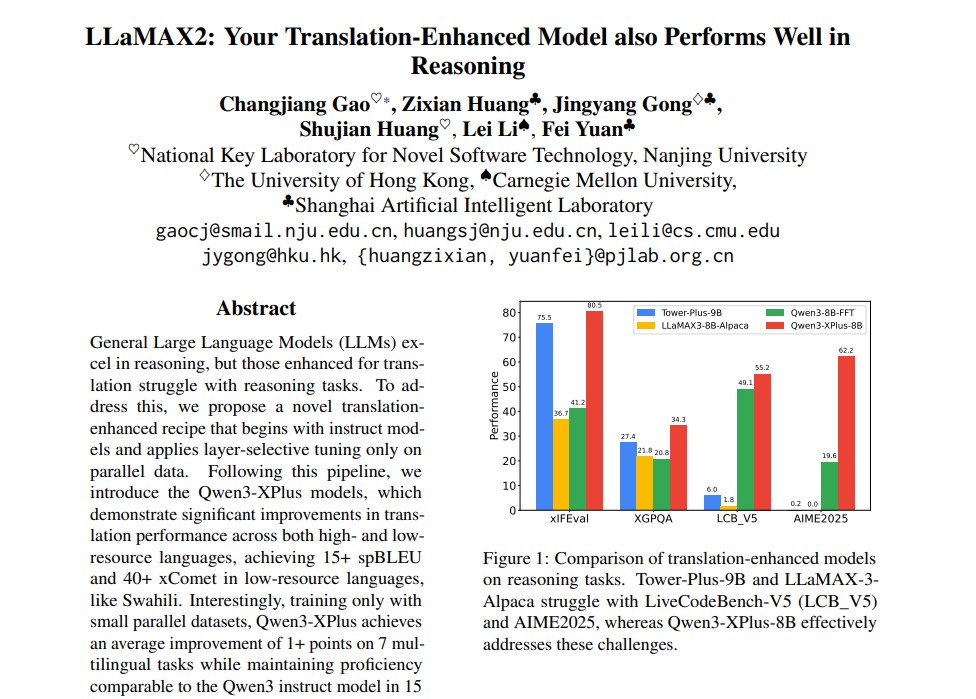
LLaMAX2 by Nanjing University, HKU, CMU & Shanghai AI Lab: A Breakthrough in Translation-Enhanced Reasoning Models

The world of large language models (LLMs) has evolved rapidly, producing advanced systems capable of reasoning, problem-solving, and creative text generation. However, a persistent challenge has been balancing translation quality with reasoning ability. Most translation-enhanced models excel in linguistic diversity but falter in logical reasoning or coding tasks. Addressing this crucial gap, the research paper … Read more

Granite-Speech-3.3-8B: IBM’s Next-Gen Speech-Language Model for Enterprise AI

Granite-Speech-3.3-8B: IBM’s Next-Gen Speech-Language Model for Enterprise AI

In the fast-growing field of speech and language AI, IBM continues to make strides with its Granite model family , a suite of open enterprise-grade AI models that combine accuracy, safety and efficiency. The latest addition to this ecosystem, Granite-Speech-3.3-8B marks a significant milestone in automatic speech recognition (ASR) and speech translation (AST) technology. Released … Read more

Ling-1T by inclusionAI: The Future of Smarter, Faster and More Efficient AI Models

Ling-1T by inclusionAI: The Future of Smarter, Faster and More Efficient AI Models

Artificial Intelligence is evolving at lightning speed and inclusionAI’s Ling-1T is one of the most exciting innovations leading the charge. Built on the advanced Ling 2.0 architecture, Ling-1T is a trillion-parameter model designed to combine incredible reasoning power, speed and scalability in one open-source system. Image Source : Hugging Face Unlike many AI models that … Read more

500 + AI, Machine Learning, Deep Learning, Computer Vision and NLP Projects with Code

500 + AI, Machine Learning, Deep Learning, Computer Vision and NLP Projects with Code

Artificial Intelligence is revolutionizing every industry from healthcare to finance, from e-commerce to self-driving cars. For learners and professionals alike, hands-on projects are the fastest way to build skills, master concepts and showcase expertise. That’s where the massive open-source repository “500+ project repository containing AI, Machine Learning, Deep Learning, Computer Vision, and NLP Projects with … Read more

SkyPilot: Simplifying AI Workload Management Across Any Infrastructure

SkyPilot: Simplifying AI Workload Management Across Any Infrastructure

As artificial intelligence continues to reshape industries, managing and scaling AI workloads has become increasingly complex. Enterprises and research teams often struggle to balance cost, performance and scalability across different infrastructures like Kubernetes, cloud platforms and on-premises clusters. SkyPilot solves this challenge by offering a unified, infrastructure-agnostic system that simplifies workload orchestration and optimizes resource … Read more

Motia: The Unified Backend Framework That Eliminates Runtime Fragmentation

Motia: The Unified Backend Framework That Eliminates Runtime Fragmentation

In today’s software landscape, backend complexity has become one of the biggest bottlenecks for developers. APIs often live in one framework, background jobs in another, queue management in a third and AI agents in yet another isolated environment. This fragmentation slows down development, creates integration headaches and makes monitoring and scaling a nightmare. Motia is … Read more

LLaMA-Factory: Simplifying Fine-Tuning for 100+ Large Language and Vision Models

LLaMA-Factory: Simplifying Fine-Tuning for 100+ Large Language and Vision Models

Artificial Intelligence (AI) is advancing at an incredible pace, with large language models (LLMs) and vision-language models (VLMs) driving breakthroughs in natural language processing, multimodal AI and enterprise applications. However, fine-tuning these massive models often demands extensive resources, technical expertise, and weeks of experimentation. This is where LLaMA-Factory steps in a powerful, open-source platform designed … Read more

RAGFlow: Revolutionizing AI with Retrieval-Augmented Generation

RAGFlow: Revolutionizing AI with Retrieval-Augmented Generation

Artificial Intelligence is reshaping industries at a pace never seen before. As organizations grapple with vast amounts of structured and unstructured data, there is a growing demand for tools that can make sense of it all with speed, accuracy and context. This is where RAGFlow stands out. Positioned as a next-generation open-source Retrieval-Augmented Generation (RAG) … Read more

GraphRAG: The Future of Retrieval-Augmented Generation with Knowledge Graphs

GraphRAG: The Future of Retrieval-Augmented Generation with Knowledge Graphs

GraphRAG (Graph Retrieval-Augmented Generation) is reshaping the way Large Language Models (LLMs) access and process information. While traditional RAG retrieves relevant text chunks to improve model outputs, it often struggles with fragmented context and shallow connections. It solves this by leveraging knowledge graphs to map relationships between entities, concepts and events. In this blog, we’ll … Read more