The landscape of artificial intelligence has been evolving rapidly, especially in the domain of video generation. Since OpenAI unveiled Sora in 2024, the world has witnessed an explosive surge in research and innovation within generative AI. However, most of these cutting-edge tools remained closed-source limiting transparency and accessibility. Recognizing this gap, Alibaba Group introduced Wan, an open and advanced large-scale video generative model that aims to democratize high-quality video creation.
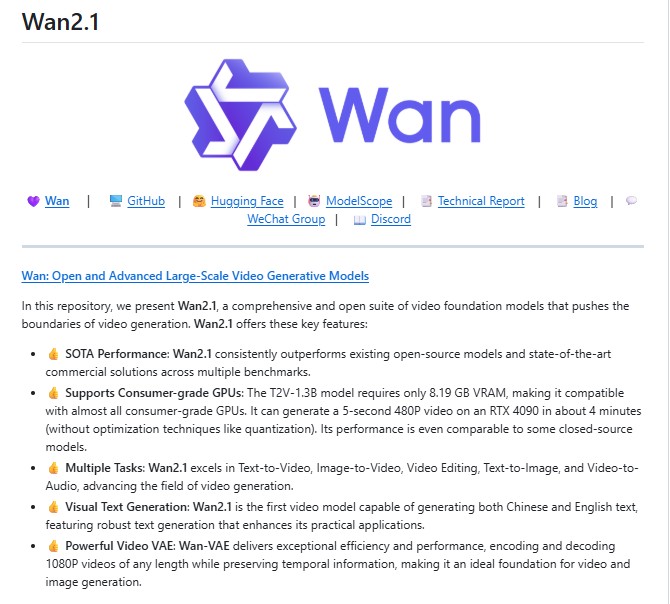
The Wan 2.1 suite redefines what open-source AI can achieve. By combining diffusion transformers, massive datasets, and efficient model design, Wan delivers studio-grade video outputs while running efficiently even on consumer-grade GPUs. It’s not just another AI video model, it’s a comprehensive ecosystem for text-to-video, image-to-video, video editing and personalized generation.
The Evolution of Video Generation AI
Before Wan, the video generation space was dominated by proprietary systems from tech giants. OpenAI’s Sora, Meta’s Movie Gen and Google’s Veo 2 showcased impressive capabilities but their closed nature restricted developer collaboration and transparency.
Meanwhile, open-source initiatives like Mochi, HunyuanVideo, and CogVideoX started bridging the gap. Yet, they often lagged in efficiency, scalability and realism compared to commercial counterparts.
Alibaba’s Wan addresses this exact challenge. With 1.3B and 14B parameter models, Wan not only competes with top-tier commercial systems but also outperforms many of them across internal benchmarks and human evaluation studies.
Core Innovations Behind Wan
Wan’s architecture is built on several technical breakthroughs that elevate it above existing open-source video models:
1. Spatio-Temporal Variational Autoencoder (Wan-VAE)
At the heart of Wan lies a 3D causal VAE that compresses video data both spatially and temporally by up to 4×8×8 times without losing detail. This allows the model to capture fine-grained motion, texture and context across frames efficiently.
With a compact 127M parameter design, Wan-VAE enables ultra-fast encoding and decoding, achieving up to 2.5x higher reconstruction speed than other leading models like HunyuanVideo. Its feature cache mechanism ensures consistent temporal coherence even for long-duration videos, a critical improvement for cinematic generation.
2. Diffusion Transformer Architecture
Inspired by the Diffusion Transformer (DiT) framework, Wan employs a scalable transformer-based design that excels in capturing long-range spatio-temporal relationships. Its integration with flow matching and cross-attention ensures precise alignment between text prompts and video content leading to videos that actually follow user instructions accurately.
3. Multilingual Text Encoder (umT5)
Wan’s multilingual umT5 text encoder allows seamless understanding of both Chinese and English prompts. This makes Wan the first open model capable of generating videos containing realistic text in multiple languages, a feature previously exclusive to commercial systems.
Data Curation and Training Pipeline
Training a video foundation model of this scale demands billions of high-quality videos and images. Alibaba’s team developed an automated data processing pipeline that ensures diversity, safety and realism.
- Pre-training phase: Billions of video and image samples were filtered through AI-driven aesthetic, motion and blur detection algorithms. Synthetic or low-quality data was systematically removed to enhance realism.
- Post-training phase: The model was fine-tuned using high-resolution, manually curated datasets to improve texture fidelity, motion smoothness and stylistic diversity.
- Dense captioning model: Using an internal caption generator trained on both open and in-house datasets, Alibaba enriched video-text alignment through dense and descriptive captions boosting prompt adherence.
This pipeline not only improves performance but also allows the Wan framework to evolve continuously as new data is added.
Consumer-Grade Efficiency
One of Wan’s standout advantages is its resource efficiency. While the flagship Wan 14B targets research and enterprise applications, the Wan 1.3B version runs smoothly on consumer GPUs with just 8.19 GB VRAM. Despite its smaller size, it outperforms many larger open-source competitors in text-to-video tasks.
This democratization of accessibility means creators, developers, and small studios can now experiment with professional-level video generation without needing massive GPU clusters.
Extended Applications
Wan isn’t limited to basic text-to-video synthesis. The framework has been extended to several downstream tasks, making it a full-fledged creative suite:
- Image-to-Video Generation (I2V): Converts static images into dynamic, contextually consistent videos.
- Instruction-Guided Video Editing: Edits existing videos using natural language instructions.
- Video Personalization: Enables zero-shot customization where users can generate videos in their own style or likeness.
- Camera Motion Control: Offers fine-tuned control over camera angles and motion paths, enhancing realism.
- Real-Time Video Generation: With optimizations like diffusion caching and quantization, Wan can generate videos at near real-time speeds.
- Audio Generation Integration: Supports synchronized audio generation allowing for complete multimedia experiences.
Benchmarks and Performance
Across internal and third-party benchmarks, Wan 2.1 leads the open-source space. It consistently achieves top scores in WanBench and human preference evaluations, outperforming competitors like Mochi, HunyuanVideo, and even commercial solutions such as Runway and Sora on various metrics including motion fidelity visual realism, and instruction alignment.
The model’s near-linear scalability during distributed inference ensures that enterprises can scale production workflows across hundreds of GPUs without latency bottlenecks.
The Spirit of Openness
Perhaps the most remarkable aspect of Wan is its fully open-source release. Alibaba has made all models, source code and training details available at
By releasing the entire suite including the VAE, Diffusion Transformer, and training pipeline, Alibaba aims to fuel research, encourage collaboration and accelerate the pace of innovation in generative video AI.
Conclusion
With Wan 2.1, Alibaba Group has taken a bold step in redefining the open-source AI landscape. It bridges the quality gap between open and closed video generation models, making cinematic, high-fidelity video synthesis accessible to all.
Wan stands not only as a technological achievement but also as a symbol of collaboration showing that open innovation can rival, and even surpass, proprietary systems. As AI video creation continues to evolve, it sets a new benchmark for openness, efficiency and creative potential.
Follow Vanita.ai for the latest in AI creativity, LLM trends and generative art tools shaping the digital future.
Related Reads
- Top 30 More Retro Bollywood Diwali Portrait Prompts for Women Using Gemini AI – Part 2
- PaddleOCR-VL: Redefining Multilingual Document Parsing with a 0.9B Vision-Language Model
- NanoChat: The Best ChatGPT That $100 Can Buy
- Unleashing the Power of AI with Open Agent Builder: A Visual Workflow Tool for AI Agents
- Sora: OpenAI’s Breakthrough Text-to-Video Model Transforming Visual Creativity
5 thoughts on “Wan 2.1: Alibaba’s Open-Source Revolution in Video Generation”