
In the rapidly evolving landscape of artificial intelligence, large language models (LLMs) have become the foundation of modern AI innovation powering tools like ChatGPT, Claude, Gemini and countless enterprise AI applications. However, building, fine-tuning and deploying these models require deep technical understanding and hands-on expertise.
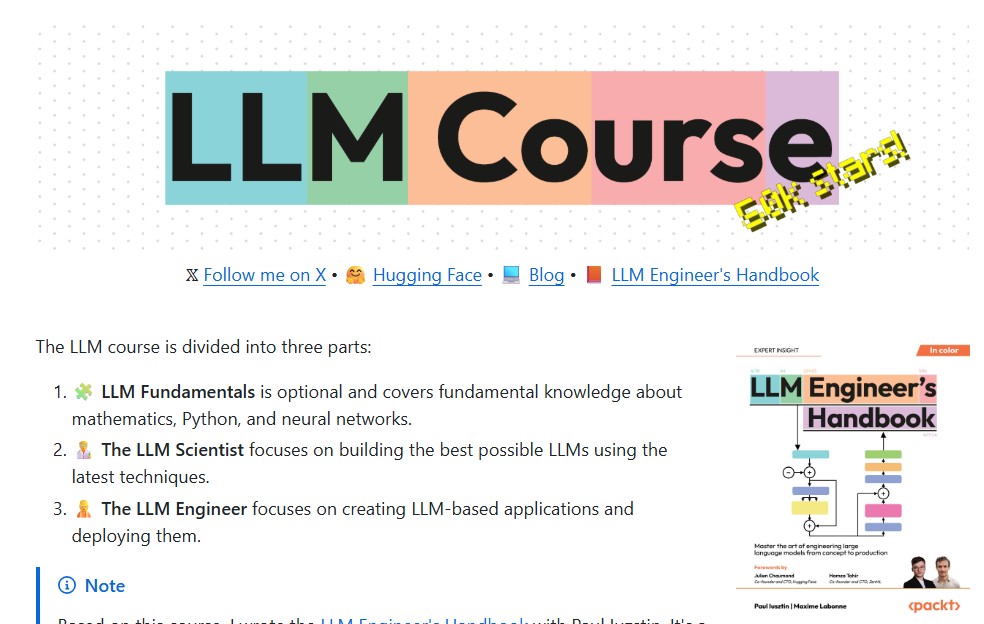
To bridge this knowledge gap, Maxime Labonne, a leading AI researcher and educator, created the LLM Course – an open-source, fully accessible learning path that demystifies everything from transformer architecture to fine-tuning, alignment and quantization. Designed for AI engineers, data scientists and researchers, this course is one of the most comprehensive and practical resources available online.
Let’s explore how the LLM Course equips learners to become complete LLM engineers from fundamentals to deployment.
The Three Pillars of the LLM Course
The LLM Course is thoughtfully divided into three key modules:
- LLM Fundamentals — Covers mathematical foundations, Python and neural network basics for those who want to build strong theoretical grounding.
- The LLM Scientist — Focuses on building, training and evaluating large language models using cutting-edge techniques.
- The LLM Engineer — Specializes in creating LLM-based applications, deployment pipelines and real-world AI systems.
This structured approach ensures learners can start from any level — beginner, intermediate or advanced and progress toward mastering the complete LLM lifecycle.
1. Building Blocks: Understanding LLM Fundamentals
Before diving into large-scale architectures, the course begins with core mathematical and computational principles. It revisits linear algebra, calculus, and Python programming-essential tools for understanding neural networks.
The section explains how Transformers, the backbone of modern LLMs, convert text into tokens, process them through attention layers and generate coherent language outputs. Through practical references such as 3Blue1Brown’s visual transformer videos and Andrej Karpathy’s nanoGPT tutorials, learners gain both conceptual clarity and coding confidence.
This foundation empowers students to understand not just how LLMs work but why they behave the way they do.
2. Pre-Training: The Heart of LLM Creation
The course then delves into pre-training where models learn from vast datasets (often trillions of tokens). Labonne emphasizes data curation, filtering, and tokenization – key steps to ensure model quality.
Students explore distributed training methods like data parallelism, pipeline parallelism and tensor parallelism, which make large-scale LLM training feasible across GPU clusters. Concepts such as mixed-precision training, gradient clipping and adaptive optimizers (like AdamW and Lion) are covered in detail.
Learners are introduced to real-world examples like FineWeb, RedPajama, and LLM360 helping them understand how research-grade datasets and frameworks drive state-of-the-art performance.
3. Fine-Tuning and Post-Training
Once an LLM is pre-trained, the next phase focuses on fine-tuning adapting a base model to follow human instructions and perform specific tasks.
The course explains Supervised Fine-Tuning (SFT) using frameworks like TRL, Unsloth and Axolotl, highlighting techniques such as LoRA and QLoRA for parameter-efficient fine-tuning. Learners gain insight into practical training parameters from learning rates to gradient accumulation and how to monitor metrics like loss curves and gradient norms.
Labonne also introduces Preference Alignment, a crucial step in creating safe and helpful AI models. Algorithms like DPO (Direct Preference Optimization), GRPO and PPO are explained in simple terms supported by visual aids and examples.
By the end of this section, learners can transform base models into capable, human-aligned assistants much like ChatGPT or Claude.
4. Evaluation and Benchmarking
Model evaluation is often overlooked, but in this course, it’s treated as a core discipline.
The LLM Course explores multiple evaluation methods:
- Automated Benchmarks such as MMLU for objective scoring.
- Human Evaluations like the Chatbot Arena, where real users rank model responses.
- Model-Based Evaluation, using judge models for scalable preference testing.
Labonne reminds learners of Goodhart’s Law that overfocusing on benchmarks can harm real-world performance. The course, therefore, encourages a balanced approach combining quantitative metrics and qualitative insights.
5. Quantization: Making Models Efficient
Running large models locally is one of the most practical challenges for engineers. This is where quantization becomes crucial.
Labonne’s course provides detailed tutorials on methods like GPTQ, AWQ, and GGUF (llama.cpp) helping students compress models to 4-bit or 8-bit precision without significant performance loss.
Learners explore real-world libraries such as AutoGPTQ, ExLlamaV2 and SmoothQuant, and discover how quantization enables LLMs to run efficiently on consumer GPUs and even CPUs making advanced AI truly democratized.
6. Hands-On Tools for Every Stage
One of the standout aspects of the LLM Course is its practical toolset. Each notebook comes with a hands-on Colab environment making experimentation easy and accessible.
Some featured tools include:
- LLM AutoEval — automated model evaluation on RunPod
- LazyMergekit — one-click model merging
- AutoQuant — quantize models into multiple formats
- ZeroSpace — create Gradio-based chat interfaces instantly
- AutoDedup — deduplicate datasets for better quality
This hands-on approach bridges theory and application ideal for self-learners and professionals alike.
7. The Future of LLM Engineering
In its final sections, the course dives into emerging frontiers such as model merging, multimodal systems, and interpretability. Learners explore techniques like Sparse Autoencoders (SAEs) for understanding model internals and test-time compute scaling to boost reasoning quality dynamically.
By blending traditional NLP concepts with the latest AI research, the LLM Course ensures learners stay ahead in an industry that evolves daily.
Conclusion
Maxime Labonne’s LLM Course isn’t just another online tutorial – it’s a complete roadmap to becoming an LLM engineer. Whether you’re a data scientist aiming to build your first chatbot or a researcher exploring model quantization, this course equips you with the practical knowledge and tools to succeed.
With interactive notebooks, real-world examples, and deep theoretical insight, it turns complex AI engineering into a structured, learnable process.
If you’re serious about mastering large language models, the LLM Course is your ultimate starting point – free, open-source and designed to empower the next generation of AI creators.
Explore the course on GitHub: LLM Course by Maxime Labonne
Follow us for cutting-edge updates in AI & explore the world of LLMs, deep learning, NLP and AI agents with us.
Related Reads
- Master Machine Learning with Stanford’s CS229 Cheatsheets: The Ultimate Learning Resource
- The Art of Scaling Reinforcement Learning Compute for LLMs: Top Insights from Meta, UT Austin and Harvard University
- DeepSeek-OCR: Redefining Document Understanding Through Optical Context Compression
- Wan 2.1: Alibaba’s Open-Source Revolution in Video Generation
- Top 30 More Retro Bollywood Diwali Portrait Prompts for Women Using Gemini AI – Part 2
2 thoughts on “Mastering Large Language Models: Top #1 Complete Guide to Maxime Labonne’s LLM Course”